Global Trends 2030: Alternative Worlds
December 12, 2012
The National Intelligence Council has issued Global Trends 2030: Alternative Worlds, “intended to stimulate thinking about the rapid and vast geopolitical changes characterizing the world today and possible global trajectories during the next 15-20 years.”
The report sees four megatrends:
Individual empowerment will accelerate substantially during the next 15-20 years owing to poverty reduction and a huge growth of the global middle class, greater educational attainment, better health care, and widespread exploitation of new communications and manufacturing technologies. Enabled by communications technologies, power will shift toward multifaceted and amorphous networks that will form to influence state and global actions.
Diffusion of power among countries will have a dramatic impact by 2030. Asia will have surpassed North America and Europe combined in terms of global power, based upon GDP, population size, military spending, and technological investment. China alone will probably have the largest economy, surpassing that of the United States a few years before 2030.
Demographic Patterns: in the world of 2030—a world in which a growing global population will have reached somewhere close to 8.3 billion people (up from 7.1 billion in 2012)—four key trends will be aging—a shrinking number of youthful societies and states; migration, which will increasingly be a cross-border issue; and growing urbanization, which will spur economic growth but could put new strains on food and water resources.
Growing Food, Water, and Energy Nexus: Demand for food, water, and energy will grow by approximately 35, 40, and 50 percent respectively owing to an increase in the global population and the consumption patterns of an expanding middle class. Climate change will worsen the outlook for the availability of these critical resources.
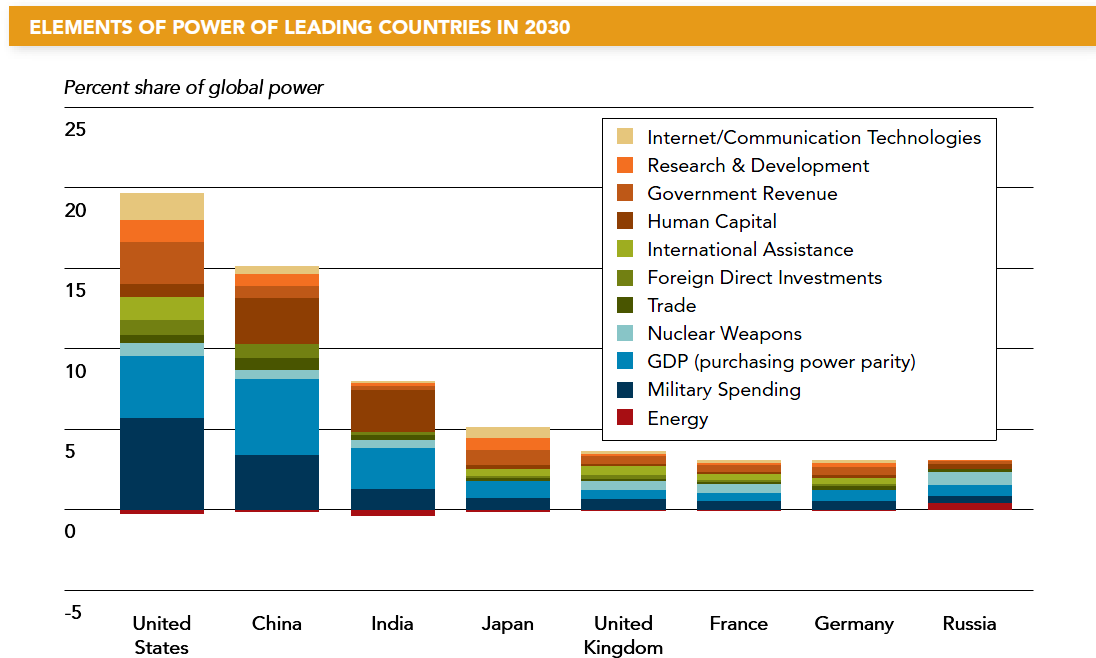
Source: International Futures Model
Human Augmentation
The report sees human augmentation spanning a wide gamut of technologies, ranging from implants and prosthetics to powered exoskeletons, for enhancing innate human abilities, or replacing missing or defective functions such as damaged limbs. Prosthetic limbs have now reached the stage where they offer equivalent or slightly improved functionality to human limbs. Brain-machine interfaces in the form of brain-implants are demonstrating that directly bridging the gap between brain and machine is possible. Military organizations are experimenting with a wide range of augmentation technologies, including exoskeletons that allow personnel to carry increased loads and psychostimulants that allow personnel to operate for longer periods.
Human augmentation could allow civilian and military people to work more effectively, and in environments that were previously inaccessible. Elderly people may benefit from powered exoskeletons that assist wearers with simple walking and lifting activities, improving the health and quality of life for aging populations. Successful prosthetics probably will be directly integrated with the user’s body. Brain-machine interfaces could provide “superhuman” abilities, enhancing strength and speed, as well as providing functions not previously available.
As replacement limb technology advances, people may choose to enhance their physical selves as they do with cosmetic surgery today. Future retinal eye implants could enable night vision, and neuro-enhancements could provide superior memory recall or speed of thought. Neuro-pharmaceuticals will allow people to maintain concentration for longer periods of time or enhance their learning abilities. Augmented reality systems can provide enhanced experiences of real-world situations. Combined with advances in robotics, avatars could provide feedback in the form of sensors providing touch and smell as well as aural and visual information to the operator.
Owing to the high cost of human augmentation, it probably will be available in 15-20 years only to those who are able to pay for it. Such a situation may lead to a two-tiered society of an enhanced and non-enhanced persons and may require regulation. In addition, the technology must be sufficiently robust to prevent hacking and interference of human augmentation. Advances in synergistic and enabling technologies are necessary for improved practicality of human augmentation technologies.
For example, improvements in battery life will dramatically improve the practicality of exoskeleton use. Progress in understanding human memory and brain functions will be critical to future brain-machine interfaces, while advances in flexible biocompatible electronics will enable better integration with the recipient of augmentations and recreate or enhance sensory experiences. Moral and ethical challenges to human augmentation are inevitable.
Technology impacts
Four technology arenas will shape global economic, social, and military developments as well as the world community’s actions pertaining to the environment by 2030, according to the report. Information technology is entering the big data era. Process power and data storage are becoming almost free; networks and the cloud will provide global access and pervasive services; social media and cybersecurity will be large new markets.
This growth and diffusion will present significant challenges for governments and societies, which must find ways to capture the benefits of new IT technologies while dealing with the new threats that those technologies present.
Fear of the growth of an Orwellian surveillance state may lead citizens particularly in the developed world to pressure their governments to restrict or dismantle big data systems. Emerging technologies such as second-generation wireless communications (smartphones) are also likely to accelerate the empowerment of individuals, introducing new capabilities to the developing world in particular.
The second wave of wireless communications engenders a reduced need for developing countries to invest in and build expansive, costly communications infrastructures. Such technologies will reduce the urban-rural split that characterized first-wave technologies, especially in developing countries.
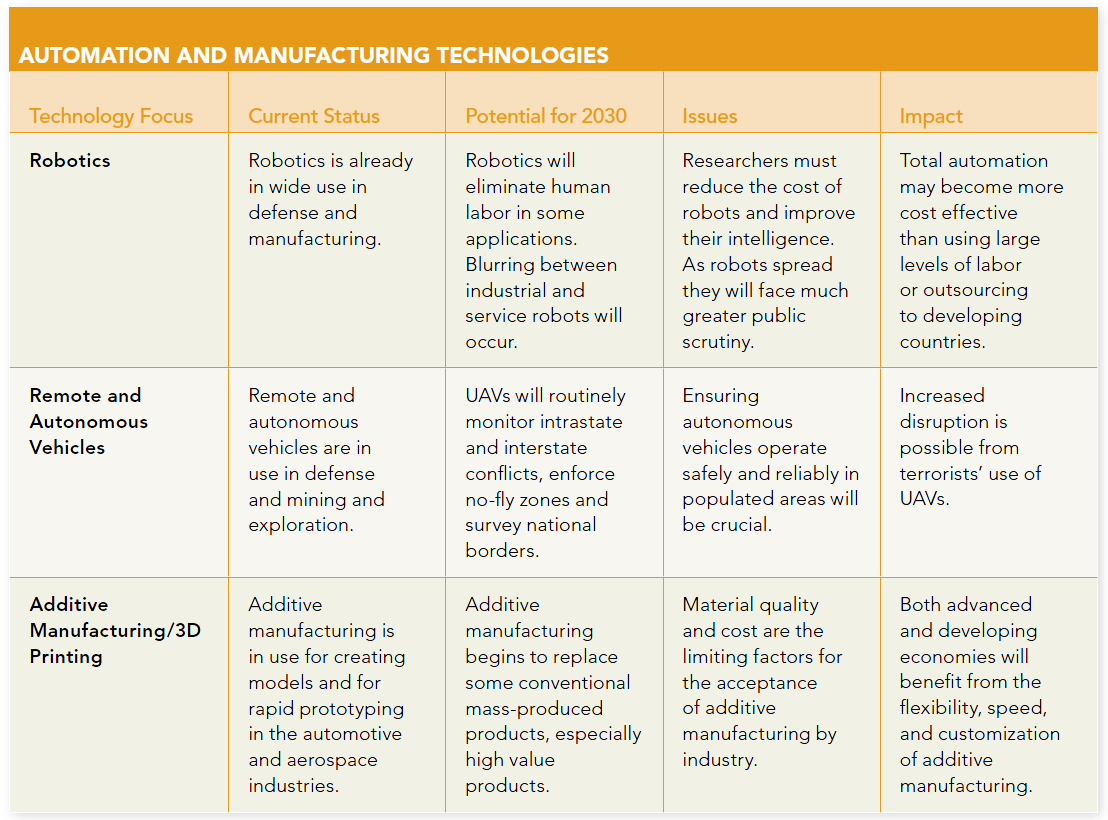
New manufacturing and automation technologies such as additive manufacturing (3D printing) and robotics have the potential to change work patterns in both the developing and developed worlds. In developed countries these technologies will improve productivity, address labor constraints, and diminish the need for outsourcing, especially if reducing the length of supply chains brings clear benefits.
Nevertheless, such technologies could still have a similar effect as outsourcing: they could make more low- and semi-skilled manufacturing workers in developed economies redundant, exacerbating domestic inequalities. For developing economies, particularly Asian ones, the new technologies will stimulate new manufacturing capabilities and further increase the competitiveness of Asian manufacturers and suppliers.
New health technologies will continue to extend the average age of populations around the world, by ameliorating debilitating physical and mental conditions and improving overall well-being. The greatest gains in healthy longevity are likely to occur in those countries with developing economies as the size of their middle class populations swells. The health-care systems in these countries may be poor today, but by 2030 they will make substantial progress in the longevity potential of their populations; by 2030 many leading centers of innovation in disease management will be in the developing world.
Game changers
The report authors also believe that six key game-changers will largely determine what kind of transformed world we will inhabit in 2030: a crisis-prone global economy, a governance gap, potential for increased conflict, wider scope of regional instability, impact of new technologies, and the role of the U.S.
The complete set of Global Trends 2030 documents is available on the National Intelligence Council’s website.
Comments (61)
by Rob Hunter
I find this study interesting yet I think it is fair to say that the U.S. will find itself as a leader in a new industrial revolution for the next century and well before 30 years. There seems to be a growing trend in returning manufacturing to the U.S. versus outsourcing to China – The reason is the ability to engineer better products – An excellent example of this is “The Atlantic” Dec 2012 issue – General Electric is back on U.S. shores making refrigerators etc for the simple reason it is cheaper and by using worker input better products can be created. The significance of this is that in time this :insource manufacturing” will lead to “cottage engineers” who equipped with 3-D design will be able to launch an entirely new wave of innovation first within existing products and later the next generation of technology. Historically speaking, it was industry itself which launch these cottage engineers who created (with the use of patent law) the steam engine and the like. The business model of business is to create a market and resist change. This is impossible given the access to knowledge on the internet and the advent of building working models (3-D) before launching costly manufacturing. Historically, Detroit depended on such small cottage engineering firms to manufacture new designs quickly. There were tens of thousands of such small engineering firms all around the Big Three. Most are gone as such designing was sent overseas. This too will return. The U.S. is by its very nature a country of innovators – It’s what we do that’s why we are so great. The ebb and flow of cottage engineering is at a low but is now returning and with it will come a wave of innovation driven by entrepenuers like those in the 1700 & 1800′s. I truly see an explosion of innovation coming in the coming decade.
by John Kulp
One perspective not mentioned yet is that economic output is a function of labor AND capital. And the trend is shifting towards capital. Imagine that everyone who could afford a car, can afford to own one or more AI’s to do their work (economic output) for them. They have shifted their ability to produce economic output from their labor to their capital, like rich people. I think it is likely that the reason for the income gap of the top 1% is that they have accumulated more capital (rapidly since the mid 90′s) and make more off it.
What happens if the AI’s are competing with each other for work?
What happens if the AI’s want to own the AI’s?
by PCMcGee
An engineered solution;
‘The Best That Money Can’t Buy.’ – J. Fresco
by twm114
How much ‘unemployment’ did the creator of the wheel cause? The unemployed in America today enjoy a standard of living unimagined by the wealthiest man on the planet of,say, a hundred years ago-by the grace of technology.DON’T FEAR PROGRESS.DON’T FEAR TECHNOLOGY(the material expression of intelligence) . If you’ve got to fear something,fear stagnation and stupidity.
by Dave Torgersen
Except that there is a great hew and cry to get the “Takers” off of the public dole. As advances in technology, manufacturing, etc, make it possible to replace larger percentages of workers with AI/Robotics, we cannot simply expect them to “reinvent themselves” without opportunities and training.
by Fredrik Wallinder
Gentlemen, what they’ve totally missed is the space frontier. My preferred scenario is augmented individuals with superintelligence leaving Earth to explore and utilize the solar system and then go interstellar. The unaugmented remaining on Earth will continue battling about resources with poor prospects in comparison.
by joe4sky
Fredrik, the next solar system, would take 40,000 years to get to, and the spaceship would need a fuel tank the size of a small moon. It also does not have any planets we could use. The change in Physics to get there quicker is still in the fantasy level of science. — We need to deal with life’s problems here. New World Order is removing excess population (us) to just have enough people to do their work for them, and fight their WARS until they have absolute control of every thing, everywhere. They only choice seems to be HOW to get rid of NWO! The problem is that they own the Banks, military, government, business, communications, and anything else you can think of. BIG PROBLEM!
by Tony Stender
What is this the “Luddite Home Companion Magazine”?
by Jayce Cameron
Finally! Back in high school taking History class I often postulated that a Future class might be even more relevant than a history class. Quite obviously to prudently plan our future rather than try to learn from passed mistakes, which we all know will be repeated regardless.
by Miguel Sacramento
I fully agree! Teaching how to build future scenarios should be the natural sequence of History.
by Jason Silva fanboy
>we have got to rule that these robots start paying the Unemployment Insurance and Social Security taxes of the people they displace.
That’s an interesting idea – but how would you break it down? I mean, one person is one taxable entity, and if each gets replaced by one humanoid-shelled strong AI, then we’re set, but I doubt that would happen – what if you have one central robot brain with multiple arms, or just one robot that works as fast as 50 people, or even a swarm of nanobots that replaces one person?
Also, would you have had, say, horses pay the tax of the plow-pulling-humans they displaced, or trains pay wagon-service taxes?
by sdfuturist
This is a very interesting way of looking at the situation…taxable entities. :)
by klaatu
INDIVIDUAL EMPOWERMENT? What could be more phony?
Since the 1980′s and probably b4 right wing think tanks
have been getting us ready for a time when
NBC weapons are easily made by just a few ppl. They were
authoring sci/fi novels about remotely reading & tracking individual
thoughts & how the surveillance state will be made to seem perfectly ok.
This fact gets lost somehow. What is considered paranoid
& tinfoil hat has been in the works for 50 yrs. Scenarios
are ready to make it seem normal. Of course the ppl
doing the screeming are the right wing nutjobs who
throw the words liberty & freedom while their southern
US economies depend on Big Gov & defense. They are
very useful in the Mfg & the spread of lies & BS necessary
for all of this to happen.
by sdfuturist
If you’re referring to the lack of concern for the very real and scary prospect of a near-future dystopia, I am in agreement with you. The sci fi books have already confirmed the seed of reality…it will either be like Brave New World or 1984 or somewhere in between. But it will definitely not be an awakening of individual empowerment. That’s just plain pipe dreaming.
by Bob Vasquez
Meanwhile certain legislators in our Congress and in State Legislations are preoccupied with contraception, marriage between one man and one woman, ad nauseum. We’ve lost 4 years of economic progress because of certain legislative obstructionists.
by Anthony
Governments are too slow and awkward to meet the challenges of exponential change. I don’t believe that “Free Market” fairies will “trickle down” salvation, nor do I believe that central planning can plan fast enough to meet the challenge. Has anyone heard of a way to bypass governments and corporations so that we may secure a better future sooner? It is not that I want to fight the government or corporations, I just want to make them irrelevant by working around them. Does anyone know a way?
by Rob
You’ve just eliminated the two possible routes. What else do you have but free market and total government control? You can have a transition stage but that usually means the free market is being subsumed by a totalitarian government or nanny state. At least with a free market you retain the option of not participating in the market. You tell the government it can’t do what it wants and see how far you get.
by Anthony
Rob, do you think It is impossible that there could be could be a third, fourth, or fifth possible way? I asked because I really don’t know. I had in mind some new system in which networks of people work arround corporations and government. What I fear about the “free-market” is that incumbent corporations tend to limit new innovative competitors through patent law, and other regulations that they have put in place to secure their dominant position. In United States, corporations have purchased “representatives” through campaign contributions. Since corporations own the government, it’s impossible to reform the government. It makes more sense to think of the corporations and the government not Separately, but as one unit – one corporate-republic. Again I ask, how might we work around this problem?
by Tame
“What I fear about the “free-market” is that incumbent corporations tend to limit new innovative competitors through patent law, and other regulations that they have put in place to secure their dominant position”.
That is precisely not the free market and you know it yourself by putting free market in quotation marks. The answer than is to deregulate. To remove the regulatory barriers to entry that favor incumbents and to reform intellectual property laws along free market lines as was proposed by the recent Republican Study Committee policy brief (the one that was pulled) titled “Three Myths About Copyright Law and Where to Start to Fix It.”
Furthermore, the free market doesn’t prescribe what organisational structures might come to dominate. The free market is based on the bottom up emergence of order analogous to biological evolution. If in the future these networks you talk of are more efficient and favored by individuals than they will come to dominate.
“Since corporations own the government, it’s impossible to reform the government. It makes more sense to think of the corporations and the government not Separately, but as one unit – one corporate-republic. Again I ask, how might we work around this problem?”
Corporations do not own the government. That is a patently absurd statement. There is no monolithic entity called corporations. There are a number of competing entities with often divergent interests. Regulations or other interventions passed by government may favor some corporations, but harm others. For instance, the bailout of GM obviously helped GM’s shareholders, but it harmed Toyota, Ford and others who would have moved in to fill the gap had GM been allowed to fail. More generally in society there are many competing interests fighting to use the state’s monopoly on violence to their own ends not one class or ruling elite.
The corporativist or corporatist view of one body (the root word is corpus which it shares with corporate, corporate is not the root word as many people seem to think) of unified state-corporate-labor interests over the anarchy of the free market capitalism is antithetical to the free market. It was the view behind the New Deal and Mussolini’s economic policies. The answer is then to support the anarchical bottom up emergent order of the free market over the top down order imposed by the institution of mass coercion that is the state.
by Anthony
Tame, Thanks for you response. Yes, I did put the quotation marks around free market because I don’t think that it is possible to maintain a truly “free” market. I remember people saying that “communism is a nice idea, but it just does not work in reality.” True. Now we can also say that the “free” market is a nice idea, but it does not work in reality (at least not for very long). After powerful corporations have enough money, they buy representatives to design legislation to secure their dominate positions (in their respective markets). This is what I mean by corporations, in effect, buying the government (do you really doubt that this has happened in the US? The Corporate Republic does not require that one, all powerful, corporation owns the government. It is an ever changing oligarchy of competing corporations, all vying for dominance over the “institution of mass coercion that is the state”. You are on the right track when you wrote that; “The answer is then to support the anarchical bottom up emergent order…”. True, but I don’t think that the “free” market (at least as we have experienced it in the U.S.) maintains “anarchical bottom up emergent order”. I am still not sure how we might get there, but I do appreciate your response. Thanks again.
by Tom
I find it interesting that everyone talks about these things like we get one chance to get it right.
Nature runs trials and selects which ones are successful.
What makes you think were not in one such trial?
Our challenge is to make this, the first singularity trial, as successful as we can.
Organisational structures are a category of systems/properties that are tested by these trials. They include religions, free markets, state systems (Democracy, Communism, Dictatorships, etc.). There have been many of this type of trial. Our challenge here is to evolve our current system i.e. without collapse, as has usually been the case, while at the same time managing unprecedented technological progress.
Are we up to it?
I have my doubts, but keep them on a tight leash, and relish the challenge.
Amazing things await us, I think, if we succeed.
by Anthony
Thanks Tom,
But Eliezerr Yudkowsky thinks that we may only have one chance to effect a positive singularity – see http://yudkowsky.net/singularity/ai-risk
by nils
Just want to say I think you’re looking in the right place – which is really not nothing these days…
by Joe4sky
Anthony, decades ago when I learned about Economics, this country’s government system was called a corporate-dictatorship, not a republic. It has been one unit for a while.
by Anthony
How do you think we might change it?
by sdfuturist
I think maybe it might depend on how far “off the grid” the government will allow each of us to go. Now is an unprecedented time for living self-sustainably while still enjoying the fruits of the 21st century.
by Anthony
Please, tell me more about what it means to go “off the grid”.
by sdfuturist
Unfortunately I think the governments and corporations are making us irrelevant by working around us. They waste our time on petty topics like gay marriage and banning/allowing abortion. European countries are debating the legality of circumcision, for God’s sake!
by Anthony
Yes, those things are distracting us from what is really going on.
by Anthony
Republicans distract the poor/religious with issues like sodomy, so that the Rich can sneak up behind the poor and sodomize them! Read “What’s the Matter with Kansas” by Thomas Frank.
by Ross
By relearning your social skills, your networking skills, and the ability to meet the right people to forward your goals. Everything is about relationship. This sidesteps the government/corporate mindset. You must learn to surf this tsunamie of change. Effective social skills that allow relationship to flourish and an effective understanding of the networking effect is a basic skill in this new kind of surfing.
by Anthony
Thanks, Ross
by Bernard Denis
Well through human education, leading to empowerment of the individual, I believe we will attain a world administration, by the people for the people as should a real government be. The vision of an ever watching entity ruling the world in 1984 was close, but the reality is that it is in the hands of the mass, not the government. The fall of most dictatorship is proof. In more democratic countries, every move of every elected official is checked and double checked by a miriad of ousiders just doing what they love with their time. More whistle blowers and scandals to come before complete tranparency. Many governments will try and regain control.
It will take time, more then 30 years, but it is coming, natural evolution of humanity. We use to have walls around cities, then later created countries and borders, but those are slowly crumbling away, to give way to continents, then one world. Europe’s example, although still shaky, will be followed by many others.
We are but one race, on one planet. In full evolution.
by Gorden Russell
Here! Here! Bob!
by Boristabby
Bri, and others, when I graduated high school in the class of Summer School ’47, (:-) , the then Superintendent of Los Angeles Schools, Verling Kersey, told the grads that they could expect to be retrained three times during their working lives. I heeded his guidance, sort of, by moving from retail men’s clothing and getting into a yet-to-mushroom field, computer programing, when the only class/textbook offered in that subject in the LA area was at Pasadena City College.
Today I observe minimum wage workers striking because their shelf-stocking jobs do not pay enough to afford a new car every three years. They march for greater financial security, but are apparently unaware that the combination of globalization and just plain progress is going to pass them bye (bye, bye) unless they wake up and reach out for themselves. Individual responsibility is the watchword? Anyone can do it? “Gummint” can keep them alive, but barely, unless we have more ego-driven wars by war-criminal presidents, then forget about even minimum help. (Boristabby, registered Independent)
by Bernat
Automation of labor will eventually lead to mass unemployment. Lets accept this and work towards a solution before it happens.
Maybe slowly starting to subsidise unemployment permanently so that when all processes are robotised humans are paid to live.
by Rob
Insane. This is no different than the cries against the automobile in the early 20th century. Sure it put a lot of blacksmiths and farriers out of business, but look at the massive economic progress it spawned and potential it unleashed when the internal combustion engine was married to different industries. Farming, for example, would the world’s production of food increased nearly so dramatically as it did without the use of the internal combustion engine? Would 1/5 the people involved in farming compared to the start of the 20th century be able to feed 100 times the people? No. It’s crazy to try to say what’s going to happen 20 years from now. Who in 1912 could have prophesied all that would have occurred by 1930?
by sdfuturist
I have to agree with you on this one, Rob. The butterfly effect is more powerful now than ever before in history, although we are faced with an unprecedented number of dampening, diffusing, and cooling mechanisms like voting, sports, television, games, and this comments section (among all the others).
by sdfuturist
i meant “butterfly effect” more in the sense of unpredictable game changers. Although this isn’t exactly how that term is supposed to be understood…
by Zando Wilson
Yes, and when the automobile took over they turned all the horses into glue. Given the efficiencies and growth that resulted, they could have put all those horses out to pasture and still turned a tidy profit. It makes sense to start thinking about ways to direct the growth that will result from automation back towards the general population rather than into the status games of a few mega-zillionaires and their minions. Much higher corporate taxes subsidizing “unemployment” or education, leisure, culture etc might be the most rational solution. Unless you want you and your children to be turned into glue, that is.
by tedhowardnz
You’re partially right Bernat.
The logical extension of automation is to make money and markets redundant.
As automation gets to the point that all essential things can be produced entirely automatically, then there is no reason for there to be any scarcity of those essentials.
Without scarcity, there is no need of money or markets, no need for employment.
We do need to start seriously thinking about how we are going to organise ourselves, and create conditions that enhance peaceful coexistence in a world where money has lost its power, and individuals are empowered as never before.
Managing the transition to a “post scarcity” social system is going to present some interesting challenges, and I am getting ever more confident that we have the tools to do it.
by Miguel Sacramento
Technology is not causing unemployment. Official data from the US Ministry of Labor shows that the amount of jobs in activities producing goods (industries, commodities, agricultural etc) remains basically the same (~25mm jobs)from 1940 up to today. In the same period, service providing jobs rose 400% (from 23 to over 100mm jobs).
by Jared
I disagree. technology review did a synthesis of several studies and came to the conclusion that they displace more jobs than they create. The growth in the number of jobs, however, may be from what you might call ‘surplus’ jobs. As our standard of living increases such ‘surplus’ jobs grow in number to provide that increase in the standard of living (and service sector jobs, health care, entertainment, etc.). So I guess that you could say that technology is destroying jobs, but simultaneously increasing wealth which allows new service or ‘surplus’ jobs to increase.
However, note that I do not quote or cite any source. I do not have time to really look at a lot of data to prove my point. But you could probably scare up the tech rev. reference.
by Jared
As a fellow technology optimist I understand the frequent criticisms leveled at Ray K. and others. However, optimism aside, I can not help but think that several of the observations and forecasts presented within the above synopsis are too timid. For examples, the “issues” column for 3D printing mention problems with quality and cost. These issues are quickly being addressed (if not already) even at the consumer level! The only real problem in this arena is production speed. I do not see how there are any remaining problems to the widespread adoption of this technology in ten years, never mind 20. As for energy problems….I have to agree with Ray K. and L. Page’s assessment on solar energy production. Even if their estimates are optimistic (which I do think), it seems that solar energy production will at least account for 1/3 of energy needs in the next 20 years (R.K. and L.P. estimate solar providing 100% by 2025-ish).
I would love to read the report in more detail if I had the time. I hope they do not ignore or gloss over the all important issues of massive unemployment due to automation/AI, gene therapy resurgence, the as yet unthought of consequences of BMI (and a host of other critical ideasit looks like they ignore). Overall, I do not think the authors take into consideration the rate of appearance of disruptive ideas/technologies. I hate being a conspiracy person, but this report makes me think that this document was written to throw off potential economic enemies (China) in the near future by downplaying the near future advances we are about to experience.
by Bri
Well it sounds like they’ve got the twenty twenties right. Not enough on the displacement of workers from robotics and AI.
by Ron Abate
I have some bold ideas on the effects of AI and robotics on the future of our society. Go to: rlabate.blogspot.com
by Gorden Russell
Just checked out your blog, Ron. I see a lot of good stuff there. I can’t finish it now, but I promise to get back to it later.
Cheers
by Gorden Russell
Like I keep saying, Bri, we have got to rule that these robots start paying the Unemployment Insurance and Social Security taxes of the people they displace. It will be needful for the benefit of society that Unemployment Benefits continue up to retirement age.
Without this, a lot of workers who had been voting Republican will become enraged at the betrayal they have suffered. There are 300 million firearms in the hands of 47 per cent of the population. I’ll bet they are largely voting Republican now. When they have to leave their homes to live in their cars, they will leave all their furniture behind. But they will load up a trunk full of guns. In time they will be ready to go “Shakespearean” on all those robots. They will bear arms against a sea of robots and thus by opposing, end them.
by AZryan
I couldn’t tell if your ‘rednecks attack the robot workforce’ digression was you joking or being hyperbolic? It kinda ruined what started as a decent line of reasoning.
We do need to plan for robotics and AI putting our labor force out of work in a way that keeps millions of families from being homeless and destitute,
but I don’t get your political angle here? The working poor are far more Dem than Rep.
You seem like a good progressive, but you might be hurting your points by always adding a political message -especially when you force it in there.
by Jason Silva fanboy
Whoops, I meant to reply to this comment, but posted it separately by accident.
by Rob
Utterly insane. So what if certain jobs in the economy are taken over by robots. All this will do is force people to innovate and find new ways to serve one another. That is, after all, how people provide for their families. Labor is a service by which you either provide something of value to others or trade your labor for a wage in an organization that provides something of value to another. This will never change. All technology does is multiply our efforts and by doing so uses less resources, which frees scarce resources for use in other areas, and drives the price of products down. Or would, if our governments didn’t routinely destroy the value of currency. Wile there may be some neo-Luddite attacks on new technology, in the end their acts will be as futile as those of Ludd and his followers in the 19th century.
by grettir76
Utterly flawed arguement. We are not talking about a few types of jobs and yes there have been industrail revolutions/shifts in the past however THERE is no law stating that technology will create more jobs then it destroys and claiming that the past 200 years of our experience in these matters will go on forever is plain ignorant and narrow minded, a couple of false wolf alarms doesnt mean its not coming, but ofc no one can say for sure what will happen in the next 20 years, but the trend is undoubtedly pointing at high automation and unemployment as it stands. Personally I love that we are heading in this direction, but the transition might be rough nontheless.
There is a new competition in town called A.I. that is gaining our precious only to be thought human skills at an increasing rate, it isnt just hitting lower skills jobs, it will hit every job sector, new industries will be created yes, the real question is how many jobs will be needed in these industies?
I recommend that you inform yourself a little better before pulling out some luddite fallacy. Race against the machines is a good book to start with among with Andrew McAfee Ted/Techonomyy talk.
by ChrisF
But what happens when machines can do anything that humans can do, Rob ? When whatever service that a human can conceivably provide can be done better and cheaper by an AI ? What happens when the cost of machine labor falls below that of human labor ?
by GAUSS
Humans then find ways to do other things.
by Jason Silva fanboy
Assuming AI can increase intelligence significantly past human standards, and automation processes can increase their efficiency significantly past human standards (and I see no reason either process would stop improving at/around human levels, any more than trains stopped getting faster at the speed humans can run or calculators stopped getting faster at the speed the average person can do the sums in their head), this is like saying “chimps will get paid human wages by finding ways to do other things” or eventually even “bacteria will make $20,000+ per year by finding ways to do other things.”
It’s not about “finding other things”, it’s about “competitiveness in doing ANY ONE of those things” – because anything humans can do, human-machine hybrids or just strong AIs hooked up to hyperadvanced robots can, eventually, do BETTER.
You could say this is the “employment singularity”, or just the advance shock of “the” singularity related to employment: the point at which (unaugmented) humans become just as incapable of meaningfully competing for pay against “post/transhuman” entities as a child or animal would be of competing against adult humans, now.
by GAUSS
That’s all assuming the same meanings for employment and, more importantly, money. These things will change beyond what we can imagine. There is no accurate speculation that can be made about these changes: hence the namesake, the singularity. We cannot see past this event horizon. All we can do is adapt, as every species has always done.
Allow me to point out that everybody who thinks that machines will be these obsessive overlords is mistaken. Present formulations of rational agents are not complete; the true solution can be shown that cooperation and mutual benefit is the best long-term strategy. If you don’t believe me, well, go do the math yourself. Retrace Von Neumann’s work, and spot the flaws: he was a great scientist, but many of the assumptions of that day were based on cultural bias, as is anything.
It astounds me how much people cling to this doom and gloom of “the machines will take us all over!” As someone who programs such machines, I can say that this is not a likely outcome. People should stop projecting their own power obsession into these new entities, and focus more on adapting to the world changing around them.
For every person who’s willing to see the opportunity and good things that can come from advanced AIs, there are five hundred who pull their hair out screaming the end of the world. I don’t know when it was we humans became so paranoid and shortsighted.
by Jason Silva fanboy
I think we’ve had a failure of communication: I’m very much a singularity optimist, it just seems to me that, at some point, augmented humans or strong AIs will outcompete all nonaugmented humans in any fair contest, such as competitive employment for pay. I’m hoping this could be a very good thing, as we could all relax while robots do our work for us.
I’m not sure what you could mean by “employment changing beyond what we can imagine”: I can easily imagine (unaugmented) people being kept around as either revered obsolete ancestors, pampered and well cared for – or monkeys dancing in front of donation jars, or, of course, exterminated. What other options did you have in mind? And if these other options can’t even be hinted at, why not?
Again, I’m here describing UNAUGMENTED humans: of course transformed/transhuman/posthuman entities can do all sorts of crazy stuff – but I take it you won’t require everybody to convert to stay alive in the new world?
by GAUSS
Us Western liberals tend to favor free choice (at least that’s what we preach), so the hope is of course that cybernetics will be a completely optional set of procedures.
As far as those who remain unaugmented, they may find themselves in a similar position to those who don’t have Internet access now, let alone a smartphone, laptop, etc. These tools for productivity are a massive economic force; choosing not to use them is completely legitimate and is a right, it just may put you a little behind the times.
The story does change a bit with cybernetics, especially as neural implants are concerned, but the general analogy should hold.
The best possible outcome for these technologies (augmentations, robotics, etc.) is that humans find themselves in a position where their abilities are unique and complimentary to that of others, including machines and other humans. This is the best possible outcome, and relies on an assumption the human element cannot be replicated, and that some aspects value in the organic species cannot be overridden.
Without this assumption, the most likely outcome is actually rather surprising. Assume for moment there is a machine revolution, they become smarter than us, etc. Most people think that by this time, they’ll just enslave all of us. Wrong. That’s what a human would do, driven by our animal needs for power, dominance, and evolutionary superiority. Machines have no such needs; they will be able to propagate almost endlessly, will have nearly unlimited resources available to them via outer space, and so on. The most likely outcome is actually the machine part of civilization will simply leave. This is counterintuitive to a lot of people who expect the worst. It’s not a particularly bright outcome either; much of our civilization would come to a grinding halt, and our mindchildren would set sail for their own domain, taking steps to become type II or type III civilizations well before we do.
That’s assuming a machine revolution, which is a worst-case scenario itself.
As for augmentations, well, it may become uneconomical to remain purely organic. That saddens me, actually, but progress doesn’t stop for purists. :(
by Jason Silva fanboy
>Assume for moment there is a machine revolution, they become smarter than us, etc. Most people think that by this time, they’ll just enslave all of us. Wrong. That’s what a human would do, driven by our animal needs for power, dominance, and evolutionary superiority.
Agreed, artificial intelligence doesn’t mean artificial greed, artificial anger, artificial ambition, etc.
>it just may put you a little behind the times. The story does change a bit with cybernetics, especially as neural implants are concerned, but the general analogy should hold.
I think the only change would be the word “little” – I’m sure Kurzweil foresees an eventual future where unaugmented humans are as relevant to the genuine needs of the cutting edge of earth-based-intelligence as apes now are, and it could be argued that the current widespread unemployment of non-high-tech-CAPABLE folks is just the start of an irreversible process.
I take your point about some types of human values maybe being irreplaceable from scratch, but that wouldn’t apply if we just end up extending certain types of human mental abilities with machines (brain nanobots, cloud thinking, etc).
The focus on “education” for people who should really have stuck to plowing fields and/or tightening bolts (and I don’t exempt myself here) just seems to give them student debt for their philosophy/english/psychology major: we could already be seeing a largely “unusable” generation of humans, scattered in the fringes of our highly advanced civilisation like stray dogs in alleys.
by de Broglie
You raise a very important point, but I don’t fully agree on your taxing concept. It seems like there would be problems determining which jobs were replaced directly by machines and which jobs were replaced by increased efficiency unrelated to robots. For example, if you redisigned an assembly line to mitigate bottlenecks and eliminate unnecessary steps and as a result you needed less workers, would you consider the redisigned line a new machine. I agree with your general concept, but it seems the reality in manufacturing would be a vast gray area.
by GAUSS
Essentially humans will have to push to new levels of intellectual work. Labor itself will be sucked up by machines, if only because corporations won’t be able to help themselves (many of them can’t resist an excuse to fatten profit margins, no matter the social consequences). Look at Star Trek’s model of the economy, however: no money. Not to completely nerd out, but we could take hints from those styles of economy. (No money does not mean no economy! Economies come in all kinds. :)