Good news for nanomedicine: Quantum dots appear safe in pioneering study on primates
May 22, 2012
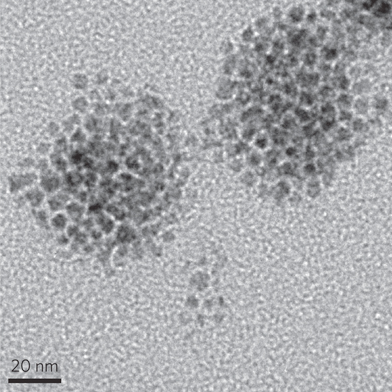
Transmission electron microscopy (TEM) images showing quantum dots after micelle encapsulation (Credit: Ling Ye, et al./Nature Nanotechnology)
A pioneering study to gauge the toxicity of quantum dots in primates has found the tiny luminescent crystals are safe over a one-year period, a hopeful outcome for doctors and scientists seeking new ways to battle diseases like cancer through nanomedicine.
In the study, scientists found that four rhesus monkeys injected with cadmium-selenide quantum dots remained in normal health over 90 days. Blood and biochemical markers stayed in typical ranges, and major organs developed no abnormalities. The animals didn’t lose weight. Two monkeys observed for an additional year also showed no signs of illness.
Quantum dots are tiny luminescent crystals that glow brightly in different colors. Medical researchers are eyeing the crystals for use in image-guided surgery, light-activated therapies and sensitive diagnostic tests. Cadmium selenide quantum dots are among the most studied, with potential applications not only in medicine, but as components of solar cells, quantum computers, light-emitting diodes and more.
The new toxicity study — completed by the University at Buffalo, the Chinese PLA General Hospital, China’s ChangChun University of Science and Technology, and Singapore’s Nanyang Technological University — begins to address the concern of health professionals who worry that quantum dots may be dangerous to humans.
The authors caution, however, that more research is needed to determine the nanocrystals’ long-term effects in primates; most of the potentially toxic cadmium from the quantum dots stayed in the liver, spleen and kidneys of the animals studied over the 90-day period.
“This is the first study that uses primates as animal models for in vivo studies with quantum dots,” said paper coauthor Paras Prasad, UB professor of chemistry and medicine, and executive director of UB’s Institute for Lasers, Photonics and Biophotonics (ILPB). “So far, such toxicity studies have focused only on mice and rats, but humans are very different from mice. More studies using animal models that are closer to humans are necessary.”
The cadmium build-up, in particular, is a serious concern that warrants further investigation, said Ken-Tye Yong, a Nanyang Technological University assistant professor who began working with Prasad on the study as a postdoctoral researcher at UB.
Because of that concern, the best in-vivo applications for cadmium-selenide quantum dots in medicine may be the ones that use the crystals in a limited capacity, said Mark Swihart, a third coauthor and a UB professor of chemical and biological engineering. Image-guided surgery, which could involve a single dose of quantum dots to identify a tumor or other target area, falls into this category.
Ref.: Ling Ye, et al. A pilot study in non-human primates shows no adverse response to intravenous injection of quantum dots. Nature Nanotechnology, 20 May 2012 DOI: 10.1038/nnano.2012.74