Google Glass update
January 2, 2013
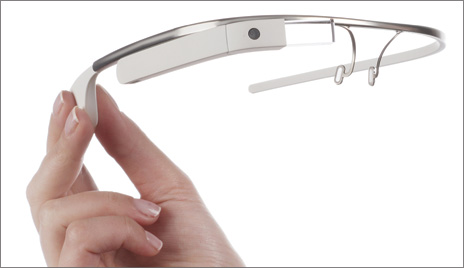
Google Glass will let you access information “so fast that you feel you know it,” says Project Glass leader Babak Parviz (credit: Google)
Summary of an IEEE Spectrum report
In the next few weeks, Google will start shipping its Google Glass to developers. More-polished consumer models are expected in 2014.
Details about Glass are still sketchy but here’s what we know:
- The lightweight browband, which looks like an ordinary pair of reading glasses minus the lenses, connects to an earpiece that has much the same electronics you’d find in an Android phone: a microprocessor, a memory chip, a battery, a speaker, two microphones, a video camera, a Wi-Fi antenna, Bluetooth, an accelerometer, a gyroscope, and a compass. The microdisplay is positioned over one eye.
- That hardware lets Glass record its wearer’s conversations and surroundings and store those recordings in the cloud; respond to voice commands, finger taps, and swipes on an earpiece that doubles as a touch pad; and automatically take pictures every 10 seconds. Prototypes connect to the Internet through Wi-Fi or through Bluetooth and a smartphone. Future versions will likely include a cellular antenna.
- Glass will run apps like Google+ and Google Search, but it’s designed to feel more natural and immersive than a PC or a smartphone. Ideally, Babak Parviz, the leader of Project Glass, told developers at the company’s Google I/O conference in June, it will let you access information “so fast that you feel you know it.”
Start-ups Atheer, First Person Vision, Lumus, and Vergence Labs all have Glass-like prototypes in the works. Specialty manufacturer Recon Instruments makes MOD Live, a head-up display for skiers that analyzes their jumps. Established firms like Apple, Microsoft, Olympus, and Sony have been conducting research into smart glasses and head-up displays for years.
Full disclosure: KurzweilAI.net CEO Ray Kurzweil is now a Google executive.
Google Glass Features and Apps Still in Flux
Babak Parviz, head of the Google Glass project, hints at what to expect next:
- We wanted to have a device that would do two things that we think would be useful for a lot of people. One is to have a device that would allow for pictorial communications, to allow people to connect to others with images and video. The second big goal was to have a technology that would allow people to access information very, very quickly. So when you have a question, you can very rapidly get to the answer.
- In the future, augmented reality will also come into the picture. So augmented reality is exciting when you think about future generations of this type of wearable computing
- A touch pad on the device allows people to change things on the device if they wish to do so. We have also experimented a lot with using voice commands. We have full audio in and audio out, which is a nice, natural way of interacting with something that you’d wear and always have with you. We have also experimented with some head gestures.
- I think since our platform allows for very quick access to information—if you need to have access to visual information, you almost instantly get it—something like Google Now could be very compelling.
Build Your Own Google Glass

(Illustration credit: Jason Lee)
By AI researcher and investor Rod Furlan
I needed a microdisplay with a screen between 0.3 and 0.6 inches diagonally, and with a resolution of at least 320 by 240 pixels. Most microdisplays will take either a composite or VGA video input, the former being the easiest to work with.
A quick search on the Alibaba global supply website returned several candidates; most suppliers will gladly fulfill orders for a single display and matching control electronics if you contact them directly. However, the corresponding optics for mounting these displays—which required them to be placed directly in front of the eye—were too bulky.
To build a sleek device, I needed to be able to mount the actual display on the side of the head and bring the image around to the eye. This setup is actually easy to make if you have the right equipment, which I don’t. Luckily, back in 2009, a company called Myvu (now out of business) sold a line of personal head-mounted video displays for iOS devices. Myvu’s products were sleek and small because they used a clever optical system alongside side-mounted screens. …
(More)
Comments (24)
by GatorALLin
these guys are showing product at CES show Jan. 2013.
http://www.vuzix.com/consumer/products_m100.html
by Cybernettr
They had better hurry in releasing this Google Glass and achieving market acceptance, since Ray Kurzweil, in his latest movie, The Singularity Is Near, predicts glasses that go way beyond this, projecting not just augmented reality but true virtual reality into the eyes of the viewer (by the end of 2015). This is actually a long-standing prediction of Kurzweil’s that is already overdue.
That means if Google Glass is released this year and gains market acceptance, we will have just two years for lightweight VR glasses to be developed, approved and released to the general public. Better hurry up!!!
by Chris
Check out Caprica on Netflix. I think you’d appreciate the science fiction behind the development
by Jerry K
The roadways are about to become even more hazardous.
by Jim Mooney
Didn’t an AI researcher recently get mugged for wearing something like that? Beware the Luddites.
by eldras
Brilliant! So this is why Ray’s there?
I met a chap with internal lenses the other day…inserted behind his own eye lenses…internal contacts robotically inserted for short sight.
iously do that with screens.
It’s easier to control mind screen than is thought.
The move from biological systems to robot ones is necessary for survival IMO and google glasses are a move there.
Whether they are great or just fun and discarded, they might paradigm shift millions and flood investment into cyborg ventures.
We have to either
1. Build contained superintelligence
-OR-
2. Modify ourselves at faster speeds than general A.I.s
Delivery technology for accelerating A.I. is still moot.
eldras
We could obv
by Gabriel
Supposedly, his focus is on AI, machine language and all the like…but considering his projections, and that Google has often been at the forefront of fulfilling them as he said, it wouldn’t surprise me at all if he actually helped with Google Glass.
by Jack Reeve
Killer app in the making
by Marcos Marin
Have we run out of jokes involving junk food, boxing and/or the French language?!
by Gorden Russell
Even while reading this article, I really was having flashbacks to fighting Algerians in the Paris McDonald’s…and I wasn’t even there.
by Marcos Marin
hehehe
by de Broglie
That’s a really funny comment in terms of this website.
by Michael
If miniaturization of kinect abilities could happen gesture control of the interface with your hands would be neat.
by GatorALLin
I have to agree that if you could use some hand gestures without having to touch any buttons or surfaces this would open the uses up for medical applications that could be way cool. The combo of voice and hand gestures could really prove a great hybrid to control visual data input/output.
by Bob Vasquez
Okay, so, here is what I would like. I need a device that attaches to my glasses that will display all my music scores; in that way, when I play my classical guitar people will think that I have memorized all my music. What an idea!!!
by Gorden Russell
Then the Google Glass is the thing for you, Bob Vasquez…except that you’ll have to keep zooming in on the score by taking your hand off the strings and touching the pad on the temple. But when they use Michael’s idea to tie it in with kinect, then the camera eye will follow your hands and keep the score scrolling along as you play.
by Gabriel
Heh, that is something I’m really hoping for and think will be one of the best applications of AR in the near-future that I can think of: self-teaching programs.
Imagine, learning how to cook, play an instrument or whatever…the overlay would present the instructions as you are doing it, and you could self-teach yourself many tasks….even better, they could make it like a video-game with scoring and make things interesting.
Or perhaps, when natural-language comes along, even learning new languages…you could practice talking to virtual avatars.
More then taking pictures and other tasks, self-teaching tools is something I’m really hoping will take off.
by Bri
@Gabriel: your personal AI could be whatever character is interesting to you, and teach you anything, everything.
by botheredbybees
there’s a pretty interesting video on the BMW site about their AR training aspriations… http://www.bmw.com/com/en/owners/service/augmented_reality_introduction_1.html
by Francesco Giartosio
You won’t need to learn new languages, you will simply speak your language and see the translation of the answer on your glasses (the person with whom you’re talking will do the same).
by Mick O'Malley
And think of the customer service operator at your local council or utility company or airline ticket desk etc etc. When you walk in the room facial recognition will pick you out and provide the operator with a heads up display about you and your habits and preferences so they can better provide personalised service.
by Snow removal
I’d like a pair of these to record all I do at work and see if I could spend my time more wisely.
by Phil
How do I become a google developper ? :)
by Fred
More some weeks and you will have more information.