Graphene’s photovoltaic potential
March 5, 2013
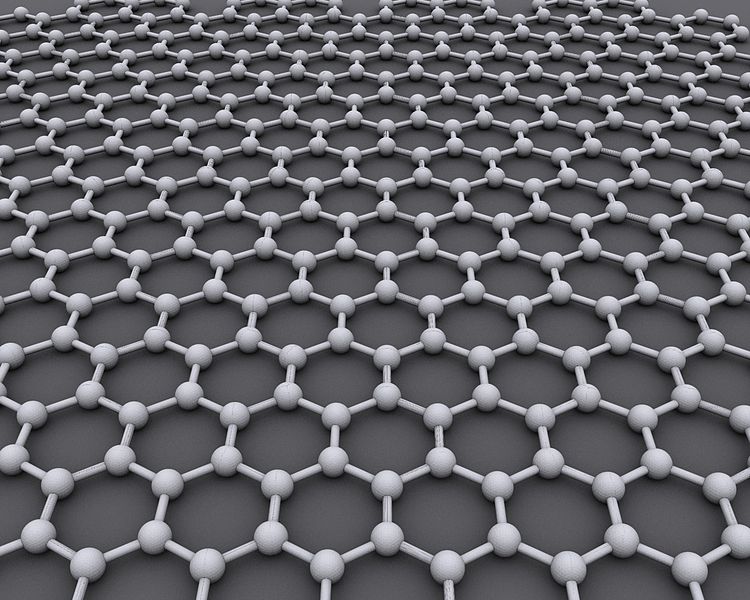
Graphene (credit: AlexanderAlUS/Wikimedia Commons)
Researchers have demonstrated that graphene is highly efficient at generating electrons upon absorbing light, which suggests that the material could be used to make light sensors and perhaps even more efficient solar cells, MIT Technology Review reports.
Conventional materials that turn light into electricity, like silicon and gallium arsenide, generate a single electron for each photon absorbed. Since a photon contains more energy than one electron can carry, much of the energy contained in the incoming light is lost as heat.
Now, new research reveals that when graphene absorbs a photon it generates multiple electrons capable of driving a current. This means that if graphene devices for converting light to electricity come to fruition, they could be more efficient than the devices commonly used today.
This will probably have the most immediate impact in the field of image sensing, but could work with future higher-efficiency “third-generation” solar cells, with a theoretical limit of more than 60 percent.
Comments (8)
by de Broglie
The fact that graphene absorbs light so well is not suprising. For those of you who know basic chemistry, the resonance structure is very obvious. It is similar to how many sunscreens work.
by A4i
From quantum mechanics perspective if a silicon surface got stroked by photon, then that particular photon should be absorbed by whole atom , not just by single electron. So graphene should have better transfer ratio for breaking the electron binding energy (over temperature increase) or probably less recombination ratio, than silicon . Looks promising.
by Bri
Not to mention that being black in color means it aborbs the whole spectrum.
by Ralph Dratman
Very interesting, A4i. What is recombination ratio?
by Bri
What does he mean by the whole atom. Other electrons in the outer shell? Other electrons in inner shells?Protons and nuetrons? Quantum mechanics describes photon radiation and absorption as an aspect of electrons. All we see and experience is electromagnetic phenomenon. ( to tell the truth that’s why my post was a reply not a new comment).
by Ralph Dratman
I don’t know exactly what he (or she) meant. That is why I asked about the recombination ratio, hoping to get some idea how a4i is thinking about this.
by Bri
I agree. I’ve had a florescent mineral collection since I was twelve. I know that when the minerals are hit with black light( ultraviolet spectrum) they are able to absorb the photons of that part of the spectrum. It excites the electrons and they jump to a higher electron shell. They are unstable there so they emit visible light and go back to their old positions. Since graphene absorbs more of the spectrum of light I think it imparts more energy to the electrons. This might help encourage the electrons to be liberated, rather than emit other wavelengths of light ( infrared or heat).
by de Broglie
Light will only be working on the electrons. Light is absorbed when the energy state of an electron increases. For those of you who want to understand why graphene is so amazing, you can learn about resonance structures. It is a fairly simple concept and explains why a lot of organic dies used in clothing are so colorful. Graphene kind of shares electrons in a big net. Electrons are not really localized in an atom. They may be “transfered” throughout a molecule.