‘Green Brain’ project to create autonomous flying robot with honeybee brain
October 2, 2012
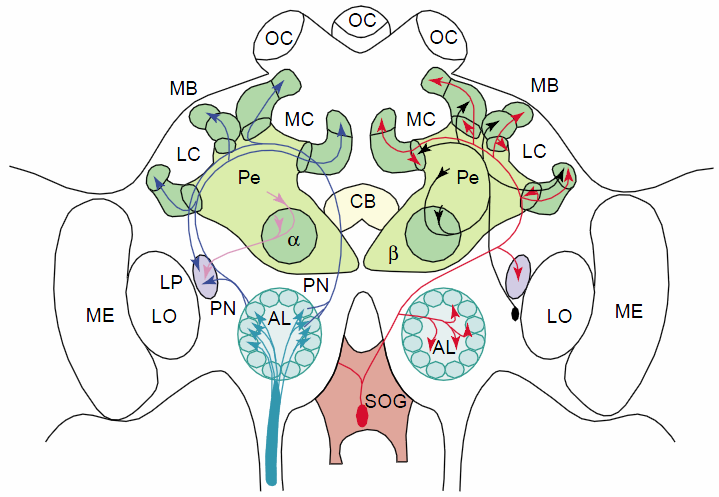
The honeybee brain: a schematic view of the major neuropils of the central brain area excluding the eyes, showing the olfactory pathway (credit: Randolf Menzel and Martin Giurfa/TRENDS in Cognitive Sciences)
Scientists at the Universities of Sheffield and Sussex are embarking on an ambitious project to produce the first accurate computer models of a honeybee brain in a bid to advance our understanding of Artificial Intelligence (AI) and how animals think.
The team will build models of the systems in the brain that govern a honeybee’s vision and sense of smell. Using this information, the researchers aim to create the first flying robot able to sense and act as autonomously as a bee, rather than just carry out a pre-programmed set of instructions.
If successful, this project will meet a major challenge: building a robot brain that can perform complex tasks as well as the brain of an animal. Tasks the robot will be expected to perform, for example, will include finding the source of particular odors or gases in the same way that a bee can identify particular flowers.
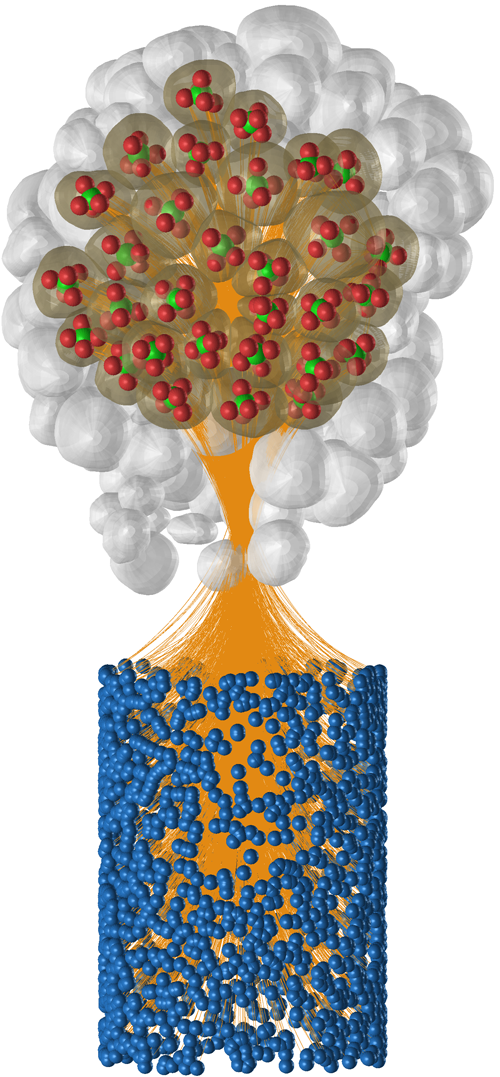
Model of a bee’s antennal lobe (top) and olfactory receptor neurons on the antennae (bottom) (credit: Thomas Nowotny)
Green vs. blue
It is anticipated that the artificial brain could eventually be used in applications such as search and rescue missions, or even mechanical pollination of crops.
“The development of an artificial brain is one of the greatest challenges in Artificial Intelligence,” said Dr. James Marshall, who is leading the £1 million Engineering and Physical Sciences Research Council (EPSRC) funded project in Sheffield. So far, researchers have typically studied brains such as those of rats, monkeys, and humans, but actually ‘simpler’ organisms such as social insects have surprisingly advanced cognitive abilities.”
Called “Green Brain,” the project invites comparison with the IBM-sponsored Blue Brain initiative, which is developing brain modeling technologies using supercomputers with the ultimate goal of producing an accurate model of a human brain.
Reverse-engineering a bee brain
Green Brain’s researchers anticipate that developing a model of a honeybee brain will offer a more accessible method of driving forward our knowledge of how a brain’s cognitive systems work, leading to advances in understanding animal and human cognition. “Because the honeybee brain is smaller and more accessible than any vertebrate brain, we hope to eventually be able to produce an accurate and complete model that we can test within a flying robot,” said Marshall.
“Not only will this pave the way for many future advances in autonomous flying robots, but we also believe the computer modelling techniques we will be using will be widely useful to other brain modeling and computational neuroscience projects,” said Dr. Thomas Nowotny, the leader of the Sussex team.
The research is also expected to provide a greater understanding of the honey bee itself. Because of their role as pollinators, honey bees are vital to many ecosystems, yet their declining population in recent years has given scientists cause for concern.
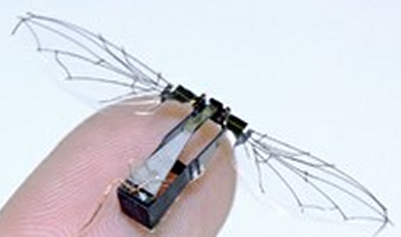
Robobee (credit: Harvard School of Engineering and Applied Sciences)
Green Brain’s modelling could help scientists to understand why honey bee numbers are dwindling and also contribute to the development of artificial pollinators, such as those being researched by the National Science Foundation-funded Robobees project, led by Harvard University.
The project sounded (to us at KurzweilAI) very ambitious, but Dr. Marshall clarified the scope in an email: “Initially we’re focusing on olfactory learning, which has been comparatively well studied, and visual learning, which has been less well studied, at least neuroscientifically.
“We have only around 10 person years of effort on this project, but we hope in the future to build larger research networks, across Europe for example, to develop this research agenda further. So, this is the first project it what I hope will be a sequence of projects, assembling the pieces of this massive jigsaw puzzle.”
We were also interested in how they might collaborate with the Harvard Robobees researchers. “The Harvard-led Robobees project has a complementary focus… in fact the Robobees project supported our own proposal, and we have plans to exchange research results between projects at the end of our first 3 years,” he said.
“A lot of the Robobees work is looking at miniaturizing robotics technologies towards the scale of a real honeybee. We’re looking at making biologically plausible models of the bee brain, but without any constraints about making a robot as small as a bee.”
The project is partially funded by NVIDEA. NVIDIA is also providing high-performance GPU accelerators, which generate the 3D graphics on home PCs and games consoles and power some of the world’s highest-performance supercomputers. These accelerators provide an efficient way of performing the massive calculations needed to simulate a brain using a standard desktop PC — rather than on a large, expensive supercomputing cluster.
“Using NVIDIA’s massively parallel GPU accelerators for brain models is an important goal of the project as they allow us to build faster models than ever before,” Nowotny explained.
Comments (30)
by Montag
Hmm… Some of you should really read “Watchbird” a 1950s short story by Robert Sheckley (a sort of a lesser-known Ray Bradbury). In it he explores – via the medium of science fiction – the perils of allowing techies to try to solve some of the weightier problems of human existence. The techies’ solution – the Watchbird – is awfully similar to the poison robotic bee described above. Oh, and of course it all ends badly… Have a read: http://www.gutenberg.org/files/29579/29579-h/29579-h.htm
by Infinitos
Looks like i’m going to get my own artificial praying mantis in the next few years .
by John
Very ambitious. I hope guys know what they are dealing with. But maybe that blindness will help them be not afraid of complexities? Or will they foolishly overestimate own capabilities and spend 10 years hitting walls and writing papers.
by MrFriendly
This isn’t so crazy. The Blue Brain project has already simulated one million HH model neurons using a terascale supercomputer (23 teraflops, i think). Obviously, a lot more biology has to go into a simulation like this, but at least the hardware is nearly here to begin taking a good stab at it.
Also, they obviously don’t have to get every bit of biological detail just right in order to advance AI.
by Marcos Marin
“Also, they obviously don’t have to get every bit of biological detail just right in order to advance AI.”
Riiight… Now that neuroscience is finally taking off noticeably, all those soon to be displaced pre-scientific psychologists can be re-deployed to treat your imperfect AI’s! =)
Mr. Russell here will certainly love having all those neurotic robots paying the price for his obsolete eaters, I mean, workers, LOL
by MrFriendly
Artificial neural networks are an abstraction away from biology, and look how powerful they are; they’re being used to greatly improve speech recognition, computer vision, language modeling, etc.
More knowledge about how real neural networks “compute” will only advance the field.
by Marcos Marin
Sorry to burst your bubble, Mr., but no, NN sucks, and they only work in highly limited contexts.
Oh, more knowledge always help, who can deny that? But guess what, NN was the way found to deny exactly that! Mwahahaha
by MrFriendly
Burst my bubble? lol. I’m composing this comment using neurons (and glia?).
Artificial neural networks are just really, really simple. Real biological neurons are incredibly complex. Transmitting spikes isn’t enough to capture what happens in a real brain, but capturing what happens at the molecular level will only yield more information processing capabilities.
I think you’re misunderstanding me as saying that we will use feed-forward neural networks to achieve AI. No, they’re powerful for narrow domains of AI problem solving, but they’re not enough. I agree with that, 100%.
Molecular, and perhaps even atomic-level simulations of biological neural networks will be necessary to make any sort of high-functioning AGI, imo.
by Camaxtli
Here’s a reminder of height of understanding we have of C. Elegans with its 302 neurons and 8000 synapses.
http://www.nytimes.com/2011/06/21/science/21brain.html?pagewanted=all
Still not fully understood, and to my knowledge, there is no practical applications like the one being proposed here with the honey bee’s olfactory processing. Just to give a little perspective on what it would take to map out and truly grok the honey bee’s 950,000.
I wonder why these guys just don’t use C. Elegan’s olfactory system, which is far better understood right now, especially since that is its main sense. Surely it has enough AI potential to make a dandy smelling bot. It could probably be adapted to other sensory processing as well I’d imagine.
by Vlad
I agree that this project is a little too ambitious, but you should look at the website of this project:
http://www.openworm.org/
And this video:
http://www.youtube.com/watch?v=xW77lANeJas
So this guy says that he expects that in 2 to 3 years it will be possible to simulate C. elegans brain (302 neurons) and body (1000 cells) and then after that it will take another 5 years or so to simulate the zebrafish brain (100.000 neurons)
by Camaxtli
I just watched that yesterday evening actually. Very exciting. I am very optimistic about what he’s doing. It is very solid. There’s also a really interesting thread on Less Wrong about this subject:
lesswrong.com/lw/88g/whole_brain_emulation_looking_at_progress_on_c/
by Heffalump
Boy, could these people benefit from studying the reverse engineering of people that has been underway for 60 years already. Detailed physical simulations you will find at livingcontrolsystems.com show that computer models replicate the work of people to the 99.5 % level, i.e. to the limit of measurement. The subject is taught at the University of Manchester. For student evaluations and much more, see pctweb.org.
by Bri
I never would have thought there would (bee) so many posts on killer bees. Those parallel Rasberry PC’s might be very useful for this project. Using them in groups to simulate different brain areas.
by Arn
Surely taking the research a bit further we could have a 3D-Bee printer? – just pour sugar water in the one end and wax 3D objects come out the other.
by Ralph Dratman
Number of neurons in honey bee brain = 950,000
(from Menzel, R. and Giurfa, M., Cognitive architecture of a mini-brain: the honeybee, Trd. Cog. Sci., 5:62-71, 2001.)
This will be quite a job.
by Editor
Thanks, Ralph. I just added an image from that paper.
by Marcos Marin
Easier than mice. =)
by Marcos Marin
“simulate a brain using a standard desktop PC”
Are they finally getting smart?!
by MrFriendly
Not smart, yet, but certainly powerful. Maybe biology will soon cough up the software to make them smart.
by Marcos Marin
I meant AI researchers.. They certainly could use a workout, if that’s what you mean =) I don’t think biology will change her mind now, lol
by Gorden Russell
One day our very lives might depend on robobee pollinators.
Just wait until the CIA gets wind of this research. When a robobee with a high-powered graphics processor can fly into a window in Waziristan and find out which room has an al-Qaida bomb-builder in it, then a Predator can fire a missile into that room when there are no women and children present.
by TomZarek
Why bother with a high profile predator strike at that point? A robobee with those abilities could be fitted with a poison “stinger” that could take out the target with no collateral damage no matter who else is present.
by Gorden Russell
Now you’ve got it, TomZarek, great idea. No more collateral damage.
by Camaxtli
If it can fly into their window, it can fly into ours too.
by david
How about a personal guardian robo bee that responds to the instinctive fear or alarm of a woman in a nasty domestic violence scenario…bee comes in and delivers a dollop of knock out to aggressor so victim can either get away or report the aggression..might chill out some of our main civil sources of war – cheaper than a pit bull and more ‘certain’ if programmed like an electronic bracelet.
by Diam
Then the beginning of nano-wars.
by Gorden Russell
Yes, Diam, that’s the spirit. One day we will print out dragonflies from open-source plans keep our homes free from mosquitoes and flies and other people’s nanobugs. We will all have our own hive of killer bees to keep the government’s bees out of our airspace.
by Gianluca Bonifazi
Of course we’re supposedly going to need some complex A.I. to make a swarms of artificial bees act organically for a specific purposes. Then, we’ll probably get wars of swarms of nanobots.
by Bri
Yup! It’s going to be hard to stop a country like Iran from coming here and printing out a swarm of killer bees, armed with deadly toxins. We’ re all going to have to learn to play nice with each other. Quite frankly, I don’t think that is possible. People suffer from herd mentality. Look how quickly the artificial bee article was militarized in posts here. If people don’t conform to our views as to how to act, we see them as outsiders. Like the post that said if you don’t get the augmented reality glasses the other kids won’t play with you. If others don’t conform to the groups norms, we tend to attack, and try to make them feel inferior, or worse kill them. That’s what the extremists from the Muslim religion are doing today. If you don’t wear the right veils and you don’t pray five times a day. Christianity used to do the same thing. Your ostracized from the group or burned at the stake.
by TomZarek
Which I think is why we are shedding our civil liberties in terms of privacy at a record pace. Oppressive governments fear the empowered individual, see the Arab spring, and all governments should fear the super empowered individual. It’s still a top down law enforcement approach and they can’t conceive any other way to keep all the genies in there bottles than by monitoring every individual, because pretty soon we’ll all be able to get our hands on a bottle, and never know who will uncork one. Someday we may all have the potential destructive power of small nation states, swarms of killer bees and all.