Help discover dark matter in the universe, win money
November 5, 2012
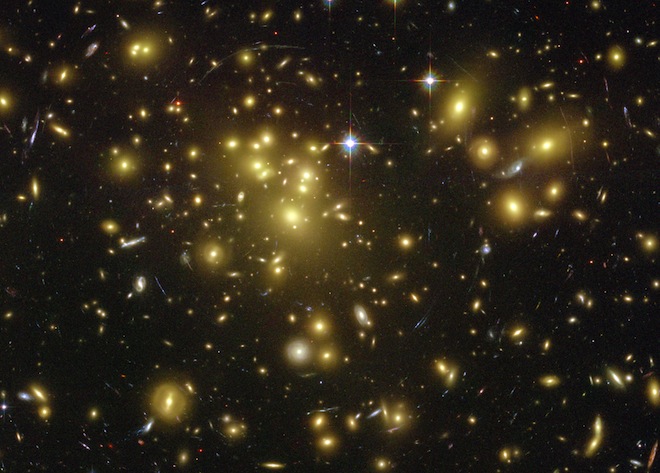
Dark matter in the Abel cluster distorts light from distant galaxies (credit: NASA et al.)
Can you generate new algorithms to spot dark matter in Hubble images?
Observing Dark Worlds aims to capitalize on the ever-growing field of citizen science, where non-experts are asked to sift through data to help make discoveries, Wired Science reports.
Dark matter is thought to be a strange form of matter that doesn’t interact with electromagnetism and light, accounting for roughly 85 percent of the matter in the cosmos.
When a large amount of dark matter gathers in one place, such as the halo around a galaxy, it will exert a massive gravitational force. This field is so strong it can bend the path of light beams passing near it.
Astronomers have been able to infer the presence of many dark-matter agglomerations by looking for this distorted light, but they haven’t been able to find a technique that can unfailingly uncover dark matter in telescope images.
“We challenge YOU to detect the most elusive, mysterious and yet most abundant matter in all existence,” write the contest’s organizers on their website.
People or groups whose code best predicts the center of 120 test dark-matter halos will receive $20,000 in prize money, split three ways: First place will get $12,000, second will get $5,000 and third place will receive $3,000. The contest runs through Dec. 16.
Comments (5)
by Art White
Aka Looking for The big dark fudge factor of the big bang failed theory at the wrong end of the telescope.
by Mortran
We have a highly speculative theory here and now we are looking for observations to prove it.
Shouldn’t science work the other way around? First there should be an observation, and then we should look for a theory to explain it.
by Editor
Actually, dark matter was originally hypothesized to account for discrepancies between calculations of the mass of galaxies, clusters of galaxies and the entire universe and calculations based on the mass of the visible “luminous” matter. See http://www.kaggle.com/c/DarkWorlds for current thinking. Note that the scientific method calls for looking for observations that falsify, rather than prove, an hypothesis or theory. There is no “proof” or absolute “truth” in science.
by NakedApe
Our editor is a very intelligent lady! In a basic Astronomy course I took, the professor showed us how galaxies spin as if a much greater gravitational force was acting upon them than could be accounted for by visible matter alone. There is no current gravitational theory to account for this except to postulate there is a mass of matter we cannot perceive — hence Dark Matter.
Why do people so often want instant truth from science or they throw the baby out with the bathwater? Science is a process of discovery and I, for one, hope to live long enough to learn the answers to some of the profound questions that we are asking today. In the meantime, I am thrilled to be alive at this fascinating time of human existence.
by YourNameHere
…And donate the money to the poor people in Caracas.