High-energy physicists smash records for network data transfer
December 5, 2012
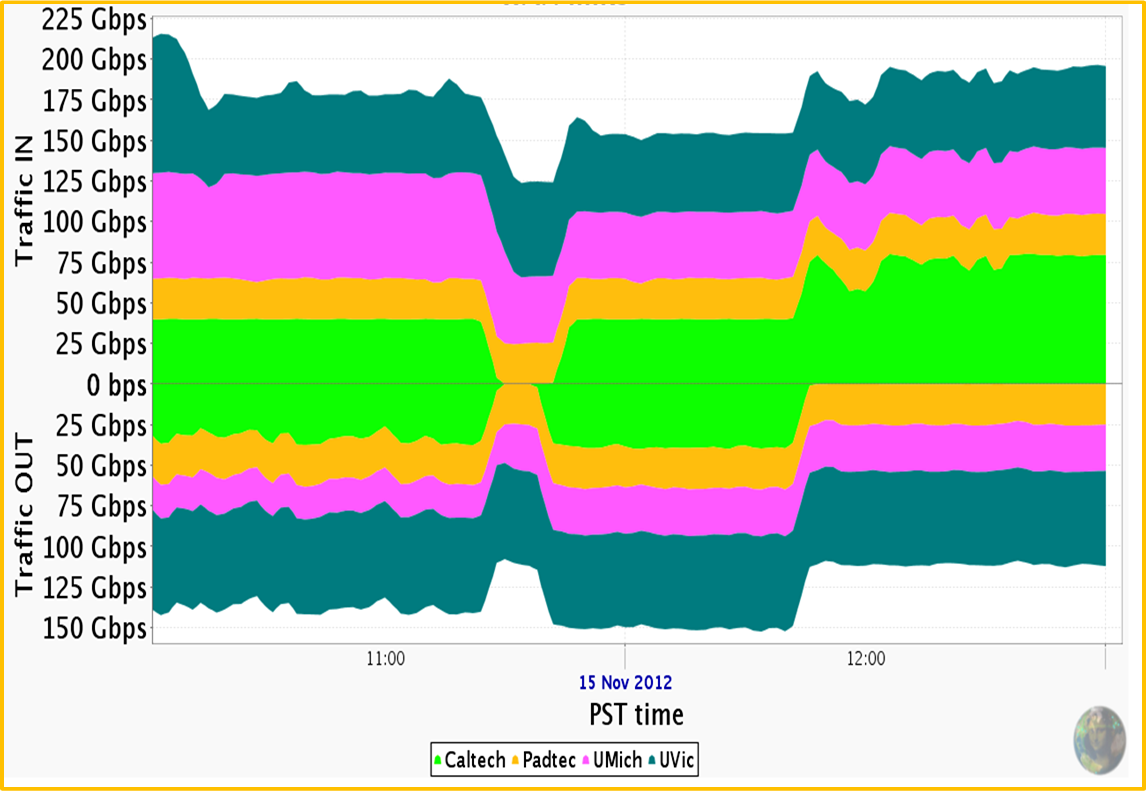
With three 100 gigabit/sec (100 Gbps) wide area network circuits set up by the SCinet, Internet2, CENIC, CANARIE and BCnet, Starlight and US LHCNet network teams, and servers at each of the sites with 40 gigabit Ethernet (40GE) interfaces, the team reached a record transfer rate of 339 Gbps between Caltech, the University of Victoria Computing Center in British Columbia, the University of Michigan, and the Salt Palace Convention Center in Utah. This nearly doubled last year’s overall record, and eclipsed the record for a bidirectional transfer on a single link with a data flow of 187 Gbps between Victoria and Salt Lake. (Credit: Caltech)
Physicists led by the California Institute of Technology (Caltech) have smashed yet another series of records for data-transfer speed. The international team of high-energy physicists, computer scientists, and network engineers reached a transfer rate of 339 gigabits per second (Gbps) — equivalent to moving four million gigabytes (or one million full length movies) per day, nearly doubling last year’s record.
The team also reached a new record for a two-way transfer on a single link by sending data at 187 Gbps between Victoria, Canada, and Salt Lake City.
Data-intensive science
The achievements, the researchers say, pave the way for the next level of data-intensive science — in fields such as high-energy physics, astrophysics, genomics, meteorology, and global climate tracking.
For example, last summer’s discovery at the Large Hadron Collider (LHC) in Geneva of a new particle that may be the long-sought Higgs boson was made possible by a global network of computational and data-storage facilities that transferred more than 100 petabytes (100 million gigabytes) of data in the past year alone. As the LHC continues to slam protons together at higher rates and with more energy, the experiments will produce an even larger flood of data — reaching the exabyte range (a billion gigabytes).
As the demand for “Big Data” continues to grow exponentially — both in major science projects and in the world at large—the team says they look forward to next year’s round of tests using network and data-storage technologies that are just beginning to emerge. Armed with these new technologies and methods, the Caltech team estimates that they may reach 1 terabit-per-second (a thousand gbps) data transfers over long-range networks by next fall.
More information about the demonstration can be found at http://supercomputing.caltech.edu/.