High-resolution remote-sensing for structures and objects, using optical fibers
August 29, 2012
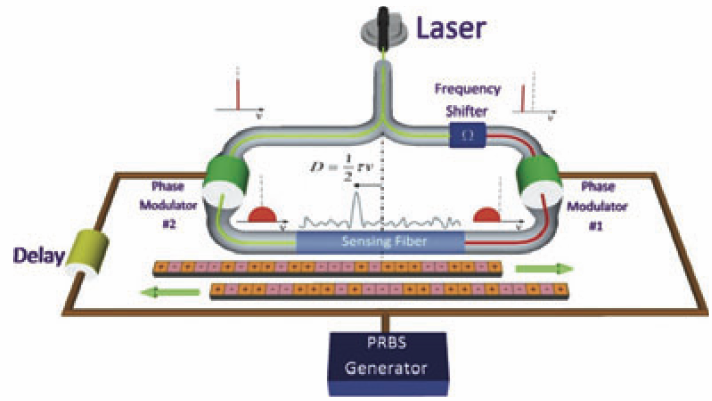
Optical fiber system for Brillouin optical time-domain analysis (credit: GFO, EPFL)
EPFL’s Group for Fibre Optics (GFO) has developed a technology that improves the resolution of measurements taken by optical fibers embedded in structures such as nuclear reactors, bridges, dams and buildings, or in smaller objects, providing valuable information about a structure’s heat or state of fatigue and wear.
Until now, data could be collected from points about one meter apart using optical fibers (thin glass threads) embedded in construction materials. Measurements can now be taken every centimeter —a hundredfold improvement in precision.
“Right now, we’re mainly measuring changes in temperature and force, but this method should eventually also make it possible to measure pressure variations, or even variations in magnetic field,” predicts GFO director Luc Thévenaz.
With this improvement, the fiber would be able to signal the presence of “hot spots” — weaknesses, deformations, or liquid or gas leakages — much more reliably, significantly improving the ability to monitor large structures.
The system uses “stimulated Brillouin scattering”: it sends, via laser, a beam of light trough the fiber. These waves of light generate acoustic vibrations, whose frequencies and phase change as a function of strain or temperature, allowing scientists to locate hot spots or unusual forces, with a range of tens of kilometers.
Placed in certain environments, such as underground, this optical fiber method could provide a means of detecting terrain movements or preventing the malfunction of geothermal energy installations. Placed in a glacier, it could provide information on the evolution of the snow pack.
This new technology also makes it possible to use optical fibers in smaller objects, such as robots, household appliances, or skis. It has been proposed to ride on EPFL Space Center’s “Clean Space One,” a small satellite designed for cleaning up space debris floating in near-Earth orbit.