How stress and depression can shrink the brain
August 14, 2012
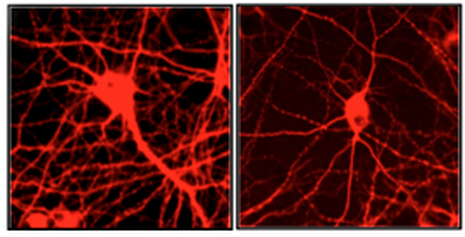
Expression of a single gene (GATA1) dramatically decreases synaptic connections between brain cells (shown on right). Yale scientists believe this may explain why people suffering from chronic stress and depression suffer loss of brain volume. (Credit: Yale University)
Major depression or chronic stress can cause loss of brain volume, a condition that contributes to both emotional and cognitive impairment.
Now a team of researchers led by Yale scientists has discovered one reason why this occurs — a single genetic switch that triggers loss of brain connections in humans and depression in animal models.
The findings show that the genetic switch (the GATA1 transcription factor) represses the expression of several genes that are necessary for the formation of synaptic connections between brain cells, which in turn could contribute to loss of brain mass in the prefrontal cortex.
“We wanted to test the idea that stress causes a loss of brain synapses in humans,” said senior author Ronald Duman, the Elizabeth Mears and House Jameson Professor of Psychiatry and professor of neurobiology and of pharmacology. “We show that circuits normally involved in emotion, as well as cognition, are disrupted when this single transcription factor is activated.”
The research team analyzed tissue of depressed and non-depressed patients donated from a brain bank and looked for different patterns of gene activation. The brains of patients who had been depressed exhibited lower levels of expression in genes that are required for the function and structure of brain synapses.
Lead author and postdoctoral researcher H.J. Kang discovered that at least five of these genes could be regulated by a single transcription factor called GATA1. When the transcription factor was activated, rodents exhibited depressive-like symptoms, suggesting GATA1 plays a role not only in the loss of connections between neurons but also in symptoms of depression.
Duman theorizes that genetic variations in GATA1 may one day help identify people at high risk for major depression or sensitivity to stress.
“We hope that by enhancing synaptic connections, either with novel medications or behavioral therapy, we can develop more effective antidepressant therapies,” Duman said.