How tension changes the structure of DNA
February 26, 2013
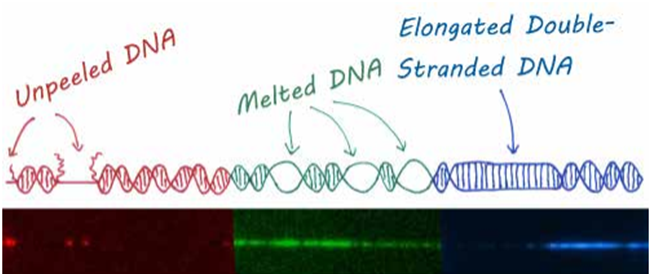
Fluorescence microscopy images (below) reveal the three different structures of DNA under mechanical tension (credit: VU University Amsterdam)
Researchers from VU University Amsterdam and from France and Singapore have discovered how mechanical tension changes the structure of DNA.
Advanced physics techniques show that the DNA structure can be disrupted in three distinct ways when the DNA molecule is stretched.
Three different structures
DNA consists of two parallel strands that are connected to each other in a double helix structure. While pulling on the DNA from both ends, the researchers were able to unpeel one strand of the DNA double helix.
However, by sealing the ends of the DNA, it was observed that DNA instead locally :melts” by forming areas of single-stranded DNA, where both DNA strands do not interact (‘melted’ DNA).
They used a simple trick to stabilize the DNA, by just adding salt to the solution. Surprisingly, the strands in this stabilized DNA did not lose their connections, but rather formed an elongated double-stranded structure.
Genome regulation and stability
The ability of DNA to melt locally, globally, or not at all, is shown to depend sensitively on the DNA structure and its local environment. DNA in the cell is often subject to mechanical force, and the ability to selectively melt the DNA double helix is vital for genome repair and regulation.
The researchers speculate that the ability to switch easily between three different structures of stretched DNA may in fact be important for genome regulation and stability.