How the Internet of everything will change the world
November 8, 2012
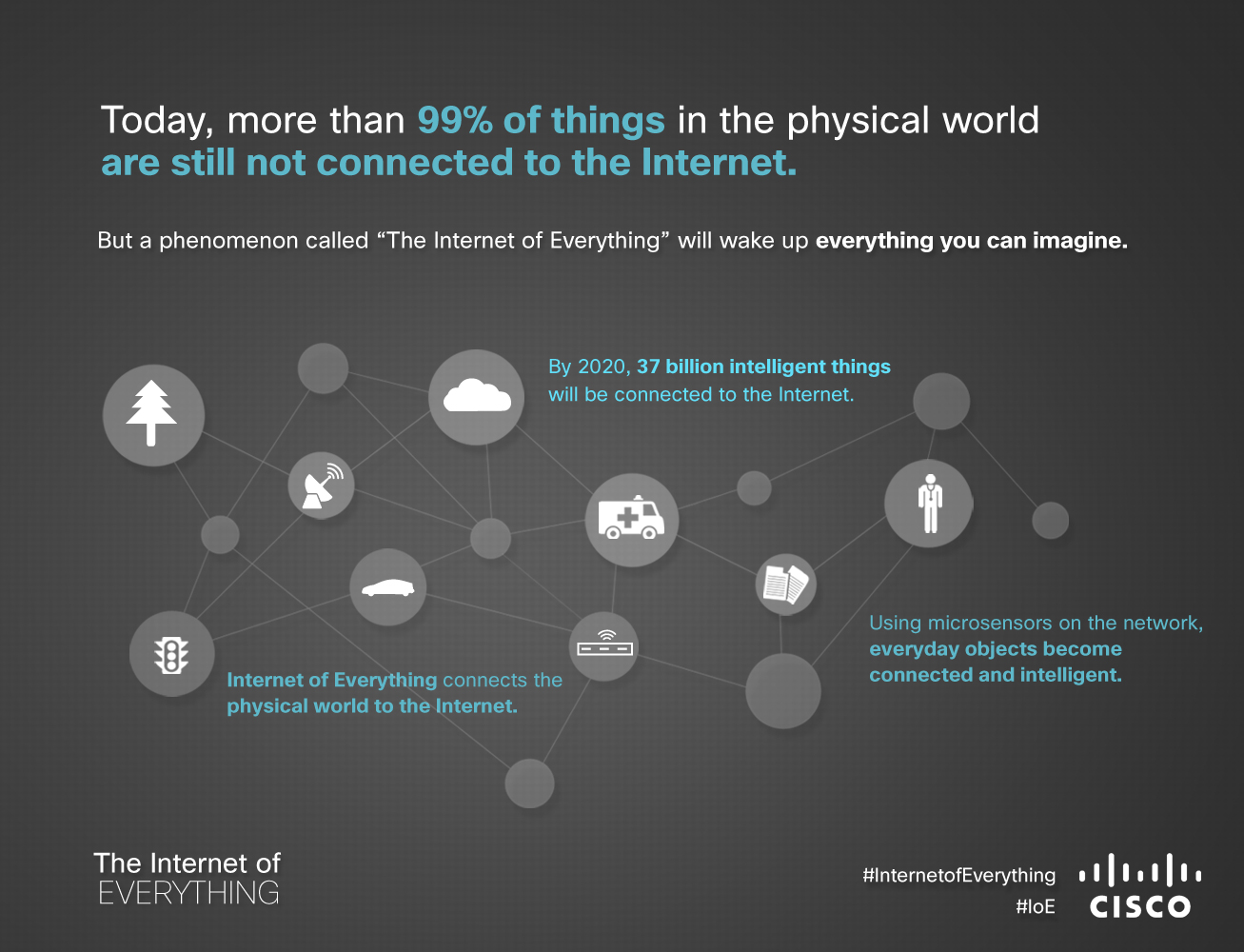
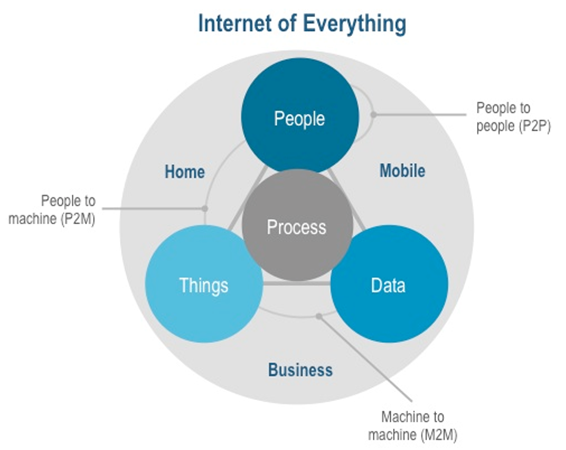
Internet of Everything (credit: Cisco)
From the Internet of Things (IoT), where we are today, we are just beginning to enter a new realm: the Internet of Everything (IoE), where things will gain context awareness, increased processing power, and greater sensing abilities, says Cisco in their blog.
Add people and information into the mix and you get a network of networks where billions or even trillions of connections create unprecedented opportunities and give things that were silent a voice.
Cisco says their IoE as bringing together people, process, data, and things to make networked connections more relevant and valuable than ever before — turning information into actions that create new capabilities, richer experiences, and unprecedented economic opportunity for businesses, individuals, and countries.
Comments (62)
by Kusuma
I think IoT will help control corruption to a great extent if various alarm messages can be triggered to appropriate units (police/cops) based on the amount of money transferred for a particular purpose .
It can also help in detecting terrorist attacks using suspicious chemicals detectors which can detect such chemicals in the vicinity of the area where it is installed. If it crosses a threshold , it should be able to send an MMS of the snippet of video when & how the substance entered that location.
by oob4uleap
I think as “futurists” one would consider the cliche ” watch out, you might just get what you want” . Certainly, there are things in the world you would NOT want touching you or things you would NOT want to touch, virtually or otherwise. A more interconnected internet is a double edged sword. Certainly, as scientists were ( and are) researching nuclear physics, they became aware of the advantages and disadvantages of nuclear power, but could not completely see all the ramifications. While a more interconnected internet can lead to many advantages, it also leads to more access, which is not always a good thing.
While building this edifice, it may be more critical to consider the architecture and not just seek to glorify and maximize it’s interconnectedness .
by knowpronto
great information shared
by Cybernettr
Don’t we already have the technology to make automobile theft virtually obsolete? Combine GPS with cell phone technology and when a car is stolen, it can notify the police of its whereabouts. I’m a working stiff, and I can’t afford to insure my used car against theft, but I can’t afford to replace it if it is stolen, either.
by Editor
Yes, OnStar, https://www.onstar.com/web/portal/securityexplore
by Phil Osborn
There was an sf novel from the ’50′s, I think, that envisioned a time when natural upgrades had suddenly led to the emergence of toasters and lawn mowers that were organizing into unions. The hitchhikers on the Google glasses or the contact lenses in “Rainbows End,” may include a lot more than meat brains, and we may not even notice as they replicate and start argueing with us for computronium (see Stross) access…
by mike rudolf
Things will advance in fits and starts, some wonderful, some not…….twenty years ago, Kroger introduced a voice translation of the price as it was scanned……..everything you bought was voiced out to you by product and price…….it didn’t take more than two minutes for you and the checker to be driven nuts by this incessant drone……within two weeks, that technology was unceremoniously removed and never “heard” from again………….and as much of a fan of future technologies and the idea of the singularity that I am, I also enjoy being what I call a “Visceral Dumb Human”……knowing that we are probablly one of the last generations of such unaided Humans!
by Christian Gehman
This Luddite begins to believe that continuous access to and use of computers leads toward …. declines in humanity.
by Tony Stender
In the discussion of software being the bottleneck.
Moores law is based on the use of humans and their problem solving ability being exponential. How is that different from software. Well software does not change as rapidly hardware and the reason is obvious if you think about it a bit. The software changes are paradigm changes which are limited by the humans slower learning abilities. hardware is simply installed and it works. Software as the limiting factor, has to be tested in place to confirm is validity and efficiency. This slower process seems to be the hitch in the gitalong.
It seems to me that whomever solves this problem will become very rich indeed. Maybe just doing the programming by computer alone with it’s faster processing speed is the simple answer.
As I write this I am thinking this must be on someones drawing board or perhaps it has been done before. Who out there knows the answer to this seemingly obvious problem?
by Face
There was an article a while ago on this site that talked about software changes and how it has lead to far more improvements than the upgrades in hardware have.
by MIc
I been thinking of a similar problem. I noticed that software development is getting simpler (i.e. almost of a layman to custime code.alter) or getting more abstract. So, I think this is part of the answer: The software seems to be getting more and more abstrated – i.e., a compilation of codes to do a given function is getting simpler, and along with that more and more funcations are being aggregated under one compilation — meaning that, it is getting much easier to code; so that eventually, each of us can avail ouselves to pre-existing “tools” or software abstractions which can be customized to individual needs (i.e., we will be able to “compile” functions from different software into a individualized custom software…) I am looking to develope this idea out further and want to meet like minded people.
by futureWA
Agreed. The tools that are used to create code are becoming easier to work with but you might still need deep domain knowledge before you can actually create anything that might be useful in a complex environment with the code.
by Sandy Klausner
Well Mic, check out our site and contact me.
by fgbouman
While the level of abstraction is rising, some of our ability to do precisely what we want with our software is disappearing so that we are constrained to suffer approximations of our intent and be constrained as well by the bloat and levels of abstraction that waste both storage and processor cycles and ultimately, energy.
I’m confident that as time goes on we’ll develop simpler and more efficient ways of developing software than we have today. This will enable us to develop many more applications where power consumption is minimal, which is what we need for an Internet of Everything.
by John Goodrich
Futurists and techies are predicting human equivalent AI by 2030 or so.
After that machine intelligence surpasses human capabilities.
It is those smarter-than-human machine intelligences which will better design the software and hardware we lesser intelligences will need.
We’ll just have to keep on plugging away until that time with the lesser intelligent and slower chemical processes that make up human thinking .
by Peter Kinnon
Without questions this will occur, and it is a very predictable part of the relentless trend that has been obviousfor decades to those prepared to make the effort to remove our naturally anthropocentric blinkers.
As I have had occasion to point out many times before:
The construction of a “brain” that will soon equal and then surpass that typical of our species has for long been a work in progress. Not as a result of any deliberate human “design” but rather as the result of an autonomous evolutionary process that can be seen to have run its exponential course since humankind acquired the ability to share imagination, which we know as language.
Very real evidence indicates the rather imminent implementation of the next, (non-biological) phase of the on-going evolutionary “life” process from what we at present call the Internet.It is effectively evolving by a process of self-assembly. You may have noticed that we are increasingly, in a sense, “enslaved” by our PCs, mobile phones, their apps and many other trappings of the increasingly cloudy net and its ever more insidious peripherals.
We are already largely dependent upon it for our commerce and industry and there is no turning back. What we perceive as a tool is well on its way to becoming an agent.
Consider this:
There are at present an estimated 2 Billion internet users. There are an estimated 13 Billion neurons in the human brain. On this basis for approximation the internet is even now only one order of magnitude below the human brain and its growth is exponential.
That is a simplification, of course. For example: Not all users have their own computer. So perhaps we could reduce that, say, tenfold. The number of switching units, transistors, if you wish, contained by all the computers connecting to the internet and which are more analogous to individual neurons is many orders of magnitude greater than 2 Billion. Then again, this is compensated for to some extent by the fact that neurons do not appear to be binary switching devices but can adopt multiple states.
Without even crunching the numbers, we see that we must take seriously the possibility that even the present Internet may well be comparable to a human brain in processing power.
And, of course, the degree of interconnection and cross-linking of networks within networks is also growing rapidly.The culmination of this exponential growth corresponds to the event that transhumanists inappropriately call “The Singularity” but is more properly regarded as a phase transition of the on-going “life” process.
An evolutionary continuum that can be traced back at least as far as the formation of the chemical elements in stars.
One that is on track to produce firstly a predominant cognitive entity on this planet from what is at present the Internet with subsequent emergence of “daughter” beings. These likely adapted for extra-terrestrial existence by virtue of the ruggedness and information processing potential of by diamond and other allotropes of carbon.
So, certainly, we may expect carbon-based life to exist within the interstellar realm , but not of the kind that comprises biology.
The broad evolutionary model that supports these contentions and speculations is outlined very informally in “The Goldilocks Effect: What Has Serendipity Ever Done For Us?” , a free download in e-book formats from the “Unusual Perspectives” website
by Christian Gehman
Please point to a computer that can create art.
by Mr.X
@Christian: http://en.wikipedia.org/wiki/Algorithmic_composition
“An early example was Lucasfilm Games’ 1982 computer game Ballblazer, where the computer improvised on a basic jazz theme composed by the game’s musical director Peter Langston; later in the life of that company, now rechristened LucasArts, an algorithmic iMUSE engine was developed for their flagship game, Dark Forces.”
by theos
Please read this:
http://www.kurzweilai.net/when-creative-machines-overtake-man?
by John Goodrich
Machine intelligence has not yet gotten to the point that it is intelligent as an insect. .
Around 2030 when it is predicted that AI will surpass human intelligence, AI may well be equipped to produce masterpieces.
A machine intelligence with the capability to store and access all information at the speed of light .
The current brain mapping project will also help to learn what it is in great art that appeals to humans , the particular combinations of color shape and form that have determined what is art and what is junk.
But the big deal is the accumulated knowledge of art centered in one intelligent form .
A big question of course , is whether that fantastic accumulation of all knowledge in AI will produce a sentient entity .
If it can and does, I have no doubt that all human efforts in art will easily be equalled and surpassed by a greater intelligence.
Hell, they sell “art” done by elephants and gorillas so I guess , in the end, art will always be in the eye of the beholder: what appeals to any particular person. .
by fgbouman
The Internet has already surpassed the level of complexity of the human brain. In our household of two we have nine internet devices, not counting routers and bridges! There’s nothing exceptional about our home so it would seem to be a reasonable guess that most Internet users have at least two devices attached to the Internet and, of course, every one of these devices is far more intelligent than a single neuron.
We haven’t yet linked all of these devices into a universal “consciousness” but neither are our brains constructed that way. With the appropriate software we certainly have more than sufficient distributed computational power to match or surpass human intelligence already. How long, then, before “the cloud” becomes our universal oracle? Perhaps it is nearer than we think.
by Claus Hansen
I dread this. Things are dumb. I hate being called up by a machine, or being emailed by machines. I hate having to talk to a machine to get in touch with my helth insurer, phone company etc. If, in this version of the future, machines would just be limited to bother each other, thats OK. But imagine your toothbrush mailing you ‘please use me now, and by the way , you should go to Walgreens and replace me’.
by Walter Baltzley
Why have stores at all, why not implement something like this: https://digitalmatternet.wordpress.com/
by Larry in IL
Back in the 90′s this same fear was voiced by all manner of retailers under the term disintermediation. The assumption was that as the internet grew more sophisticated, consumers would go directly to producers and bypass the middleman in a worldwide marketplace. The problem is that consumers are not reliably able to distinguish between similar products from different sources unless we are talking about commodities. Retailers and professional merchandisers add value through their ability to vet sources and present collections of products. They add value to the equation beyond mere convenience for pickup.
Furthermore, the internet is great at delivering results from directed searches. But contrary to people’s beliefs, consumers frequently don’t know what they want until they see it. If they don’t know it exists, they don’t know to search for it. Try searching for an unusual statue or point of interest that is a perfect highlight piece for the foyer you are remodeling or maybe a great gift for Aunt Sally’s 50th wedding anniversary and see how productive that is.
Retailers are aggregators in a way that individual producers are not able and they evaluate quality and reliability of vendors in a way that is not practical for individual consumers. When buying furniture from a firm in Bangkok, as an individual, are you sure you will get what you want if you only make one purchase from that vendor in a lifetime? Sure you can rely on crowdsourced reviews, but anyone who has relied on crowdsourced reviews of lodging accommodations is familiar with the shortcomings there.
Frictionless commerce is not nearly as frictionless as its utopian supporters expect it to be.
by ErikSMeyer
You can’t automate all of this and separate things like inventory restocking entirely from human decision points; inevitably, these algorithms will break down and do stupid, destructive things. It’s sufficient to have a person monito the process and give final authorization for restocking orders, etc.
On a different note, most of this seems like a waste of time and energy.
I don’t want my coffee table to have a voice. I don’t need my refrigerator to order crackers or whatever.
We have here a company that sells networking devices trying to convince us that is would be splendiferous if everything on earth had a networking device embedded in it. Most things don’t need to be part of some network and would not benefit from being chipped, or acquiring a “voice.”
If you think your carpet or your sofa has something important to say, I think we have other problems.
by larry
I think that you are under thinking the kind of intelligence that will be present in web/cloud enabled switching. Decision making comes from a top down and bottom up fashion. The repository of information that a machine can scan, in order to help make a decision, is as broad as the internet. The amount of computational capability to form the bottom up decision process, will not only be robust, but exquisitely fast and massively parallel. Humans are limited in their top down library and have parallel processing capability, yet the rate of processing pales by comparison to what a machine will be able to do. Net result…Google enabled cars for example will make far fewer mistakes than humans. Orders of magnitudes fewer.
by fgbouman
Suppose your smart carpet senses a spill and calls out the iRobot to come over and clean it? Seems like a good thing to me ;) We simply need to release our imaginations in order to find applications.
by Dave Evans
Ray and team, thanks for picking up this piece. We believe we are entering a new era of the Internet, where things that were silent will have a voice. The potential is significant – to change how we sense (and improve) our world. The journey is just beginning…
by alfri
This is called “end of work” which will have profound implications on the workforce. If you think we have unemployment problems today “you ain’t seen nothing yet”. We as a society must come up with solutions for this eventual senario and soon.
by Gorden Russell
Yes alfri, when a robot takes a job away from a person, that robot must start paying the Unemployment Insurance and Social Security taxes that will otherwise be taken from the tax base.
When a robot takes a job, that job is gone forever. So unemployment benefits can’t be allowed to run out after 26 or even 99 weeks. The benefits must be continued until age 65, when Social Security becomes available.
by alliwant
It seems like a small step further to extend Social Security to include unemployment. That might be a simple way to cushion some of the shock from the sweeping change on the horizon.
by Mr.X
The robots (meaning worker -somewhat funny to me- , a word from the ex warsaw-pact member czechia) will bring about true communism ;)
by John Goodrich
With futurists predicting total elimination of all requirements for human labor by 2030 , the unemployment we are now seeing will get progressively worse and will end in a collapse of capitalism .
You cannot have much beyond 25% unemployed and have a peaceful society in a capitalist economy.
That might well be replaced with democratic economic and governmental forms .
Unemployment will not be a problem is a society where all goods and services are produced by machine intelligence since the world will have to go to a democratic socialist or communist/ anarchic system of distribution of those goods and services. The decisions on how that distribution is to be effected will be made from the bottom up via direct democratic input from the electorate.
That presupposes that the society wants democracy.
It’s going to be a much different world just 30 years from now. .
by fgbouman
Since this is already well underway, it is clear that we need both a new ethos and a new economic system to deal with this changing reality. Is there any chance we’ll actually develop these without a great deal of anger, bloodshed and pain?
by Bri
Let’s say you are a fabulously wealthy individual. Let’s take Mitt Romney and Bill Gates as an example. Once you have your jacked up house, what do you need for your day to day expenses? If robots do all the governmental stuff, and energy becomes cheap, taxes would be very low to nonexistent. Food and clothing could be extremely inexpensive. If everything is made and maintained by AI and robotic systems, we could all just go to a bank and withdraw the tiny valuations necessary to get the products we need. That valuation would go right back into the financial system. Nobody would need to be super wealthy. We all would be super wealthy. Valuations would change forever. You could live in the desert and have beautiful views of the sea. Have a house full of fine art like in a museum, and it all would cost a tiny fraction of what it would today. There would be no need to horde money like we do today. The big problem is getting the geopolitical system to accept this. As unemployment rises, it will derail the world economy. Robots and AI will eradicate all jobs. Without income, the consumer based economy will collapse. As you say, we ain’t seen nothing yet!
by John Goodrich
Thanks, I am in total agreement with your assessment of the future of capitalism . It cannot possibly survive either because automation will eliminate all jobs making it unworkable or that increasingly more effective educational methods utilizing brain ,mapping info, direct brain chip-Internet links, universal access to the internet will educate the entire world .
No educated population will support the totalitarian and needlessly nature of capitalism ..
I’ll be close to 90 years old if I make it to 2030 .
I hope to live to see that day.
by Bri
Imagine Watson being 16 or 256 times smarter, and being connected to all of this.
by seeker
Good vision, but for me internet of things bring vision from Ghost in the Shell – where you can hack everything if you are clever enought. even if some places ( or things) have intranet fully separated from internet, you can hack some physical tools, and use them to brake into. If ToT going to came true then no objects like factories could be fully separated from net (or the price would be very high).
by Gorden Russell
Yeah, seeker, we are going to have to be very careful. We will need the top shelf version of Kaspersky in our inner ear. (Mine just told me that a malicious URL was inactivated yesterday.)
You’re right about factories,too. They will be turning robotic assembly lines on and off in response to demand. Robotrucks will be parked at the loading docks just waiting for orders to come in.
by Mr.X
@ Seeker:
Well, the best hacker would certainly be some kind of super ai.Now way we could compete with that, I guess.
by Gorden Russell
Right Bri, you’ll have a cell phone in your inner ear that gives you an advanced Siri that can answer any question instantly.
by Bri
Is that that ringing that I hear?
by Dav3000
@Gordon Russell
“you’ll have a cell phone in your inner ear that gives you an advanced Siri that can answer any question instantly”
If Ray is correct in his projections, there will be many cells in your brain, each connected to the proper group of neurons, which will bring up the information you want as if you already knew it. No ringing or Seri needed.
by Sandy Klausner
Moving beyond Smart Phones and ‘pads,’ there is a general belief that the Internet of Things (IoT) will shape a newer “information society” and “knowledge economy.” However, there are fundamental technological barriers that are attenuating the transition from the present “Internet of PCs” towards an “Internet of Things” (IoT) in which 50 to 100 billion devices might be connected to the Internet by 2020. The primary reason the ‘thing’ ecosystem will remain largely unrealized is the lack of an intelligent network infrastructure to support it. Such an infrastructure requires new Internet software architecture and an underlying applicative design methodology to transform connected objects into real actors at scale.
The manner in which software is developed hasn’t fundamentally changed since the 1960s. Character string-based programming languages have ruled computer science, but even the latest dialects such as Go and Dart are not likely to materially improve software productivity or enable a broad population to participate in the IoT systems creation process. Now after several thousand dialects, we can reasonably ascertain that legacy computer science will not produce the exponential improvements needed to manage the overwhelming interoperability, contextualization and security challenges of global scaling.
The orchestration of a paradigm shift is essential if the software industry is to ever become at least as innovative and productive as the hardware industry, which is following Moore’s Law. A new software science approach needs to be established to meet the requirements for the emerging IoT of unattended devices. Such a ‘clean slate’ approach must extend processor architecture ecosystems up through the software layers in a holistic manner to greatly simplify the build-out of the IoT.
by tim333
Huh? I think things are just going to be connected up without many new paradigms eg the Hue lightbulbs etc http://mashable.com/2012/10/29/apple-light-bulbs/
by Gorden Russell
This is a really thoughtful and instructive post, Sandy.
by Casey
So if today in late 2012 99 percent of physical things aren’t connected to the internet, to which number should that percentage drop by 2020?
by MarkOates
I guess it depends on what you consider a “thing.”
by Gorden Russell
Well, Mark, tools are things. Electric drills have had chips in them for a long time. With rechargeable drills and nail guns connected to the internet, the Department of Labor will know when a “cash-under-the-table” roofer gets work.
Of course, the IRS will find out about these guys too. A lot of roofers pay no taxes, not even unemployment insurance or Social Security.
Then there are guns. Police already have guns with chips that prevent a criminal from grabbing them and turning them on the officer. When all new guns have GPS in them, a stolen gun can be tracked down. This will also allow police to know who is packing a gun in a crowded theater. The NRA will fight this tooth and nail.
This will also allow Homeland Security to keep track of the components used by bomb builders.
by ErikSMeyer
Actually, people in the NRA would be very receptive to technology that minimized gun theft by making guns trackable. More than anybody, they want criminals disarmed (and ideally put someplace they can’t hurt anyone in society); having said that, the obvious problem is that all of these GPS IDs will end up in some little government creeps database, and given a policy shift, could be used to easy confiscate chipped firearms and disarm everyone in compliance. If the NRA is worried about that, well, it’s a rational concern.
by pax4pax
You trust your government that much? Throughout history, it is the governments that kill all the people and take their wealth and freedoms.
by Thomas Jensen
In other words: Revolution would become almost impossible. Old guns without GPS would sooner or later become outlawed, but would soar in price on the black market. At the same time, it would become possible to build one with a 3D printer… Lots of scenarios that could be taken almost directly from Ghost in the Shell.
by MarkOates
I was wondering today why, when I stepped into an elevator, it had to go down in order to go up. It seemed to me as if the elevator should “know” that there was nobody on the lower destination floor, and it was not the location that I had pressed. Strange thought to expect an elevator to be smarter, and to be disappointed that it wasn’t.
Also, when I was being checked out at the supermarket, an item didn’t scan correctly on the bar code scanner. I thought, why doesn’t it just have a camera and identify the object by image recognition? Aren’t bar codes an unnecessary overhead at this point, since their sole purpose is to identify the object?
More and more, I’m expecting things to be smarter.
by Gorden Russell
When the cashiers at the grocery checkout are robots, they will be able to “identify the object by image recognition.” They will even be able to weigh an onion by holding it in one hand. Of course, a lot of things will have RFID chips on their boxes, bags, and cans. This way the robocashier will just take your groceries out of the cart and bag them, getting the prices of everything along the way. It will just take your goods out of your cart and put the bagged items in another cart waiting at the foot of the counter. Then your empty cart will be rolled into position for the next customer.
by Gorden Russell
This will also give Kroger’s and Piggley Wiggley an instant inventory. An algorithm will order straight from Del Monte or the Gorton’s Fisherman and everything will be delivered by robotrucks and unloaded by roboforklifts and stocked by smiling robostockboys with realistic latex faces.
by Jay DeFehr
The Robocashier seems unnecessary. I think checkout would occur invisibly at the moment of product selection. When a shopper is finished shopping, her account is already debited, and she simply leaves the store. No checkout lines, no cashiers.
by Bri
If we have cell phones in our head, as soon as we pick up an item, or a household robot picks it up, it would be done instantaneously.
by MatthewQ
Exactly. New World means new ways of thinking/approaching problems. It is almost a knee jerk response from contemporary people to simply make a robot to mimic the way a human does things. Robots do not have the same limitations as we do. They can be made to solve problems in ways that would be impossible for a human with a souped up abacus.
by Jerry
That would require too much energy, easier to have an area you walk through to go to the bagging station. In fact that’s already been planned and will probably be here within a decade. At least in Australia, we’re leading in shopping automation, it’s been years since I went through the checkout manned by a person.
by alliwant
Self checkout is taking over the volume grocer in my area. The self-service checklanes are growing rapidly and are more productive than the best checkers. An RFID system where the customer confirms his purchase quickly before leaving the store would be the next logical improvement. The robot is really not required for checkout. The robots will likely be involved on the stocking end, as others have mentioned here.
by Noelle
Why would you even go to the store? Your refridgerator will remind you that you are running low on milk, ask you if you would like to replace it and notify the store who will deliver it to you.
by Dav3000
If everything had RFID tags, all you would need to do is put the groceries in your bag as you shop and walk out the door. The scan and charge could take place at the moment you passed the door frame.