How to double the power of solar panels
October 16, 2012
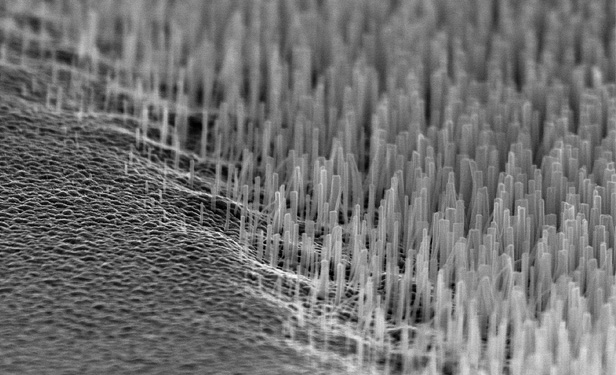
Solar collectors: A micrograph shows silicon nanowires produced by Bandgap Engineering. They can help a solar cell absorb more light. (Credit: Bandgap Engineering)
In an attempt to further drop the cost of solar power, Bandgap Engineering has a long-term project to develop a nanowire-based solar cell that could eventually generate twice as much power as conventional solar cells, Technology Review reports.
Meanwhile the company is about to launch a simpler version of the technology, using silicon nanowires that can improve the performance and lower the cost of conventional silicon solar cells.
Bandgap says its nanowires, which can be built using existing manufacturing tools, boost the power output of solar cells by increasing the amount of light the cells can absorb.
These changes could lead to solar panels that convert more than 20 percent of the energy in sunlight into electricity (compared with about 15 percent for most solar cells now) yet cost only $1 per watt to produce and install, says Richard Chleboski, Bandgap’s CEO.
Comments (19)
by Dirk Bruere
Chinese manufacturers are selling PV panels at 60c/W
by utomo
Another important part is to design the storage, which can collect the electricity and use it when needed. current battery is not good enough.
and also the electric car also will need good battery design. it is huge market.
I hope some company look at this opportunity and develop it
by Bruce Wright
I’m not sure that even next-generation batteries will be very useful for bulk storage of energy – they are relatively expensive and relatively short-lived compared to lower-tech alternatives. But their big advantage is portability (storing a significant amount of energy in a small footprint) – hence the interest for electric cars.
Lower-tech energy storage like large water holding tanks into which you pump water during peak generation times would probably be a cheaper bulk storage solution until at least a couple more battery technology revolutions have occurred.
by melajara
Meanwhile, A123 Systems (AONE), the EV battery maker went BK today.
I lost a TON there as this precipitated bankruptcy was a scheme to prevent a much anticipated Chinese takeover. Besides the company has been a collateral victim of the silly bipartisan political games heating up in those election times :(
by JFH
Having followed technology blogs for some years now i have to wonder
a) why we haven’t seen any significant advance in commercial solar technology in terms of efficiency
b) if there is a concerted effort on the solar energy front or if the left hand has no idea what the right hand is doing.
For example there have been what appear to be MULTIPLE small breakthroughs in solar tech over the last 5 years that could and should be combined to create one major improvement in solar efficiency if these guys worked together ala the Manhattan project.
How about this non reflective nano coating that was discovered 4 years ago (!) that would allow almost ALL the light from ANY angle to be absorbed. Thats a pretty major breakthough that could be combined with any of the other recent advances.
http://news.rpi.edu/update.do?artcenterkey=2507
by Richard Sittel
I totally agree with your “Manhattan Project” idea. However, there are so many haters of anything green or renewable that it would be hard for any politician to stick their neck out. At some point it’s worth it for the US to just print extra money and make it happen, counting on the technology to pay for itself before the next election. I firmly believe that cheap, abundant electricity will cause an economic boom never seen before on earth. Install it once, like roofing shingles, and never have an electric bill. For the price of 1/2 of one war, we could already be reaping the benefits.
by JFH
It is increasingly frustrating that vested fossil fuel interests and their political cronies have forever trumped national interests like cheap, renewable energy sources that create homegrown jobs and reduce reliance on fuel sources from unstable regimes. If politicians REALLY cared about national security, job creation and America continuing to be a technological leader they should put their money where their pie hole is.
by Satan
What’s increasing frustrating is people thinking that there is money just sitting around to throw at projects and that it only takes money to make anything work. Diverting resources away from what is needed today into something that might or might not work in the far future is bad policy.
by Hugh Chatfield
Why no significant advances? I wonder if there is resistance to any technology that can produce “free” energy (at least can’t be metered) – and with current corporate focus only on the bottom line of the P&L statement there is no corporate incentives to develop such technologies.
by GatorALLin
If your a fan of solar power… check out this cool KS project.
http://www.kickstarter.com/projects/alex9000/the-solar-pocket-factory-an-invention-adventure
by snake0
They say this will allow them to absorb ‘lower energy’ light but don’t refer to which part of the spectrum they are aiming to absorb. I remember a few weeks ago there was an article about harnessing areas of the spectrum not visible to the human eye such as infra-red, I wonder if Bandgap are going for an analogous approach or something completely different.
by Editor
Yes, “lower energy” refers to the near-infrared region. Energy is inversely proportional to wavelength.
by Richard Sittel
But, according to Twin Creeks Technologies, they are already able to reach 50 cents per watt for the modules, here is a link: http://www.twincreekstechnologies.com/solar/hyperions-value-in-solar/
I’d like more news on this technology and to know what others are coming forth, as well.
by Bruce Wright
I don’t believe that their $0.50/watt includes installation – it goes up to about $1.00/watt when you include that.
Many of these new solar technologies are complementary – you could combine several of them to get a bigger efficiency boost than with any one of them alone. This has the potential to dramatically reduce our reliance on fossil fuels and on OPEC, with all of the attendant geopolitical problems in the Middle East.
We are rapidly approaching break-even with respect to traditional power sources, which will dramatically affect both the economics and regulation of electrical power. Much faster, in fact, than has been expected – it looks like it will be in the next year or two at most. Some of the regulatory issues that will have to be addressed will include things like selling the power back to the grid: As the cost of solar comes down and lots of it gets installed (I expect just about every large building will have its roof covered in solar panels before long, it’s space and energy that’s currently going to waste), we’ll have a situation where there is a power glut during the daylight summer hours, and a power famine during the nighttime winter hours. The power companies become, in effect, power brokers (even more than they are now) – but most of them don’t have the infrastructure in place to store all that excess power to use when we have a shortage. Some of the changes that may be required will be to allow the utilities to buy back the solar power for less than what they are selling the fossil fuel-based power (Otherwise it makes it more difficult to fund the storage infrastructure needed, plus the inevitable transmission losses mean that otherwise the power would be sold back to another customer at loss), or that power used during a summer day might cost less than power used during a winter night, or even (somewhat counterintuitively by pre-solar power standards) less than the power used during a summer night. It’s one thing when the amount of solar being produced is relatively miniscule but somewhat useful for smoothing out the peak demand during the summer months (as now), it’s quite another when there’s a glut of solar power at certain times of the day and year (as will be increasingly the case over the next decade).
In any event, there will need to be major changes in the regulatory environment (given that electrical power in most of the world is produced by regulated monopolies) if we are to take full advantage of the new technologies. Unfortunately I do NOT have any confidence that this will be handled effectively by any of our politicians in this or any other country, since they tend to react to technological progress “a day late and a dollar short.”
by Bri
Amen to that!!!
by Jerry
In Australia we’ve been able to sell solar back to the grid, though we’re already having trouble with the huge uptake in solar causing troubles to a system that wasn’t designed to reserve the flow. It seems it’s a massive expenditure to set up such a system but here’s hoping as Australia pushes towards 20% solar by 2020 that we’ll slowing improve our cabling and move towards a more decentralized-friendly energy system.
by Ian Clarke
Bri, the “$1 per watt” relates to the one-off initial cost of manufacture and installation of solar cells. I don’t believe this figure can used to compare against the other energy sources you cite.
by Bri
I’ve read numerous articles that try and relate the two. Unfortunately I’m foggy as to how they exactly arrived at the numbers. As far as I remember, relate it to costs to build and maintain the coal fired plants, plus reasonable estimates as to the projected costs of coal. Many commentaries point out that those costs don’t include environmental costs. The last time I read an in depth article, it stated that we were coming close to the other means of electricity production, but that coal was still very inexpensive in relation to the others. I was just hoping for some crowd sourced info in relation to this article. If they achieve a doubling of efficiency, then it starts to really be feasible to install and sell the energy back to the utilities.
by Bri
I think that’s around grid parity. How much does coal cost per what? What’s the longevity estimates for power output? Some of the early solar cells lost effeincy fairly quickly.