How to remote-control a robot on another planet
July 4, 2011 by Amara D. Angelica
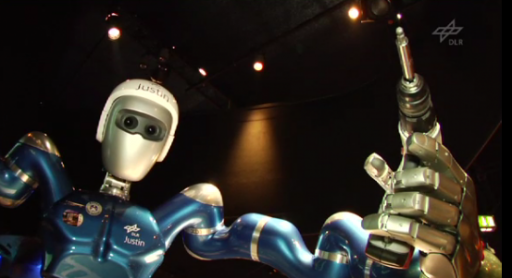
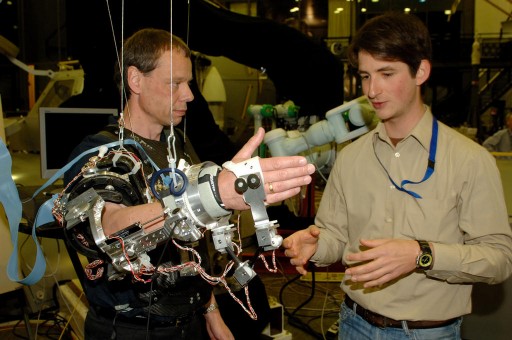
Meet Justin, an android on Earth who will soon be controlled remotely by an astronaut in the European Space Agency’s Columbus laboratory on the International Space Station. The astronaut will don an exoskeleton to remotely control Justin.
The long-range goal: explore the Moon and planets with tele-operated robots.

Suggestion: don't arm-wrestle with this dude -- I'm just sayin'. ESA astronaut Christer Fuglesang controls exoskeleton (credit: ESA/J. v. Haarlem)

Comments (6)
by Gus314159
This is a fine concept and all, but haven’t we sent enough probes and robots the the planets already ? For me, this has always been a major sticking point. I feel that the space program as a whole with it’s limited budget tends to nickel and dime itself to death by constantly sending probes and robots. I know there are a lot of people that don’t like this viewpoint, but we need to put the probes and planetary missions on hold and focus all of our efforts on putting boots back on the ground permanently on the moon. We need to establish a workable lunar base of operations that will start to pay for itself as it begins to grow. “Justin”, on the other hand should be mated to a modified MMU that’s been retrofitted with RTG thrusters. It could then be flown by an ESA astronaut much like an underwater ROV, and used to rendezvous with and capture space debris for de-orbit. I feel that would be a much more challenging and beneficial mission from a training and learning aspect.
by Khannea Suntzu
This problem should be manageable. First you make a few snapshots of the environment from up above. Using that data the boffins create a 3d representation of the workspace and load that in a similator. I’d call this voodoo exploration – first we sim the exploration, and reverse engineer what we all see …
and then based on these detailed extrapolations we send a set of safe and optimized instructions for that bit of environment we know to the exploratory device or devices. In effect that means we reduce “the theatre of exploration” to something like the most lucid game environment we can come up with.
A rendition maximized in information. It won’t work in very fast paced environments.(unless we have very smart exploratory devices) but this should be just fabulous on places such as teh Mars.
by Brian H
Already done with the Mars Rovers; about as good as you can get. Takes days to go a few hundred meters. Detailed control/planned movement is ultra-slow. Significant autonomy with general remote goal-setting would be about the best that could be achieved.
by rickschettino
Or Justin A Nickotime?
by SWP
Does he have a second name? Y’know, Justin Case.
by rickschettino
On another planet? The latency would be maddening.