IBM Research achieves new record for quantum computing device performance
February 28, 2012
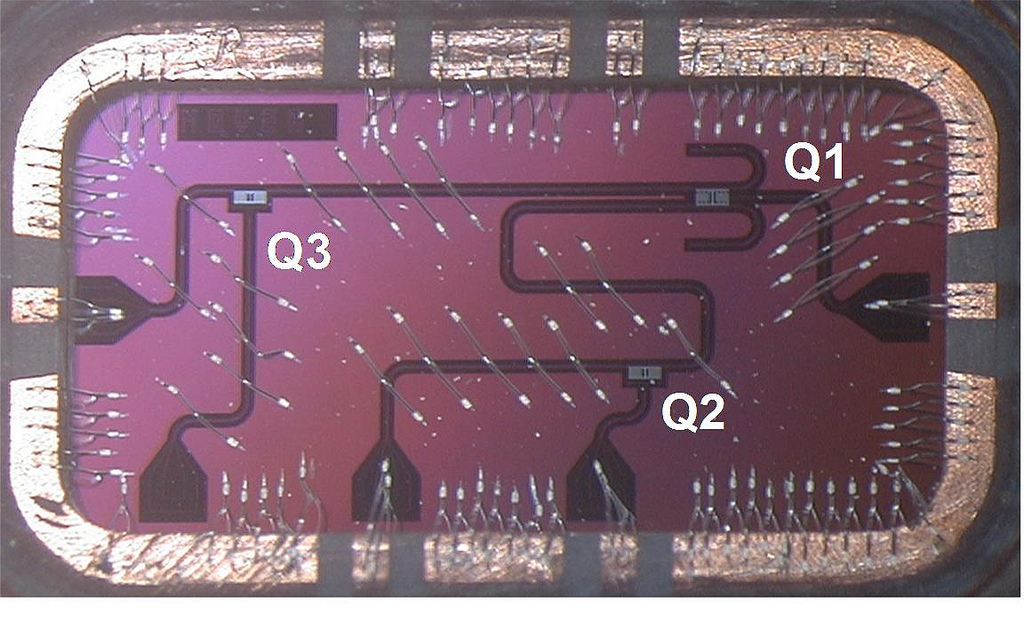
A picture of the silicon chip housing a total of three qubits. The chip is back-mounted on a PC board and connects to I/O coaxial lines via wire bonds (scale: 8mm x 4mm). A larger assembly of such qubits and resonators are envisioned to be used for a scalable architecture. (Credit: IBM Research)
Scientists at IBM Research have achieved major advances in quantum computing device performance that they say may accelerate the realization of a practical, full-scale quantum computer, with quantum states lasting up to 100 microseconds — a 2 to 4 times improvement over previous results.
The scientists have established three new records for reducing errors in elementary computations and retaining the integrity of quantum mechanical properties in quantum bits (qubits) — the basic units that carry information within quantum computing.
IBM has chosen to employ superconducting qubits, which use established microfabrication techniques developed for silicon technology, providing the potential to one day scale up to and manufacture thousands or millions of qubits.
IBM researchers will be presenting their latest results at the annual American Physical Society meeting taking place February 27-March 2, 2012 in Boston.
The Possibilities of Quantum Computing
The special properties of qubits will allow quantum computers to work on millions of computations at once, while desktop PCs can typically handle minimal simultaneous computations. For example, a single 250-qubit state contains more bits of information than there are atoms in the universe.
These properties will have widespread implications foremost for the field of data encryption where quantum computers could factor very large numbers like those used to decode and encode sensitive information. Other potential applications for quantum computing may include searching databases of unstructured information, performing a range of optimization tasks and solving previously unsolvable mathematical problems.
Quantum states up to 100 microseconds
One of the great challenges for scientists seeking to harness the power of quantum computing is controlling or removing quantum decoherence — the creation of errors in calculations caused by interference from factors such as heat, electromagnetic radiation, and materials defects. To deal with this problem, scientists have been experimenting for years to discover ways of reducing the number of errors and of lengthening the time periods over which the qubits retain their quantum mechanical properties. When this time is sufficiently long, error correction schemes become effective making it possible to perform long and complex calculations.
IBM has recently been experimenting with a unique “three dimensional” superconducting qubit (3D qubit), an approach that was initiated at Yale University. Among the results, the IBM team has used a 3D qubit to extend the amount of time that the qubits retain their quantum states up to 100 microseconds — a 2 to 4 times improvement over previously reported records. This value reaches just past the minimum threshold to enable effective error correction schemes and suggests that scientists can begin to focus on broader engineering aspects for scalability.
In separate experiments, the group at IBM also demonstrated a more traditional “two-dimensional” qubit (2D qubit) device and implemented a two-qubit logic operation — a controlled-NOT (CNOT) operation, which is a fundamental building block of a larger quantum computing system. Their operation showed a 95 percent success rate, enabled in part due to the long coherence time of nearly 10 microseconds. These numbers are on the cusp of effective error correction schemes and greatly facilitate future multi-qubit experiments.
Quantum computing progress
“The superconducting qubit research led by the IBM team has been progressing in a very focused way on the road to a reliable, scalable quantum computer. The device performance that they have now reported brings them nearly to the tipping point; we can now see the building blocks that will be used to prove that error correction can be effective, and that reliable logical qubits can be realized,” observes David DiVincenzo, professor at the Institute of Quantum Information, Aachen University and Forschungszentrum Juelich.
Based on this progress, optimism about superconducting qubits and the possibilities for a future quantum computer are rapidly growing. While most of the work in the field to date has focused on improvements in device performance, efforts in the community now must now include systems integration aspects, such as assessing the classical information processing demands for error correction, I/O issues, feasibility, and costs with scaling.
IBM envisions a practical quantum computing system as including a classical system intimately connected to the quantum computing hardware. Expertise in communications and packaging technology will be essential at and beyond the level presently practiced in the development of today’s most sophisticated digital computers.