IBM scientists discover new liquid molecular technique to charge memory, logic chips
March 22, 2013
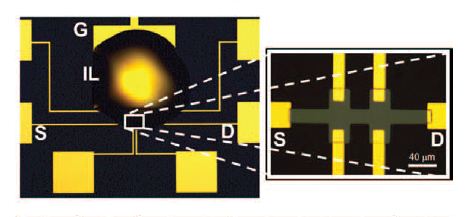
Optical image of a new device showing a droplet of the ionic liquid. S, source contact; D, drain contact; G, gate electrode. (Credit: Jaewoo Jeong et al./Science)
IBM has announced a materials science breakthrough at the molecular level that could pave the way for a new class of non-volatile memory and logic chips that would use less power than today’s silicon devices.
IBM’s scientists discovered a new way to power chips using tiny ionic currents, which are streams of charged molecules that can mimic the event-driven way in which the human brain operates.
Today’s computers typically use semiconductors made with CMOS process technology and it was long thought that these chips would double in performance and decrease in size and cost every two years. But the materials and techniques to develop and build CMOS chips are rapidly approaching physical and performance limitations and new solutions may soon be needed to develop high performance and low-power devices.
The IBM research scientists were the first to convert metal oxides from an insulated to conductive state using the insertion and removal of oxygen ions during the material characterization process.
Once the material becomes a conductor, the IBM experiment showed the non-volatile memory chip would maintain a stable metallic state even if the power to a device is turned off. This non-volatile characteristic means the chip could be used to store and transport data in a more efficient, event-driven manner instead of requiring the silicon to be constantly charged on and off by an electrical current.
To achieve this breakthrough, IBM researchers applied a positively charged ionic liquid electrolyte to an insulated oxide material and successfully converted the insulator material to a conducting metal. The material held its metallic state until a negatively charged ionic liquid electrolyte was applied, to convert it back to its original, insulating state.
“Our unique ability to understand and control matter at molecular dimensions enables us to come up with new materials that could one day stand in for silicon based technologies,” said Dr. Stuart Parkin, an IBM Fellow at IBM Research.
“We’re writing a new chapter in the future of computing with innovations — including looking beyond traditional electrically charge-based devices — to prevent the industry from hitting a technology brick wall.”
Metal-to-insulator transition materials have existed and been researched for years. However, contrary to earlier conclusions, IBM discovered it was the removal and injection of oxygen molecules into the metal oxides that was responsible for the state changes in the material.
The transition from a conducting state to an insulating state was previously achieved by changing the temperature or applying an external stress, both of which do not lend themselves easily to making chips.