Is ‘Big Data’ the next big thing?
August 13, 2012
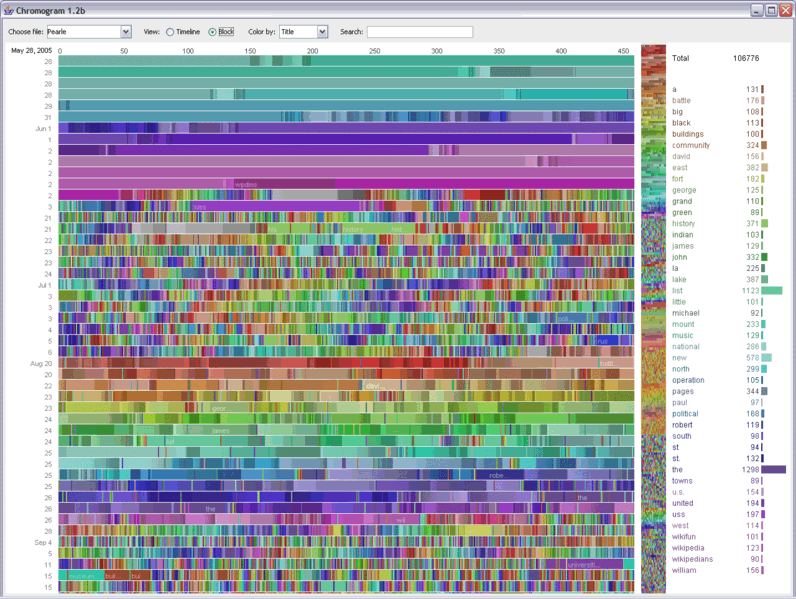
A data visualization created by IBM shows that Big Data such as Wikipedia edits by bot Pearle are more meaningful when enhanced with colors and position (credit: viegas/Wikimedia Commons)
This has been the crossover year for Big Data — as a concept, a term, and a marketing tool, as it enters the mainstream, The New York Times reports.
Big Data was a featured topic this year at the World Economic Forum in Davos, Switzerland, with a report titled “Big Data, Big Impact.” In March, the federal government announced $200 million in research programs for Big Data computing.
Big Data is a shorthand label that typically means applying the tools of artificial intelligence, like machine learning, to vast new troves of data beyond that captured in standard databases. The new data sources include Web-browsing data trails, social network communications, sensor data, and surveillance data.
In theory, Big Data could improve decision-making in fields from business to medicine, allowing decisions to be based increasingly on data and analysis rather than intuition and experience.
The Data Collective is a fund specializing in investments in companies doing everything from creating large, complex databases and faster processing of information from diverse sources, to applications that make use of novel and interesting patterns that might be exploited, another Times article reports. It already includes 35 equity partners who have a lot of experience in the field, and the fund has already made 46 investments.
And Smart Data Collective suggests five scenarios for how relationships between data scientists and IT could evolve.
Comments (2)
by Bri
The amount of data coming from your senses is staggering. It’s huge, let’s face it, huge means well um HUGE! Like the number of post on the cyborg article was huge in comparison to the small trickle of usual posts. It’s hard to read all those posts, and filter out the useless info, and get to the truth, or essence of what is being said. There usually is a lot of superfluous info. A lot like spam. Ray’s electric piano is like this. The old way to make a violin sound realistic. You would sample a violin played in every imaginable way, then draw upon that HUGE data base to make your keyboards sound like a violin. In practice it wasn’t so easy. To sift through all those samples and play the right sound, at the speed of a performance was impossible. At a lecture Ray gave at MIT, he described it as a data compression problem. He used pattern recognition AI programs that he was developing to reduce things down to thier essence. Like a spam filter, it cut through all the, can’t see the forest for the trees stuff, and just left the essence or the redux. Ray’s keyboard is still the best at achieving a realistic facsimile of other instruments, and the utilization of those AI principals to cut through all the bull, and see what patterns are really behind something. The unconscious mind is really good at that. Hearing is a really good example. In a crowded club, with music blaring, you can isolate a friends conversation. Like a spam filter, your mind can suppress all the non essential sounds, and hear the truthyness of what sounds you are really interested in. All data sets need to be mined. The larger they are, the harder for a human mind to mine them
by Mr.x
I once had a friend who said: Big data is big dumb.