Is growth over?
December 28, 2012
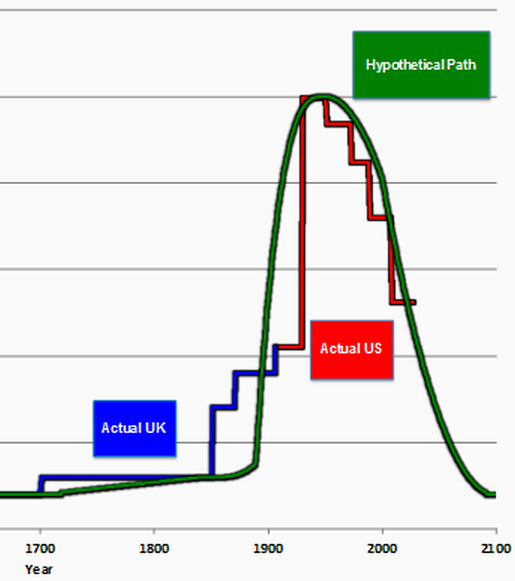
Growth in real GDP per capita, with actual (from .2 to 2.5 percent per year) and hypothetical paths (credit: Robert J. Gordon)
Global growth from the current industrial revolution (computers, the web, mobile phones) is slowing — especially in advanced-technology economies, and long-term economic growth may grind to a halt, Robert J. Gordon, Stanley G. Harris Professor in the Social Sciences and Professor of Economics at Northwestern University, has argued.
Now economist Paul Krugman counters in The New York Times that we are moving toward a world in which “Big Data — the use of huge databases of things like spoken conversations — apparently makes it possible for machines to perform tasks that even a few years ago were really only possible for people.
“Speech recognition is still imperfect, but vastly better than it was and improving rapidly, not because we’ve managed to emulate human understanding but because we’ve found data-intensive ways of interpreting speech in a very non-human way.”
However, he warns, while smart machines may make higher GDP possible, “they also reduce the demand for people — including smart people. So we could be looking at a society that grows ever richer, but in which all the gains in wealth accrue to whoever owns the robots.”
Interestingly, neither economist considers the effects of future exponential growth of hardware and software computation (and other tools) and the technological Singularity. — Ed.
Comments (144)
by craigtown61
This is propaganda fraud. Look at the date that the green line peaked, about 1970. What happened during that time that greatly attacked and destroyed capital accumulation which is the driver of economic growth as well as natural economic deflation? It is simple, look at the graphs you can Google on the inflation rate of the US. It takes off exponentially in the late 60’s early 70s especially under Nixon. Then add the neo-Malthusian anti-humanist Greens who have done everything to create an artificial resource scarcity that has done nothing but drive up the price of energy and all commodities. Their self-fulfilling prophesy is all based on getting everyone to believe that the world is ruled by the Law of Decreasing Returns, not Exponential Returns. Oils huge run up in price hit the GDP of the world hard! This is all a fraud to get you to believe their linear system of thinking. Krugman as a Keynesian is a linear troglodyte. It is the inflationary system itself that has covered over the incredible deflationary rate of technology. If the gov printing press were to stop all prices would plummet and growth would be exponential again, the very thing the UN and the Malthusians don’t want. Cheap abundant energy, commodities, etc. are a horror to them (Ehrlich et al.) Limited minds love limited systems in which they can cram a limited humanity into. Singularities are all about unlimited freedom of humanity. Valid economics upholds the singularity, invalid ones are designed to derail it.
by craigtown61
Kurzweil had one error in The Singularity is Near on page 100, where he thinks that inflation has been over estimated for decades. This is in fact an error, inflation has been greatly underestimated for decades especially since the great advance of science and technology in the late 50’s. If the Fed inflated the money supply at an average of 5% a year and the natural deflation rate of a freer market with increasing returns is creating a deflation rate of 4% a year, the economy would only register a 1% inflation rate in most products affected by the deflation. Thus the Fed could increasing inflate the money supply as technology took off greatly deflating the price of goods as the 20th century aged. The effect would be the under reporting of inflation as inflation is always the amount of money the FED pumps into the economy and not the costs of consumer goods. Since the Fed inflated prices 2,500% since 1913 the natural deflationary rate of the Law of Increasing and Exponential returns actually saved the US from a huge economic collapse decades ago, but the one thing the inflation did do was it caused all profits and prices to be artificially raised and it drained away capital thus causing a major slowdown in real growth. Inflation has been underreported as deflation, especially through technological development, has caused the real prices in terms of real wages to continue to drop even in the presence of inflation in increasing amounts. Valid Economics is indispensable to understanding this whole entire economic mess and to see the way clearly to a “utopia” for all humanity.
by eldras
If technology doesn’t make economics obsolete it will have failed to reach a Singularity.
by notthe1st
If you don’t participate in commercial/productive enterprises – you don’t get paid. This is the central tenet of modern economic systems. We do have (in most western countries) a safety net to keep folks from falling into abject poverty – but the basic ideal for everyone is to get a job or run your own business to pay your own way.
However here’s the rub – all productive enterprises are rushing towards the ideal of doing more with less. Year after year companies and governments are seeking ways to increase productivity and employing fewer people to get greater results.
Well the global population just keeps increasing. There are more and more people in the world and fewer ways to participate in the global economic engine.
I don’t doubt that as we approach the singularity there will be more than enough resources to enable everyone to live a decent life. But what do we do in the intervening thirty years as people become unemployed by the millions and all the profits accrue to the owners and managers of companies that don’t need real human beings in their factories, farms and virtual enterprises?
Hang on for a VERY bumpy ride kiddies.
by Blade
Hello notthe1st,
My thoughts here is to have the IRS eliminate the label employee and transition everyone to contractor status. The safety net will need to be privatized (Lively Hood Insurance share by both the contractor and company). If the Citizen United decision can turn corporations into natural humans for political reasons, then humans should be afforded the same option in reverse when it comes to employment (each citizen is a corporation when dealing with any company considering contracting with them for their services). This will allow for fair compensation across the board, allow the individual to cover overhead cost and a reasonable profit.
The problems of production and pay is being solved by technology, we just haven’t realized it yet. Take housing data-in essence, in its natural form it belongs to the property owner and they should share in the profits it generates. But, they don’t because they have been to willing to give it away for free because the current process tells them that it has always been done this way. Well, the information from the data they actually own generates billions of dollars when the data is aggregated. If a property owner is allowed to have a share of these profits, it alone will not make them rich, but it will be just one of many revenue streams that will help keep them from abject poverty and the economy growing.
It will be a bumpy ride, but it doesn’t necessarily need to be a long one. We will have to change our thinking where it concerns work and how we allow people to earn income. Let’s Get Going!
by craigtown61
Easy, create the Universal Productivity Fund (UPF). Instead of corporations and business paying taxes to government, they instead pay 20% to the UPF, in which every citizen has 1 share. These funds stay in the private market and are available for greater productivity, loan funds to start ups, R&D etc. In time this fund will do away with the need for retirement, welfare, school funding programs, etc. all funding by the political state through taxation will instead be done through the opposite, By feeding productivity and creativity all social problems will evolve away. The dividends paid monthly alone on a fund comprising trillions of dollars would eliminate all of the need based programs.
by Alastair Carnegie
NASA’s “Dawn Mission” 216 Kleopatra, a gigantic pile of rubble ore in the Asteroid “M” Belt. … How many cubic kilometers of which metal are you interested in? even Gold is no problem, but not too many cubic kilometers of that stuff. Iron? As much as you like!
by New Code Order
You all are way off topic. The question is:
Are there any more technologies that can be developed – in the short term, not decades or centuries – that would bring growth?
The answer is: No.
Growth (as we knew it during the past decades). Is. Over.
By all means prove me wrong.
by pt
Past decades have been spurred quite a bit by continual advances in computing, which show no signs of slowing down in terms of a reduction of price per computing power. Graphene processors are a short term reality which would be a pretty incredible leap. Making energy extremely cheap with rapid growth of alternatives before the decade end is also a real possibility, particularly if inexpensive nanotech infused batteries make an appearance soon.
by pt
3d printing also has massive potential. Turning from a goods-dominated marketplace to an idea marketplace may have pretty profound impacts.
by ChrisF
In general, ANY technological advance is sufficient to increase growth. It’s just a matter of finding a more efficient way to turn raw materials into consumable goods. Yes, the improvements are often just “incremental”, but the compounded effect is what’s driving the continued geometric rise in global GDP (that and our population growth of course…)
by Johan Liebert
The industrial revolution was an incremental step to shaping how we used the material we extracted from the ground. But the effects were lasting. It spurred the assembly line, precise measurements, efficiency, logistics, etc. Interestingly, workers at the time felt threatened by automation (even way back in the early 1800s) and so used a variety of methods to slow production. But with clear hindsight what can we learn? Technological progress is both a smashing of the prior ways of doing things so we may do more with less, but also a tool to develop new industries to employ these workers.
The real risk as I see it isn’t technology somehow sputtering out, or being unable to develop better or new industries (e.g. computers smashed old ways of pretty much everything but also spawned a new industry to support them). Rather, I see technological growth displacing ever smarter people as the threat. We keep forgetting that IQ is a bell curve. Take your average Joe and 1/2 the people will be stupider and 1/2 will be smarter. Technological change is causing the machine to displace ever smarter people, and these folks won’t be able to retool.
I think the moment the machines begin to displace engineers is the time we should really start to worry. Engineers haven’t lost the need to think and strategize yet. If that happens, we may as well inject ourselves with nanobots or upload our consciousness to merge with the machines, because we won’t have a snowball’s chance in hell of maintaining our inquisitiveness and ultimately stagnate (think Idiotocracy).
by Jimmy
Your wrong. Done that was easy.
by Sally Morem
The editor’s aside is important. Accelerating tech may make it possible for everyone to own their own wide array of production and service robots, including, nanobots, when they come into being. This, at least, is what I’m predicting At that point, all scarcities vanish and economics changes forever.
by Dale
Great observation. I’d add that vanquishing scarcity (a critical factor in evolutionary biology and natural selection) will occur when (not if) we solve the alternative (and inexpensive) energy conundrum (e.g. with solar, wind, geothermal, et al), which will “fuel” our robots and other machines, desalinate ocean water, etc. This was a thematic in Diamindis’ book “Abundance.”
by John Y
Technology drives fast growth but bad government policies trump technology.
by Vladislav
What nonsense!
Look at this chart:
http://newmarksdoor.typepad.com/.a/6a00d8341c9b9953ef0105356af946970c-800wi
So economic growth is something that is soooo predictable!
And read this:
Michael Clemens of the Center for Global Development provides some interesting perspective.
The entire effect of the 1994 so-called “Tequila” Crisis on per-capita real income of the average Mexican . . . was erased in exactly three years. In Thailand, epicenter of the 1997 Asian Financial Crisis, it took all of six years. In Indonesia, the poverty rate in the population was back to its pre-crisis level within just three years. Even the big, bad 1982 Latin American debt crisis, in this figure, looks a lot more like mean reversion: Yes growth was bad in Mexico after 1982, but it had been unusually high in the years beforehand, and the net result is that real income per capita simply reverted to its historical trend. The same goes for Thailand in 1997. Bad years are typically followed by offsetting good years, and good years by bad. The good years get smaller headlines, or none at all.
He also points us to this graph of real GDP per capita for the last 200 years of American history:
He writes:
Over these years we had violent financial crashes of various types, bank panics, piles of recessions and a huge depression, many foreign wars and one enormous domestic war, had a central bank and didn’t, were on the gold standard and weren’t, had governments topple in scandal and multiple leaders assassinated, and what did it all amount to in the medium to long run? In per-capita income terms: Nothing. The overall trend does not bend or shift. Every bad year was followed by a good year that returned us to trend. The US average growth rate of real per capita incomes over the last 190 years has been 1.8% a year, and the same rate over the last 10 years has been…. 1.8% a year. Stare at that graph: The Great Depression was traumatic in countless ways, but astonishingly, it’s not clear that we are any worse off today than we would be if the whole thing never occurred. Anyone who made such a claim in the 1930s would have been scoffed at, but that’s what happened.
by Editor
Thanks. Do you have links for sources?
by Vladislav
http://blogs.cgdev.org/globaldevelopment/2008/09/crisis-not-if-we-take-a-long-v.php
http://www.singularity.com/charts/page99.html
by Editor
Thanks, I thought that graph looked familiar :) .
by nicky
All true, but in the last 4 years the expansion of bureaucracy and regulation has been so big that western economies and some others are grinding to a halt. The system of price signals to steer economic decisions has been all but destroyed by central bankers.
There may not be any entrepreneurs left to bring new discoveries to the market.
So where is the economic turn around going to come from if no one is allowed to move without permission from the bureaucrats.?
by Boyd Martin
I think you are missing what is really being referred to here, and that is the undeniable fact that we live on an island with finite resources, without the mandate for concomitant interplanetary technology that would relieve any further demand for growth. Therefore, at some point–whether it’s in 20 years or 200 years, growth must stop or be reversed. Intelligent economic thinkers such as Charles Eisenstein, advocate reframing human expectations as a way to head off the inevitable future pain and suffering of dwindling resources. He asks, Why not use the machines to create leisure, rather than more labor? After all, that’s what they are usually invented for. Why must we all work like hamster slaves? Of course this requires re-imagining money, but isn’t that a lot easier than continuing to figure out what people can do for “work”, and certainly a lot easier than developing the technology to mine and ship interplanetary resources.
by mike white
The one depressing thought I haven’t seen as a solution to overpopulation and increasing unemployment in this thread is war. Nation States have an unpleasant propensity to send their surplus youth off to war. China has an unhealthy overabundance of single unemployed young men. That is a very dangerous scenario.
by Christian Gehman
“All the gains in wealth accrue to whoever owns the robots.” — Didn’t this already happen? But alas, the truth is that “all the gains in wealth” have accrued to the super rich wealthy elite, whose highly paid lobbyists have managed to give a tax regime that lets them pay tax on their income at rates ranging from absolutely nothing to about a tenth of what the middle class pays. You might read Ferdinand Lundberg’s book The Rich and the Super Rich for a cogent look at the history of the lobbying efforts that created not only these legislative initiatives, but also a large super wealthy elite class; and in fact the most important result is that the insane tax breaks for the wealthiest Americans passed in the name of “job creation, did in fact create jobs — overseas! — and bankrupted or impoverished American government on every level from local school boards and town governments on up through city, county, state and federal government. And see this article relating to how H1-B visas robbed American knowledge workers of $10 trillion dollars over the last few years — by giving jobs to foreigners. http://www.thesocialcontract.com/pdf/twentytwo-three/tsc-22-3-nelson.pdf
Again, the owners of the companies benefited, and the American people paid the bill. It may no longer be true that the best driver of investment is increasing demand in a vibrant, thriving, prosperous economy — as long as most of the money goes into the pockets of the rich and the super rich. It seems to me that those people declared war on the rest of us fifty or sixty years ago, and now we’re going to suffer while they keep laughing all the way to the bank.
by Christian Gehman
Further to the point about offshoring knowledge worker and data processing jobs — and completely overlooked thus far in all conversations about the health insurance mandate known as ObamaCare — is the most important question of all: where will the jobs live? For example, when Anthem Blue Cross was purchased by (primarily) Indian investors, Governor McDonnell in Virginia forbade the overseas transfer of many back office jobs. To get around the governor’s prohibition mandate, the new Indian owners of Anthem Blue Cross transferred the jobs to Illinois, parked them there for six months or a year, and THEN shipped them overseas. Problems like this could be addressed with legislation at the federal and state level. If they are not addressed, then a huge source of jobs for American citizens will quietly and in many cases covertly move offshore — to India and the Philippines. This is the true travesty embedded in ObamaCare, and — so far! — no politician has ev en mentioned it. No provisions of the Interstate Commerce Act can be construed as requiring Americans to compete for work with low paid workers in India. The Obamacare health insurance jobs — and all the data — should be kept here in America. Wake up — this multi-trillion dollar heist is waiting to happen, and it will happen on your watch unless you actually take the time to do something about it.
The same is true for Student Loans — much of the student loan processing and many of the data centers are located overseas (to the Philippines, among other places). Money paid out in wages overseas rarely has a positive effect on stimulating demand in America. Stimulating demand creates the need for investment in manufacturing that will help satisfy that demand. Tax breaks create wealth — and often the wealth decides to invest itself overseas. Tax Breaks do not stimulate the demand from the middle class consumers that is necessary to stimulate investment. So when American wages level off for 30 years, eventually the American economy staggers into a prolonged period of malaise. The plain fact is that America has been paying its wealthiest citizens too much for the last 50 years. Even Warren Buffet agrees that what we need now is not a minimal tax for the wealthy – or no tax at all! — and here’s the link: http://www.nytimes.com/2012/11/26/opinion/buffett-a-minimum-tax-for-the-wealthy.html?_r=0&pagewanted=all&gwh=
by trakk
Its not a solution….its an inevitability.
by Deleo77
I don’t think there will be more war, because wars often come about when there is too much demand for limited resources. I think the future for many countries will look like the way Japan is now – slow growth, low demand, aging populations. I am not sure that is a recipe for war. No matter how much the government tries to loosen monetary policy, it won’t create growth because there isn’t a demand for workers, no matter how much money gets thrown into the system, because everything is automated.
I am not one for banging the raising taxes drum, but it would seem that the best solution is to raise taxes on corporate profits over time and require them to bring their profits back into their home countries. It would create a society where corporations with trillions of dollars of profits would pay taxes to the government and the money would be distributed throughout the population. That sounds a lot like socialism, but pure capitalism with a huge labor force is going to go away. So some hybrid like this has to exist, and keep in mind, corporations will need this system at some point to maintain demand for their products. Their profits will ultimately come back to them with new purchases. They will also be able to make things with fewer workers, and they will be taxed on their profits only. It could work, but everyone will still have to figure out what to do with their free time while the robots and AI make everything. Hopefully that doesn’t involve starting a war.
by New Code Order
Judging by what’s (not) happened over my lifetime, it’s over, folks.
There’s nothing to discuss.
Get over it; It’s OVER.
by Michael
I worry about the inherent laziness in people when most is provided by automation. Capitalism works for very dirty humanistic reasons. It spins up innovation and productivity by priming our desire for survival.
by Ian Clarke
I don’t believe people are inherently lazy. Given the time and resources to educate themselves in their favoured fields (rather than mind-numbing menial work) will lead to a speeding up of innovation and creativity. This is what I see in our futures – everyone having the opportunity to contribute, and doing so for the buzz/satisfaction – the problem-solving mammal in his/her element. At the moment, I believe a lot of creative minds are being smothered. An age of abundance will release these minds for all our betterment.
by OsirisX
I agree. With soul crushing work lifted off our backs – a lot of creative output will be released. There are a lot of people who are unable to give their creative gifts to society because of our mind numbing labor system. I think creativity will skyrocket along with innovation.
by Nebby1989
By democratization of technology. We are already seeing it with computing and programming through easy to use development platforms. It’s just a matter of time before the average person can influence the capabilities of robots. I could imagine a cloud sourced robotics platform in which all the capabilities of a type of robot come from suggestions from the cloud. In this way no single individual will own all of the ideas programmed into a robot in the same way no one owns all of the videos on YouTube. There will always be room for improvement no matter how advanced AI becomes, seeing that at some point in the near future AI will be advancing our own intellectual capabilities if it isn’t already.
by John
Maybe too prejudiced, but when hear “economist”, i see someone who doesn’t know what he doing or saying.
by steve
I agree & Krugman is one of the worst.
by Tony Stender
Human life requires movement, choice, exploration, discovery, knowledge, education, skills, abilities, production, and finally self esteem. Or not.
As some above mentioned, we humans have never quit solving problems which enable our ability to exist and excel at our chosen venue.
Viola’ education which used to be the privy of the wealthy, is now on the front burner of those who would enlighten the masses in return of course for their earned portion.
The education of the planet has already begun and the results are obvious in those places which have seen the light at the end of the tunnel effecting their worldly presence.
And so, I think the news of the demise of the growth of intelligence, knowledge, and wisdom, has been incorrect by some exponential as yet to be seen.
Thank you for that keenly accurate, and shared observation Ray Kurzweil.
We can now all go back to work or sleep as the case may be. Chuckle!
by Rick Lewis
I rather like the comment that Ricker made in one of the Star Trek – Generations episodes. “We live to better ourselves.” This was the model whether it was bettering oneself in art or music or literature or knowledge or other experiences.
Abundance can and should afford the vast majority of people on Earth the ability to live to better themselves. This will not an easy way forward, I would imagine given that there remain many different visions of betterment and not all of them tac to the Western European Enlightenment model. However, the potential is there.
It will require in this Nation (USA) a government which is even more responsive to every citizen and not less so. Currently our government is owned by a handful of interests and for Abundance to become a reality the politics will have to change.
by Gorden Russell
You’re right on target, Rick. Government needs to be more responsive to every citizen.
Check out the December 10th issue of “The New Yorker.” On page 29 there is an article discussing the work of British economist Arthur Pigou. In his book, “The Economics of Welfare,” printed in the year 1920. Pigou points out that certain products create social costs, such as alcohol and tobacco, and need to be taxed to pay for the social remedies of these problems. The article discusses carbon taxes, such as Australia and Sweden already have. But this policy must also come to apply to robots. Robots must be taxed so society can care for those thrown out of work.
While we’re at it, let’s talk about taxing assault rifles and large capacity magazines. They create great social costs that must be paid for.
by Robert Pike
Growth should be over. It must be over. Our planet is not growing. Our resources are not growing. Yet our population continues to grow by more than 200,000 per day. and our pollution and reduction of resources continues to grow as well. Until we get to ZPG, and stop talking about “growth” as a good thing, we will continue to suffer.
by JC
But who represents the Unborn? We are creative enough to plan huge tax bills for them and to pollute their world. So now our solution to all the suffering we created is to ZPG them? or even further to NPG them? Our only way out of this mess is Abundance and that means more young people.
by Robert
ZPG doesn’t mean no children; it simply means the equalization of births minus deaths. Every day nearly 1/4 million MORE are born than die. This is unsustainable. All I’m suggesting is that we plan fewer children, and plan them later in our lives, when we can afford them. Until we stop growing more and more will share less and less and fight harder for the right to do so. This cannot continue without disaster for us all. You think the ‘only way out of this mess is abundance and more young people”? Malthus said it over 200 years ago; “as the quantity of life increases, the quality of life decreases”,
by Robert
See this; http://www.worldometers.info/world-population/ The more we “grow” the more we suffer. More and more fighting for less and less. The Religulous will continue to kill in the name of God…if you really love children you plan for them, and educate others to do so. The point of the article is that we might not continue growing economically; all I’m saying is maybe that’s a good thing.
by Kyle Rybski
As it happens, as the quality of life increases, population growth more quickly approaches zero.
by Robert
See this; and contribute to Zero Population growth if you love children
http://www.populationconnection.org/site/PageServer
by VoirDire
But this data is just a snap shot…..its the trends that matter. Simply put, fertility rates are crashing around the world except in Africa. In 1970 India, Mexico and Brazil had fertility rates of 7-9 per household, now they’re in the 2-2.5 range….merely replacement. In fact, look up fertility rates on Wikipedia and you’ll see that >100 countries are below the replacement rate. Now, Africa accounts for 9 of the top 10 fertility rates (mostly >6/household), but (a) that is a temporary condition, those rates will start coming down in time, and (b) its Africa…
by trakk
But job opportunities are falling even faster and resource availability (necessary for agriculture and manufacturing) is getting more erratic…..hence the rise in global unemployment.
by Will Jones
The unborn dont exist.
by Gorden Russell
Only a government with the power of Red China can limit the numbers of children born. People in starving countries see children as their only social security program.
But, Robert, when the poor are raised up to the middle class, they will have fewer children by their own will.
by dwk67
There is no problem with growth if we start to move out into space, first for resources, and then for settlements. There is an inifinite amount of wealth waiting out there for us if we dare to claim it. If you told someone in july 1969 after Apollo 11 landed on the moon that NASA couldn’t even launch men into orbit in 2012, they would have thought you were nuts. All the planetary challenges we face now are things we will have to learn to solve in order to be a successful spacefaring civilization. We are capable of doing so, but are we still bold enough to do so, that’s the question…
by George Grant
When I say “growth”, I mean efficiency. What do you mean? Post industrial countries have negative population growth. Perhaps when the world is post industrial, world population will decline.
by Nyk
Peter Thiel made an argument along the lines that growth is slowing down because all of the low-hanging fruit of science that current human minds could grasp have pretty much already been grasped.
IMO the solution would be to improve the quality of the minds doing the science. Human cloning should be top priority, with the end-goal of mass-producing Einsteins, Feynmans, von Neumanns to discover and build the things the rest of us cannot in the present (potentially including AGI that is also friendly)
With ~10 years to develop safe human cloning procedures and ~20 years of maturing for the genius babies, in ~35 years we could be on our way to the Singularity.
by Gorden Russell
Sounds great, Nyk…but can we get viable DNA of Einstein? His brain has been preserved, but was his DNA denatured by the process?
Maybe we can get by with all the great minds that are alive today. Our peerless editor here brings us learned papers every day by great minds working all over the world. They can get us to the Sing.
by advancedatheist
>IMO the solution would be to improve the quality of the minds doing the science.
That conflicts with the diversity ideology promoted by our elites. White and Asian MEN tend to dominate technological fields for a reason, and when the state steps in to enforce “diversity,” then progress in those fields effectively stops.
by GrahamRounce
Oh I see! It’s not The War Against The Robots, it’s The War Against The Owners Of The Robots we should be preparing for! It’s obvious now – ok, let’s get going!
by Gorden Russell
Don’t laugh GrahamRounce, this just might happen. There could very well be a future where armies of the unemployed march on the Boston Dynamics and General Robotics plants. The gates will be guarded by Berserker robots, straight out of Fred Saberhagen. Robots will march straight from the end of the conveyor belt to rush to the fence line and dig in. They will be armed with guns made by 3-D printers.
To deliver the robots, armored convoys will be needed. Tractor-trailers will have a pintle-mounted machinegun on the cab and Gatling gun turrets at each end of the trailer, with waist-mounted sponsons for machineguns to hang out over traffic from port and starboard.
by Whittaker
I would like to point out that you don’t need to kill these people. You can anesthetize them, then upload them for free. Or, if the superintelligence is not as benevolent, they can be confined in pods where their biological brains are used as very effective parallel computers (if there is indeed some subtle function of biological brains that non-organic computers cannot emulate). I’ve read a book about the movie Matrix, in which it is suggested that (if something akin to the movie’s scenario happens in real life) the human beings in the pods can’t really be used for electricity (human bodies can’t produce more energy than it consume), rather, they are used as biological computers that helps operate the (in the movie, successful) fusion reactors.
by mises
Need jobs? Ban farm machinery
by Gorden Russell
But no Americans want to do the farm work of today, mises, let alone the backbreaking drudgery of chopping weeds with hoes and bringing in the sheaves with a knife, (even if you are joking). That’s why people from south of the border risk crossing the desert to take those jobs.
by tim the realist
In Chine they use people armed with shovels to dig instead of heavy equipment. If the people had to use teaspoons there would be even more “jobs”. This expensive approach can only work in non-capitalist economies where inefficiency is encouraged.
by richiemobile
Sorry, I posted the Krugman article in the Forum without reading the lead article of the day. on automatic pilot..I guess.
I believe that just as in the past, more efficient ways of meeting our needs has
led to improviement in the lives of the human species. From the stone ax, planting seeds, all the way up to the AI that is emerging, all these technologies have been improvements in our species ability to thrive over time. I believe that humans will adapt to adjust all technologies to their benefit. We created money and the work ethic, we can create more creative and productive ways of measuring our activities. My late father, was a teacher and a coach, and taught and grew hundreds if not thousands of lives through the discipline(s) that he had at his disposal. He was never compensated for most of his lifes work, but he accomplished things in peoples lives that benefitted them, and everyone knew iPerhaps, we can find new ways to measure contribution in our society, and be rewarded in different ways. I don’t know. You can be the owner of billions of dollars and in the end have nothing to show for it…
As always, I could be wrong.
r
by Gorden Russell
No, you’re not wrong at all, richiemobile. There will continue to be good, caring, sharing people in the future who will teach and coach and make a difference in the community…and there will always be the greedy who are never satisfied. Just look at the Koch brothers. Between the two of them, they have over 32 billion dollars. Yet all they do is to complain about other people. It’s not enough that they have won, they have to see everybody else lose.
by follower
Gorden,
You don’t know the Koch brothers, do you?
Maybe you regurgitated something you may have heard.
Maybe you think they have “enough” and think you are entitled to some.
But here is some information of people who have wealth:
Other than a lottery win, wealth is obtained by knowing how to obtain wealth.
When one knows HOW to do it, one can keep doing it.
Money DOES make more money; especially if it is handled by someone who knows what to do with it.
This synergy makes millionaires and billionaires.
Everyone has their own reason to retire from making money or to continue.
by Gorden Russell
There is a lot about the Koch brothers in the news, follower. They just can’t stay out of the headlines.
by follower
If someone accumulated a billion dollars, wouldn’t he have the billion dollars “in the end”?
You make HAVING a billion dollars seem so worthless.
But people of wealth are generally “giving people” throughout their life and smart enough to plan what their Estate will do with the wealth long after they are gone.
So what they have left in the end is all the good a billion dollars can bring to others. Last time I checked, a billion is…. a lot of money.
(you could almost buy a Congressman)
by Gorden Russell
Not “almost,” follower. The Koch brothers put a lot of money into a lot of Congressional campaigns and they support a lot of think tanks that inject a lot of anti-Progressive propaganda into the media.
by Will Jones
They are against the policies of the progressive left that demand more and more centralized control. The propaganda comes from the progressives because most would not buy into their ideas if they werent spun and frosted. The problem is most dont connect their progressive vote with the conditions we have today created by progressive policies. They foolishly think more progessive ideas are need and implemented.
by trakk
I wondered about the same thing on another site a few days ago.
In my opinion it isnt over yet, but it will…….sometime this decade.
.
Europe and UK, japan? are already in a recession. China and india have slowed and dont look like picking up a lot without the west doing so. And in america tax increase and spending cuts will furthur slow america down.
The purchase of houses and cars can only do so much to lift the economy without permanent jobs being added to the economy. And even they will get affected with TI’s and SC’s.
Big data and robots and AI will create jobs in the short term but will only eliminate even more jobs in the medium to longer term.
And fewer and fewer music and movies and television shows are being made year on year (i read about this somewhere). Even sport is getting stale and boring. These stuff play a huge role in keeping hundreds of channels, newspapers and the sales of electronic devices alive.
The way i see it, we could face a great depression this decade.
by braekmans
What we need is IA (intelligence augmentation). Why is there so little research done on people with the “autist savant” syndrome and investigated how we can upgrade cognitive abilities in people who wish it from these data. There should be massive funding for the research on people with the savant syndrome.
by Chris
Krugman who usually gets it totally wrong is less wrong than Gordon in this instance. Two countervailing megatrends to the “New Paradigm” they worry about are 1) on line education which is coming on fast and 2) increasing G at the molecular level and / or with non carbon enhansements both of which will take longer. It would obviously be nice if the latter could come sooner than later.
by Fabian L.
RELAX! My theory for the next 100 years in five easy steps solves everything:
1. A much needed massive near-extinction event takes place within the next 25 years. Everything screeches to a halt.
2. In the 5-10 years that follow, tribes of survivors bond together and migrate to select pockets of the planet.
3. Vast survivalist-oriented knowledge is transferred over social networks; this ignites a sustainable-living renaissance.
4. After a 30 year period of stability and ‘kumbaya my lord’ inspired unification; someone gets greedy.
5. Repeat Step 1 but this time: Game Over.
by trakk
We are already on that path. Something similar also has happened once in before in the 14 th century
by Tom B.
It seems clear that capitalism is about to run its course. Socialism has failed in the past because people won’t work if they can’t get ahead as a result of their effort. Well, guess what, they don’t need to work anymore (or won’t soon). We can automate any job that nobody wants to do for the love of it.
Space is a great idea. Right now, we’re stuck on this rock — not a great strategy for long term survival of our species. If we don’t kill ourselves in the transition to what Michio Kaku calls a Class 1 civilization, we’re gonna need more real estate.
by Gorden Russell
Yes, Tom B. I’ve always said that nobody works harder than the man who works for himself. Even after robots take over all the factories, there will be creative young people designing new products. They will sell their designs over the internet for a few bucks to people who will print out the new wares at home. Aren’t there already people selling new smart phone aps from home?
by Gorden Russell
Also, Tom B., for the short time we will get more real estate by using graphene to filter salt from seawater and turn all the vast deserts of the Earth green.
Long before the deserts are filled up, asteroid miners will succeed and raw materials will be brought down from orbit, or even smelted and cast into finished products that can fly themselves on down for a soft landing.
Without a doubt, sometime after the Singularity, after the mid-point of this century, there will be billions of robots building millions of interplanetary ships in the Lagrange Points.
Robots will bring back carbonaceous asteroids to geosynchronous orbit and grow perfect cables of carbon nanotubes to lower to the surface for space elevators.
Starships will be built after that. With fusion power, massive charged particle accellerators can thrust gigantic ships at a steady one gravity. At that rate, it only takes a little more than a year to get up near light speed. Once that is achieved, all stars are in range.
Just go look up the “List of exoplanetary host stars” at Wikipedia. I can only find time to look at the list on Sunday afternoons. I’ve been doing this for a month now and still haven’t gotten through all the stars of spectral class “G.” There are so many, why bother with stars that are too hot or cold for our type of life? Our Sun is class G2, so stars from G0 to G5 would be like the baby bear’s porridge for us.
by james
What about the whole idea of ai merging with human intelligence?
by road_runner321
Capitalism is based on the rarity of things and competition for finite resources. The rarity of things is due to the energy required to make them. Once we harvest more energy than we can use “price” will become meaningless because anything can be had for the cost of the energy required to make it, which will be vanishingly small.
by Gorden Russell
Right, road_runner321, robots powered by hydrogen made from solar energy will make everything so cheap, that anyone with a job will be able to buy what they need…but the robots will have all the jobs. So the robots must be taxed to support the unemployed.
by Whittaker
Ray Kurzweil said, in his 2005 book, that the full colonization process (for the whole universe) can be done “well before the end of 22nd century”, assuming that FTL is possible.
If that is the case, the GDP graph on this page is certainly inaccurate (Actually, I think it is inaccurate even if FTL is impossible: just one asteroid from asteroid mining should bring enough wealth to produce a mountain that is at least as tall as the 20th century peak on the graph).
by Bri
Honestly, the area of economics is still a soft science. Part of what we need to do right now is develope more accurate computer models of how all economies work. It’s still pretty much a black box. We can’t figure out how to control it, if we don’t understand how it works fundamentally. I hear pundits from all sides screaming that we should be doing this or that, but in reality we don’t know what effects any actions might produce.. All the research organizations and universities that delve into this issue should, pool their efforts and make realistic simulations that we can use to, probe possible solutions, and see their direct effects, without wasting time and money on real world tests. This in essence was the major issue of the last election. Two different views on how to fix the economy. Without an accurate model for forecasting we are just playing craps.
by Rob
Sorry but that’s just wrong. You can’t quantify economics because, at it’s base, economics is about human action. All we can really say is that people act, they act to meet some need or want and that they rank their needs and wants according to some internal scale. You tell me how to quantify an inner value system that most people can’t articulate, much less think rationally about. Mathematics has no meaning when you’re discussing things like this, it’s also not able to be empirically tested, which is why economics is classed as a “soft” science.
by ChrisF
It’s simple to quantify the “inner value”, Rob – simply measure how much money people are willing to spend to obtain the particular good or service. You don’t need to ask people to describe their value systems, simply observe their behaviour in the marketplace. Economists have known this for hundreds of years.
by Rob
You’re getting a medium of exchange, money, confused with what people demand. It’s not so much money that people want, it’s a good or service. Money is just the medium that we use to exchange one thing for another. Most people forget that which is why we get idiots like Krugman. For example, let us say that you enjoy the Superbowl. It’s something that I am indifferent to. You may value tickets to the game whereas I would not be as enthusiastic about it. In fact, I may choose to exchange my tickets for something that I am interested in. That’s what I mean by inner value system. We rank wants and needs according to a value system that is unique to the individual. That’s why you really can’t apply mathematics to economics. Consider that most people do things without being able to explain why. How you do measure that mathematically? You can’t.
Sure this idea goes back to the Scholastics of the School of Salamanca, but when you have positivists like Krugman spewing their nonsense, things can get confusing. It’s not like this stuff is taught in our government-run schools. What may seem like common sense to you and I could be mind-blowing to someone who has never been exposed to these ideas before.
by Micahel B
Human behavior can be modeled, we do it all the time when we predict that a loved one will like a particular present, for example. The issue is the complexity of the mass of human interactions that make up the economy i.e. the problem is largely intractable. But even theoretically intractable models can be approximated. Although, an approximation might not be very useful (or even misleading) for a specific application or question.
by Wholewitt
Rob, you seem to think that economics cares what particular item or service you or someone buys, it doesn’t. So individual values are not that important. Money and credit are the best measurements of activity, the use of which is an aggregate human activity. This can be measured or tracked by math.
Growth is extremely complex and that is something I think will end overall. With the enormous global population, the demand for growth will increase while the need for workers will be replaced by automation, AI and robotics. Societies will need to figure out what to do with the excess humans, they can’t all work from home. A simple example of that is to ask how many Apps do we still need for smart phones and tablets?
by Bri
Right now there is enough information obtained by the IRS and law enforcement, to simulate all commerce in a computer model. It won’t be one hundred percent accurate, but it would be insightful as to how things might react. The degree of accuracy could evolve to be very close to actual events. To some extent it seems like an invasion of privacy, but it also seems quite replicable. The information gleaned from running simulations would be invaluable to unraveling what to ro in the future. I think predictive economic AI type programs need to be evolved, and that VIKKI will help implement feedback and control to our economy. It is consumer based, giving more buying power to the consumer will turbocharge it. It can be regulated from privatized interests, or governmental systems. Either way it’s symbiotic. Both ways need strong feedback loops and oversight. Each and every way needs a clear understanding of what happens if certain aspecks go awry. We need more attention to these issues.
by notthe1st
Gee- there’s a streetlight over here so here is where I’ll look for my wallet that I lost OVER THERE.
Yeah guys – economics is concerned with money and credit and trade deficits and things that can be measured. Some heavy duty math comes into play. But economic theories and systems are the RESULT of human activity and aside from some overly broad generalizations about human behavior economics is not a proper gauge by which human behavior is to be controlled or measured.
Honest-to-God, flesh and blood, people are what makes any set of social arrangements work and persist and if the great mass of people decide that those arrangements are not working in their best interest – well here come the pitchforks.
Unfortunately, today, too many people are finding that the roads designed mainly for the use of big rigs (aka multinational banks and companies) are not designed for them.I can’t get a income tax rate of 0-15% because I don’t earn enough!
You can’t predict or fine-tune human behavior. People are the wild cards in
the human equation. If we could predict the arrival of folks such as Ghandi, Nelson Mandela, Steve Jobs and Mark Zukerberg – life would so much simpler. But an unknown farmer in Tunisia set himself on fire and the entire Middle East was thrown into turmoil.
Economics is a system designed by men for the benefit of men. If we just put people first, the rest of the variables will fall into place.
by Daniel LaLiberte
Who will own the robots? How about everyone? We are already moving in that direction, with personal computers per person every increasing. We could also increase the inequities between rich and poor, but that has got to stop.
There will always be more work for people. Though everything we have today may become all but free, there will always be new things (and some old things) that are valued more, and always more creative work that people will be better at doing than computers for a long time.
But, we have an enormous amount of work to do in the next few decades to switch over to 100% renewable energy and 100% recycling of all resources, and to restore the balance of nature. Yes robots will be a significant part of that, but they will not replace us, and more likely, we will integrate more intimately with our creations and with each other, just as we are connecting here on the ever-growing internet.
by Gorden Russell
Yes Daniel, we will get into the hydrogen fuel economy as photovoltaic cells, fuel cells, and fuel tank hydrides become cheaper and more efficient.
Just imagine the ten million vehicles of Los Angeles County all running on hydrogen with nothing but water vapor coming out of their tail pipes. This just might raise the humidity in L.A. It might actually rain in Southern California.
And yes, the robots will have a great deal to do with all the recycling. They will have the ability to sort out every last bit of waste and scrap. They will put all organics into compost and melt all plastics and metals back into raw stock. Some cities and counties will even have their robots manufacturing the goods that local governments need for their daily operations.
Once robots can build copies of themselves, it will be economical to have them start mining old landfills for the copper from broken electric fans and the rust deposits made from food cans.
by Rob
Things wont become free, but they will become less expensive. That’s what makes studying futurist technology so exciting from an economics perspective. As prices for goods and services fall due to the influence of robotics, the standard of living of people will increase. What people will need to do is find new ways to make a living. One of the things Krugman, et. al. are doing is deflecting notice away from their failed policy and are attempting to change the paradigm and blame “progress” rather than their own ineptitude for the current crisis.
by Thorsten
Yeah well, having to deal with abundance of free time by automating 90% or more of all processes necessary to sustain human life and sharing that among all is essentially the easy and most achievable way out. There might be transitional pains of unpredictable Magnitude involved but we could very easily reach an Age of wealth being a Term only Describing what you have ON TOP of having all your Basic needs met, and abundantly so, Within the next 15 years if we Would actually want to. Also, trying to predict the Future by Looking at small slice of time and projecting Forward indefinetly was Never a Smart move. Exploitation of near-earth objects for resources might be the next step of industrial Revolution and Start as early as Within the next 20-30 years.
by PirateRo
I like the “sharing among all” comment and the sentiment it expresses but do you really think that will happen? Or will it be a small handful grabbing as much as they can as fast as they can? Because there’s history to demonstrate the latter..
by Gorden Russell
Right, PirateRo, the owners of all the great industrial robots won’t want to share and they will tell the members of Congress that they own to obstruct all efforts to levy taxes on the robots to support those they throw out of work. But there will be a big disaster if the robots don’t start paying the Unemployment Insurance and Social Security taxes of the people put out of work by automation. When their Unemployment Insurance benifits run out, people will become homeless. When they are forced to live in their cars, they will have to leave most of their possesions out on the curb. They will have just enough room to pack some clothes, photos, and guns.
There are 300 million guns out their in the hands of 47% of the population. Most of these gun owners now vote Republican. What will they do with all these guns when they are sleeping in church parking lots waiting for the food bank to open in the morning? They won’t “go gentle into that good night.” These people are fighters. “They will rage, rage, against the dying of the light.”
by Gorden Russell
Just look at how people spend their time now, Thorsten. If the government can respond to the crisis and give people Unemployment Benefits that last until age 65, then a lot of people will just stay home. Many will spend a lot of time playing video games or going out in the street to shoot some hoops.
But some will enmesh into the world wide web and spend their time learning and creating. They will provide low-cost designs for 3-D printers, and later for self-assembling photovoltaic carbon nanocells.
Of course, there will still be serious problems. One student has already printed out a simple medicine. When criminal gangs get these printers, they will flood the streets with cheap meth and crack. Also, they will be printing out guns. Cities will need a lot of robot cops to deal with this. The first of these will be war surplus robo-soldiers built by Boston Dynamics.
In time, cities and counties and states will be printing out robots from open-source designs provided by out-of-work post-docs.
by OsirisX
I predict a creative explosion. People who were unable to share their talents will now be free to explore and grow their creativity.
by bodazyphir
@tim the realist
It can be stopped , it would however mean we would have to go backward. The biggest problem we are going to have to tackle is the change in mindset from “You have to earn/pay for whatever you get” to “You just get whatever you need when you need it”. As labor is automated the cost of production will plummet and we will have to move to a society where people stop “owning” things like houses and cars , to one where these things are built by robots and made available for human use. We will then have a human population unfettered by the need to provide for their own survival and free to focus on higher concepts. Designing the technology to accomplish this seems easy in comparison to making the world understand that this is the future …
by PirateRo
I actually do not accept the premise that this can be stopped.
I think to stop it, you have to be something other than us and eventually, something else will evolve into something like us and crank this thing up again. I think we need to have the conversation about the impacts this has already had on the economy and how we employ 7.2B people productively.
by Roland
We will then have a human population unfettered by the need to provide for their own survival and free to focus on higher concepts….
Oh yeah something like “Dude, I’m f**king bored. Got some drugs?”
Most people need concrete goals in life to strive for to stay mentally healthy and happy. It’s just like physical exercise, without it you deteriorate.
by Gorden Russell
F’sure, Roland. There will always be drug abuse, and rumors of drug abuse. But in time, if they survive the cheap drugs from 3-D printers, droogies will able to stimulate the same neurons that meth and crack work on, but without drugs at all. When we have computers in our heads, people will feed their heads electrically. This will be the new jack city; people will jack into their brains with a USP 6.0
by Rob
Wrong, wrong, wrong. Explain to me how getting what you “need” is any different than theft? If you remove the incentive to work, a la socialism or communism, then people are worse off. If you allow people to skate, they will not work and add to the communal pile. Even in the face of starvation, people in communistic societies don’t work harder because the whole point of working is to get the materials you need so that you may meet your personal wants and needs.
What you will see with automation is that the cost of physical things like houses, etc. driven down but it will never become zero because you will always need to utilize at last some raw materials, which are scarce. That being the case, you will always need to choose between different things. Since that will always be the case, you’ll never be able to totally ignore survival.
by Gorden Russell
“…but it will never become zero because you will always need to utilize at last some raw materials, which are scarce.”
But Rob, one thing that you are forgetting is that robots will be mining asteroids soon. Another thing is that robots will be building robots very soon. There was an article here in this newsletter a few weeks ago about an automated Philips plant in the Netherlands that can build advanced electronic appliances.
There are thousands of near Earth asteroids filled with rare metals and carbon and water. The main asteroid belt has half the mass of the moon, and the Trojan Asteroids (check the Wikipedia page on this) are about as massive as the main belt.
There are plenty of unexploited resources in the Solar System.
Oh, and by the way, do you remember the big discussion we had about Tau Ceti the week before Christmas? Astronomers have seen that this system has ten times the asteroids and comets that ours has. Once people get there, they could build a ringworld as Larry Niven described.
by AZryan
“-Explain to me how getting what you “need” is any different than theft?-”
Uh…because you can get what you need in many cases without stealing it. For example -I need air, but I’m not stealing it. Maybe you shouldn’t write ‘wrong, wrong, wrong’ before asking goofy, loaded questions.
Removing the incentive to work isn’t what would happen, isn’t what Communism/Socalism entail and doesn’t have to lead to people being worse off. Just imagine the concept of ‘retirement’ in the favorite Capitalist nation of your choice to see an example of what you’re failing to grasp.
You say a house will never cost ‘zero’ because raw materials are scarce. Again, you fail at your point. Some materials are scarce, some are not scarce at all…like carbon -a hugely useful raw material.
Since we’ll always need to choose between different thing, we’ll never be able to ignore survival’??? You don’t even make enough sense in that to start correcting it.
by Gorden Russell
There you go, AZryan. After the Sing we will be able to grow houses with the power of the sun taking carbon out of the air to assemble graphene, and carbon nanotubes, and every other useful carbon compound. But the people who design the self-assembling photovoltaic carbon nanocells will want to be paid for their intellectual property. Yet the nanocells will be self-replicating like the cells in a leaf, building themselves from light and carbon dioxide. When they are sold for a low price to billions of people, great wealth will go to their creators.
by ChrisF
Yes, agreed. Even when we figure out how to generate unlimited free energy and raw materials, I think it’s likely that two “factors of production” will remain in short supply : intellectual property and actual physical land. Building a house may be free, but you still need to acquire the land to build on. At least until we leave the earth and begin to colonize the galaxy in large numbers…
by sdfuturist
that is a great distinction to make, bodazyphir. that is the great paradigm shift challenge that we will face soon. i like to view civilization (and culture for that matter) as nothing more than what the tools and technology of the day allow, and it’s all measured by production and consumption of these things.
i especially like what you say at the end about designing the technology. i took it to mean that the only way we will steer people and civilization into the realm of using robot-made goods rather than owning is by means of the kind of technology we design for this purpose. more solar panels and exploration robots, fewer rockets and ammunitions. war and defection just isn’t as informationally rich as peace and cooperation. the goal is to produce the kinds of tools and tech that will steer consumption in the direction of cooperation and sharing. so simple! (sigh)
by Dwee
Is this the same Krugman that has nothing to say unless it is alarmist and negative? Why would anyone write an article quoting just one opinion, his or anyone else’s, unless they were just too lazy to think?
Journalists are mimicing whatever government neuromarketers tell them instead of striving to find fresh ideas. People mimic what the journalist spew. In effect, people ARE becoming more like robots, robots are becoming more like people. Soon, the two will switch places, no doubt. You CAN program a robot to weigh all variables, i.e., think. Unfortunately, you can’t do the same for people.
by Gorden Russell
Well, Dwee, I’ve been reading Krugman along with a lot of others and I tell you that he makes the most sense. He paints the picture clear enough for anyone with a basic education in Economics to see. I am sure that our editor, Ms. Angelica, did not quote anyone from the Chicago School of Economics because the news is out that they have been bought out by the big-monied special interests.
by Rob
Utterly wrong. Did you read the Krugman article in 2002 or 2003 talking about the need for a housing bubble? How did that work out? Or how about the one where he called for burying jars of money so that the government could print all the money it wanted and avoid inflation by letting people go out and dig the money up. Most sense? The man is an utter idiot and you’d do better to read up on Ron Paul and the Austrian School of Economics than the drivel Krugman writes.
You are aware, are you not, that the Nobel Prize in Economics was set up by the Swedish National Bank, right? Not Alfred Nobel. You think there might be a little selection bias there towards central bankers and government economists?
by PirateRo
Actually, it’s the Krugman who has finally started to understand the role rising automation plays in the economy and, as he generally does, warns others. This not being an alarmist, it’s a tool for planning ahead.
And I do not understand your comment about programming people at all. Why would you want to? It is counterproductive and unethical to do that to a living, sentient thing and as machines become intelligent, the same will be true for them. As for control, which is what I think you meant, you can certainly control people: Just don’t pay them.
by AZryan
“Is this the same Krugman that has nothing to say unless it is alarmist and negative?-”
No, that’s the demonized version in your right-wing blinded head.
“-Why would anyone write an article quoting just one opinion, his or anyone else’s, unless they were just too lazy to think?-”
If they were writing an article about a specific person, then that person’s sole opinions would make perfect sense to be the only ones quotes. See about a billion articles for examples of this.
You don’t even write like you understand that Krugman is an economist, much less a Nobel Prize winner in that field. An article with of his own opinions is perfectly reasonable and greatly informative.
Oh, and you actually can’t “program a robot to weigh all variables, i.e., think.”, so you’re wrong there too.
by New Code Order
Dear Hardware Exponentialists,
The problem isn’t how fast the computers are. We have plenty of oomph already. Better code (computer programs) is needed. We’re well past the point where most solutions to problems are constrained by compute power. We’re limited by human minds not by cycles per second.
by Editor
Right, clarified “computation” to include software
by Gorden Russell
I am sure that you, New Code Order, have seen that code is now being written by computers. That is certainly going to make robots more capable. There are already algorithms that are replacing lawyers and sports writers and business writers, and now robot code writers are here too.
by PirateRo
Machines have produced code since 1993. This is not new.
by Editor
I just corrected the graph (I had posted the wrong one).
by Singularity Utopia
Soon economists will put two and two together thereby coming to the Post-Scarcity conclusion. They will finally conclude everything will be free thus nobody needs to work. Currently they are dimly grasping how all jobs will be replaced by machines but they have not yet taken the next logical step, which is a world where everything is free. I wish they could grasp this truth now but it might only be in the early 20s when they begin to accept the inevitable… #DeflateToZero. No wonder the economy is a mess, economists are largely clueless.
by Khannea Suntzu
You hope, I fear,
by Rob
What a load of hooey. Even if automation takes over you’ll sill have a need for…..wait for it….raw materials. Raw materials cost to utilize in production. How can you have something for free when you must shell out for raw materials? You can’t. You can drive the price down, which is what the industrial revolution did and what work automation is about to do to contemporary industry. The end result will be, well much like that of the industrial revolution, the cost of goods and services will go down and the standard of living go up. It may actually drop to the point where people currently prices out of the infrastructure market, might be able to make a go at it. Africa comes to mind. It would be a great thing if the price of goods dropped to the point where even people in that benighted land could afford the goods and services needed to uplift them to the ranks of first world nations.
by George Grant
When something is produced in sufficient quantity, the cost to produce it approaches the cost of the raw materials. The greatest portion of the cost of obtaining raw materials is linked to the cost of energy. If you would reduce costs of production, reduce the cost of energy.
by Jason
‘Professor in the Social Sciences and Professor of Economics’
Masters of essentially nothing.
by melajara
Actually governments, influential NGO, prominent political figures , economists, deciders, seem all too blind to see the forthcoming MASSIVE unemployment crisis. Even Hugo de Garis artilect’s war has more advertising than this gloomy evidence.
I think part of the problem is that those key people assimilate the forthcoming robotic revolution just as another epitome of the IT revolution.
Besides, they tend to consider it as a refinement of the industrial robotic revolution already pioneered by Japan in the Eighties.
But this is not comparable as this time we will have to deal with general purpose machines, endowed with true proprioceptive abilities and hence all the mandatory apparatus to develop true common sense, for now the realm and superiority of human beings only.
Here on KurzweilAI, people are very well aware of this forthcoming reality. It is a shame key people are not. Or (maybe) they just pretend not to be aware of this impending future to buy yet another few years of social peace (or secure their advantages in an unequivocally more and more unegalitarian society).
This is IMHO the major limit to traditional growth: no place to wages anymore -> no buyers -> no growth, period!
The second one is our shrinking planet with its depleted resources. Overpopulation, global warming and natural catastrophes are taking their toll. All the resources from Earth cannot be assumed to be given for free anymore, or just at the cost for extraction as within the conceptual framework of traditional economics. We are not living in open systems anymore but in a more and more closed and interlinked one. This is a MAJOR limit to growth.
No, to make possible further growth, it’s about time to reopen the system, i.e. open new frontiers, would be only to offer hope and purpose for the new generations facing only the prospect to live a harsher life than their parents in the real world of an overtaxed planet.
Those new frontiers cannot be (over)exploitation of so far neglected zones like Arctic and Antarctic . Nor is it to tax even more the oceans. No, the ultimate source of growth is to go for space, reaching Mars, the asteroids, Europa, Titan and then the planets of other stars!
Sure, you are not winning a 4 years term mandate with such a program but, someway, the political elites have to cultivate a long term vision and have to encourage ordinary people to do so and to discuss the shape of things to come rather than evade them.
This was the prevalent attitude one century ago, they were encouraging with suitable news and propaganda an indomitable faith in progress within the general public and it shaped U.S.A as the true leader in the world.
Big time to ascertain this heritage and not ruin it with stupidities like regular “congress battles over the fiscal cliff”! Go America, go!
by Rob
You miss the most basic of economic phenomenon. Price. Most government economists dismiss price as irrelevant, but in reality price is a signal. Prices that incease signal that more production needs to be allocated to a particular sector of the economy. In a sane world, this is driven by demand. In an insane world (ours) it is usually driven by short-sighted intervention in the economy to a particular end and no attention is paid to the other great worry of economists, unintended consequences.
Your idea that resources are being depleted ignores a third great economic idea, that of alternatives. Consider China for a moment. They have the largest reserve of rare earth metals in the world and recent actions by their government look to restrict their availability to the rest of the world as a sort of “strategic resource”, In response, there is a massive initiative by all sorts of groups to move away from rare earths and other, more abundant, materials. You can read of some of the results in the posts of this very blog.
The short-sightedness of China’s leaders will not only cost them in the present, it will cost them in the future as their “hoard” of rare-earths looses value because alternatives are adopted. What’s true for rare earths is true for other resources as well. One thing you can always count on is mankind’s propensity to solve problems.
by melajara
I’m not dismissing price at all, but I didn’t consider it explicitly.
It is the competition on price which drives the incentive on productivity gains and cost per unit reduction. This is the chief factor for industrialization through robotization.
Now wages have been considered to be adjustable (read minimizable) up to the current limit.
But price is easily manipulable. If you take luxury items, e.g a Vuitton case, only 10% of the price is imputable to production costs, including wages. The rest is margin (up to 50% or more), marketing (up to 30%) and branding, e.g. paying insane sums to have the right to show off the products in the most luxurious places on the planet. Shocking, no?
About your rare earth elements example. True, ultimately we will replace them by graphene and carbon nanotubes, once readily available at low cost but in the mean time we still need rare earth elements.
We are not dispensing of them by now but extracting them from Australia and refining them (with radioactive side effects) on Indonesia despite all the protests of the local people.Is it a fitting scenario for you?
But even so, off course we need to open the frontiers. We can recycle a fair amount of gold, silver, copper, etc but the reserves are not inepuisable and cost is irreversibly up on the long run, despite occasional drop when a phenomenal source is discovered or made publicly available like e.g. last Septemeber the diamonds from that Popigai crater in Siberia.
I better see the short-sightedness of China in its relentless pursuit of growth at all costs. Live near Beijing and commute daily within your flashy Audi, soon enough you’ll never see the sun for the day but sure, you’ll have this expensive (for the environment) clim and filters to continue to breath acceptable air and move on, unaffected, from traffic jam to traffic jam.
What a wonderful Audi, what a wonderful world!
by tim the realist
It will certainly be interesting to see how various governments deal with the ever increasing pool of displaced workers. Many jobs will never be replaced for unskilled labor. The definition of “unskilled” is constantly under upward pressure.
The evolution of technology towards a singularity cannot be stopped. Predicting the pace and the societal impacts along the way is the real discussion
by Rob
No it wont. They’ll make a hash of things like they always do. They’ll attempt bread and circuses to keep the population from becoming restive, while attempting to control the wealth and automation will unleash.
by sdfuturist
it’s funny, isn’t it, how being a branch manager at a bank is now culturally considered an unskilled job? even if you have to show some sort of fancy piece of paper to get it! journalism? unskilled. customer service? unskilled. oh and spanish. still unskilled. it’s funny now but will be scary soon.
by Ari
If I’m understanding the above correctly, Ed’s comment points out the fact that both economists’ opinions overlook the possibility that we will become the robots?
by Editor
No, I meant they overlook the possibility that exponential growth in computation will provide radical new tools to increase GDP per capita, but your interpretation deserves consideration.
by Rob
In a lot of ways GDP is a false measure. What really matters is standard of living. When one studies the industrial revolution, for example, one comes away with the sense that the common man benefited most from it. What was the industrial revolution but the application of automation to industry, agriculture, etc.? Of course it was also applied to things like warfare, which just goes to show that it’s not our tools that are evil, just some of us. The upshot of the industrial revolution was that people survived who otherwise wouldn’t. Increased automation will have the same effect. Perhaps benighted places like Africa, India and other poor areas will benefit as the cost of manufactured goods become cheaper. If they can afford these goods due to the cost savings of automation, perhaps they will have a chance to uplift themselves.
by nils
What about Martin Ford’s analysis in “the lights in the tunnel”? If a high degree of automation concentrates the GDP in few hands, won’t this have an adverse effect on the economy through reduced purchasing power? Comments?
And thank you everyone for this thougtful discussion thread in lower case and civil tone.
by Editor
Yes, that was Krugman’s concern, but another trend is giving more people access to more information and more tech tools. However, highly disruptive new tech can quickly upset that balance. Thoughts?
by Jezycka
We need to practice what Kurzweil talks about in the ethics portion of “The Singularity is Near,” namely treating our universe and everything in it with respect and dignity. Wealth should not be concentrated just to keep up the capitalist game. If we are in a new era, where wealth is so abundant that everyone can reap the benefits, then it should humanitarianly be spread amongst the people. In a capitalist democracy, there are more than a few ways to influence power: run for an elected position, voice your opinion to your representatives, buy only products whose ideals align with yours (I’m thinking Fair Trade, etc), and no matter where you live, you can always spread information by word-of-mouth. Once people understand that their jobs are being replaced by technology (and it’s a premise that makes sense when taken into consideration, all politics aside), then the stage is set. It will be the governing body, however, that will have to make changes; With a waining GDP & recessed economy, the people will not be able to help themselves (unless they live self-sustainably or have a fairly large chunk of savings).
I apologize if that is a large text block.
by Gorden Russell
Not too large a text block, Jezycka. You said just enough.
by Sally Morem
Advanced tech will make it easy as pie to share the wealth. Want to help your poor neighbor? Tell your 3-D printer replicator to replicate itself. Give your neighbor the copy. It’s not like we’ll need a welfare state ordering us about at this point.
by nils
If the earn-spend cycle stops functioning we’re still in for some bumpy times. We’re ill equipped culturally and politically to handle it I fear. I agree with Jezycka that we need to start with respecting each other.
The future (singularity?) is not an ivory tower that can be built on top of a broken populace or planet. At least not in a non-dystopic way. Of course, lots of available workers should be a boon to a society. But I’m still bouncing back and forth between optimism and pessimism these days…
by Rob
Power can only be concentrated in a few hands with the creation of a monopoly. A monopoly is, by definition, an artificial creation by a governmental body. Kings granted monopolies to trading companies, colonization efforts, etc. Contrast that with the growth of the US. We extended the same rights to our colonists as the inhabitants of the original colonies. And we reaped the benefits of that. That is why so many people came here. We didn’t, by and large, decree how people were to live and those localities that tried it found that people left for greener pastures. That’s one reason why Progressives couldn’t get a handle on national politics until after the closure of the frontier. Kinda hard to force people into a pigeonhole if they can just move somewhere else.
One benefit to the rate of increase of knowledge is that governments are, by and large, reactive by nature. As such they usually do not take proactive measures against new technologies. You may wish to read the following article which does a great job describing how and why information technology destroyed Communism by the late 1980′s. https://mises.org/daily/3060
by nils
Striving towards monopoly, I would claim, is the tendency of any institution, be it state, corporation, church or singularity inc. Otherwise I agree. The growth of the US had a lot to do with personal liberty (the south was relatively poor during slavery) and widespread/plentyful access to resources, work, information and real estate. You need to revisit some of those principles to keep them working in a new situation.
by GAUSS
“won’t this have an adverse effect on the economy through reduced purchasing power?”
That all depends on how the economy is structured. If we leave our economics systems as they are now, and this technology hits, then yes, it would be disastrous. Wealth disparity would increase tenfold, maybe even another tenfold still.
If nation states take steps now to create a balanced economy that uses these new technologies not to concentrate wealth but to raise the overall living conditions of their citizens, then life and liberty stand a chance. Who would do this? I can’t think of anyone, except maybe Sweden. (They have arguably the best track record for a truly liberal modern democracy – this is highly subjective of course.)
Of late we have not seen governments take a lot of responsibility, let alone demonstrate adequate foresight (fiscal cliff anyone?), so I find it doubtful that many of them could see ahead enough to create a truly great economic plan to account for mass automation.
by james
Great point. What happens if someone or some company develops a general purpose engineering technology of enormous power. Say software that can solve any solvable problem far faster than what we could dream of today. Say there is a algorithm that proves p=np or something similar, and someone now “owns” this idea. Its not hard to imagine how fast such a algorithm could be integrated into all other services and products. Suddenly this person/company literally rules the world. What is the umbrella policy for such an event? What is the limit of ownership on such a thing? How do ensure both legally and in practice that everyone gets treated fairly, and that there are no world dictators?
by GAUSS
A great point – right now in the US it’s illegal to patent algorithms, yet companies are doing it every day and filing multi-million dollar cases on them. Were someone to successfully patent a solution to P=NP, likely in the form of some meta-algorithm, the results would be catastrophic. Here’s to hoping our patent system wakes up before this can happen.
There will always be dictators, corruption, etc. Before MontSanto, there was the East India Trading Co. This pattern has been propagating for some time now. The idea is these laws would have to be laid down now, not after the fact. For a long time, here in the US we’ve been legislating on problems that have been nipping at our heels for decades. Rarely do you see someone bring up legislature that actually preempts certain problems. But that’s all very political, so we shan’t get into it much, lest the forums explode. :)
by Ian Clarke
“There will always be dictators, corruption, etc. ”
Personally, I think the days are numbered for both.
by Marcos Marin
You should get your history straight. But, since Angel is selfishly keeping all my humor to herself, I will leave it at that.
by GAUSS
Do explain.
by Marcos Marin
Sorry.
by GAUSS
No need to apologize. Just curious. Anyway, happy new year!
by Marcos Marin
you never know…
around here.