Just add water: a portable hydrogen fuel cell
January 25, 2013
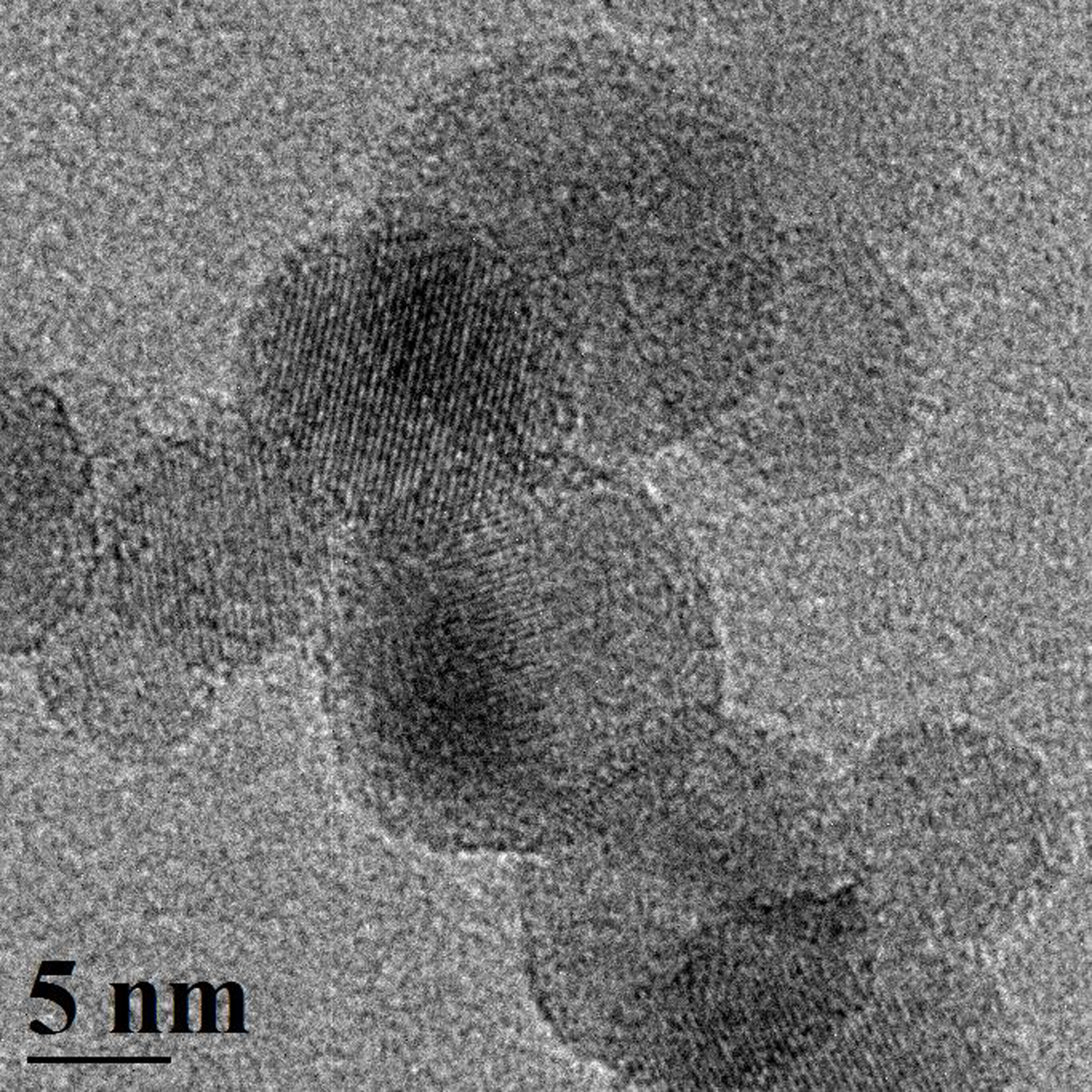
A close-up of spherical silicon nanoparticles about 10 nanometers in diameter. In Nano Letters, UB scientists report that these particles could form the basis of new technologies that generate hydrogen for portable power applications. (Credit: Swihart Research Group/University at Buffalo)
Battery dead in the middle of a phone call and you left your charger home, or worse, you’re on a camping trip. Sound familiar?
No prob, just grab some nanosilicon powder, mix with water, and zap: instant hydrogen fuel to generate recharge current — thanks to University at Buffalo researchers, who have discovered that super-small particles of silicon react with water to produce hydrogen almost instantaneously.
They created spherical silicon particles about 10 nanometers in diameter. When combined with water, these particles reacted to form silicic acid (a nontoxic byproduct) and hydrogen — a potential source of energy for fuel cells.
The reaction didn’t require any light, heat or electricity, and also created hydrogen about 150 times faster than similar reactions using silicon particles 100 nanometers wide, and 1,000 times faster than bulk silicon.
Just add water
It takes significant energy and resources to produce the super-small silicon balls, but the particles could help power portable devices in situations where water is available and portability is more important than low cost, the researchers said.
Military operations and camping trips are two examples of such scenarios.
You’ll take along a small hydrogen fuel cell and some plastic cartridges of silicon nanopowder mixed with an activator. Out of juice? Just add water, advises Mark T. Swihart, UB professor of chemical and biological engineering.
Comments (14)
by your name
I think it would be easier to just carry around a loaded hydrogen fuel cell. You aren’t magically generating energy out of nowhere with this.
by Marcos Marin
do explain.
by Jabbah
All depends on how much hydrogen can be generated from how much nanosilicon powder. If for the same weight as a container able to hold compressed hydrogen you can have as much nanosilicon powder to generate 10x as much hydrogen then the benefits become obvious.
by Cloudswrest
I can think of a lot cheaper sources than silicon nano-balls for mixing with water, like, for example, metallic sodium, which I played with a lot in HS. I’m sure it could be productised into a safe and effective device. You could then use the leftover lye to clean your drain.
by Jabbah
Its all about energy density. For the same weight how much can each produce?
by Bob Vasquez
The problem is not nanosilicon or an orchic-like fuel cell, etc. The problem is “memory”; the camper forgot his charger!!!
by Marcos Marin
yeah.. try generating electricity from your Alzheimer’s medicine.. and by simply peeing on it.
Allow me to get (even more) philosophical:
You can’t forget what you do not need ; )
by Ralph Dratman
Dehydrated hydrogen? Hmmm.
by cosmowrench
Could you tank this in a electric vehicle? How much watts/kg does it contain?
by Editor
I was wondering the same. The paper only says that “scalable and energy efficient processes for nanoparticle production must be implemented to expand the potential use of silicon-based H2 generation beyond niche applications. Laser pyrolysis has been demonstrated at kg/h scales, and thus it may be one such process.”
by Gorden Russell
Well, I dare say these plastic cartridges of silicon nanopowder will cost more than .50 caliber bullets, but in a combat emergency, the Department of Defense won’t care…but it might be a few more years before there is a hydrogen fuel cell cheap enough for civilian campers, so when out in the forest, I’ll still keep a hand-cranked LED flashlight in my cargo pocket for the near future.
by Marcos Marin
Worry not, Mr. Russell. I’m designing a orchid like fuel cell you can plug in any PLANT nearby and extract the “juice”. Doesn’t get much cheaper than that =) until extracting directly from vacuum that is.
by GatorALLin
…(wink) but who will speak for the trees…. http://www.youtube.com/watch?v=4T9vw0jnGOg
by Marcos Marin
They’ve got a complaint box, haven’t they?
http://www.youtube.com/watch?v=0QmSrYEaVb0
But the process would get too inefficient way before you can kill anything, you’d switch to the next plant or your cell would be charged. In fact it would be actually good for the plant and provide some — high intensity perhaps — exercise. (wink) Sorely needed I should add, it doesn’t get any more sedentary than that either.