Leap 3D out-Kinects Kinect
May 22, 2012
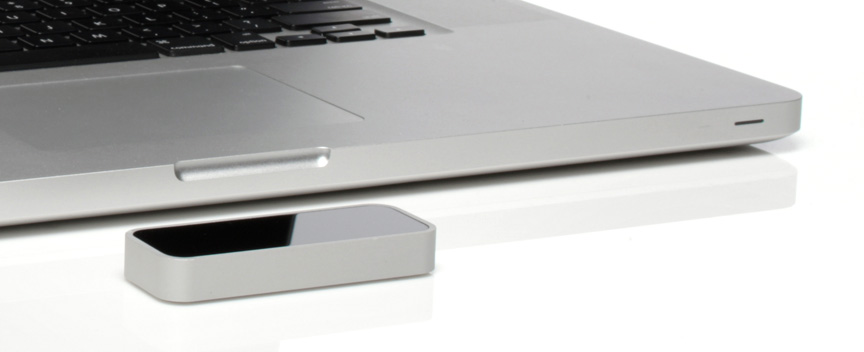
The Leap is a small iPod-sized USB peripheral that creates a 3D interaction space of 8 cubic feet to precisely interact with and control software on your laptop or desktop computer. (Credit: Leap Motion)
Leap Motion is unveiling its Leap 3D motion control system, Technology Review Hello World reports.
Leap Motion appears to outrank Kinect in terms of its capability. The technology, reports CNET, can detect motion with up to a hundredth of a millimeter accuracy; it’s nuanced enough to detect fingers, for instance, enabling the possibility of touch-free pinch-to-zoom.
When the device is available for commercial release, it’s expected to retail for around $70. The device itself is fairly simple — a small USB input device (plus an advanced software platform).
There’s a range of possibilities for the technology: consumers might use it to browse the web; engineers could mold virtual clay; designers could draw precisely in 2-D or 3-D; and new gaming possibilities could evolve.
Leap Motion is looking for a “few hundred” developers to get involved with their tech, and soon intend to send out as many as 20,000 free developer kits when it’s officially released — in 2013, according to reports.
Comments (12)
by Phil Osborn
This field is the perfect example of how utterly destructive our current intellectual property laws are. Myron Krueger pioneered the entire field in the 1970′s on main frames at universities and wrote two books on what he called “artificial reality,” long before “VR.” His generic name for the “Eyetoy, Kinect, Mandala, CyberScape, etc.” technology – anything that uses a video-like sensor to map images into an interactive computer-based system – was VideoPlace, on which he had a patent, which is now, I think, run out. During the life of the patent, numerous companies and individuals developed “augmented reality” systems, perhaps starting with “Mandala” on the Amiga system in 1986. All of the systems worked well enough that there was a world of potential applications, but everyone was running scared of Myron’s patent. I spoke with Myron on numerous occasions,the last time in 1999, I think, as a journalist covering this kind of cutting edge digital tech. His position, as I understood it, was that he just wanted to ensure that the ideas were not misused, but that apparently meant that he had to personally supervise and sign off on everything. I also spoke with perhaps five or six independent developers of VideoPlace APPs, both on the Amiga and the PC, when it finally became a powerful enough platform, and the impression I got from all of them was that they lived in fear of a letter or phone call from an attorney, should their product actually take off in the marketplace.
As to practical APPs, one that I recall running on the Amiga using Mandala enabled a quadraplegic kid here in Santa Ana, at the Blind Children’s Center, to play music. He could move one finger of one hand, but using a macro lens, that was enough that he could play a virtual drum kit, one of the Mandala demo APPs that came with the package.
Carel Struycken (“Lurch”) carried this several steps further, developing physical rehap APPs on the Mandala clone, CyberScape, that were targetted at people who were physically disabled, usually with injuries involving reduced mobility.
Bottom line: there were and are a world of APPs to be developed for this system, unless one of the big boys steps in with patent infringement claims and then buys them out, as has happened all too many times. BTW, Sony could have dominated this whole field several years ago with the EyeToy, but they first released a SDK to the public and then apparently retracted it, which was unbelievably DUMB. Mandala in 1986 had a fully user programmable system, all done with a graphical GUI and mouse that allowed total control of the computer from the video input image. Sony could have done the same and owned that market…
by Singu2023
Good to see the competition. It’s healthy and maybe others will get into the game to heat it up.
by MikeB
Nobody questioning the authenticity of this device? The company’s website is exclusively a sales pitch and nothing more. The precision claimed would make it highly competitive for manufacturing applications where precision positioning is required … and yet the company seems to be targetting the game market. Odd, since 8 cubic feet is a box with 2 ft a side which is very small compared to the kinects’ volume and distances, right? Maybe useful as a device for those with severely limited mobility, say, positioned on a wheelchair arm for the recognition of minute hand gestures. As for MacDo’s … the current button system is far simpler and more accurate and yet the customer has still not been given the opportunity to use it for input.
by Steve
The value of this product is definitely real. There is no way the investors of this product would ever put out so much of their time and money to develop such amazing technology without expecting some real results. And these investors include big names such as Bill Warner(the man who started Avid Technology and Wildfire Communications) and Brian McClendon (VP of engineering at Google). There are more investors I will not mention. Regarding the game market, one reason I can see them advertising this for the game market is mainly because they want as much as they can get out of this product and the video game industry has not been hurt by the economic downfall, in fact there is an increase of profit in most gaming companies profits, such as Blizzard who’s profit margin raised 20% since Jan2012.
by GatorALLin
Not sure if I agree the big market is for ordering at fast food chains…. I would expect that there are some cool/creative touch free medical applications where it could help keep a sterile field clean. A very cool idea… seems like price at $70 is low as well and should help this take off…
by gaoptimize
I have so many programming concepts back-logged for my day job, I could never find the time to write it myself. When the economic SHTF, there will be tens of millions of people with the time and urgency to make this happen.
by Tab Cocovillea
Instead, develop the “app” that does this, then license it to McDonald’s for millions.
by Editor
… or start a new chain
by Tab Cocovillea
Actually, use these at the McDonald’s point of sale (even at the drive-through) and let people point to their food choices… if they are unable to use the interface, then it would summon a human order taker.
by gaoptimize
Put 4 of these in every McDonald’s restaurants in America, network them to a central server, then bring back the time-and-motion studies that made America an industrial power-house in the 1950s. I am outraged by the inefficiency I’ve observed of the crews in my numerous (but very rare travel expedientcy-driven) glacial waits for my so called “fast food”.
by Durabys
So why not actually really sending this idea to McDonalds and others?
by Editor
McDonald’s restaurants: … yes, and useful data for the next-gen fully automated, individually customized super-fast-food locations (with food biotech-synthesized in real time) …