Liquid air ‘offers energy storage hope’
October 2, 2012
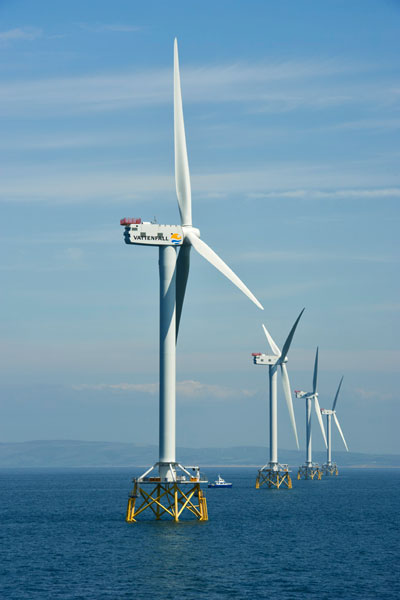
The Institution of Mechanical Engineers says liquid air can compete with batteries and hydrogen to store excess energy generated from renewables, BBC News reports.
IMechE says “wrong-time” electricity generated by wind farms at night can be used to chill air to a cryogenic state at a distant location. When demand increases, the air can be warmed to drive a turbine.

Comments (13)
by Eugene Mihaliuk
Some of the greatest companies, for example
Hewlett-Packard, were started by guys tinkering
in their garage. Trying to make something useful
is always admirable.
However, we should not forget that even the most
clever design must obey the laws of physics. As the temperature goes down, further cooling _unavoidably_
becomes less and less efficient [1], ( that is why you
can never reach absolute zero of temperature ).
Since liquid nitrogen normally boils at a temperature
of 77K which is almost four times below the
room temperature of 300K, the best theoretical
efficiency of _making_ liquid nitrogen is about 36%.
The real world practical efficiency is a small fraction
of that: a medium size liquid nitrogen generator that
you can buy [2] (if you have a million dollars) uses
100 KW of electric power to produce 40 kg of liquid
nitrogen per hour. The best literature values [3]
for liquid-nitrogen powered machinery are
approximately 100 W*hr per kg of liquid
nitrogen. The complete cycle using this machinery
will thus recover 4KW of power for 100 KW
consumed, which is 4% _overall_ efficiency.
Using liquid nitrogen in the cooling cycle of a coal
or natural gas power plant can capture some of
the energy that would otherwise be spent heating
air in the cooling towers, and is perhaps the best
possible way to obtain higher efficiency, but the
overall gain is still limited by fundamental
thermodynamic principles.
The ultimate question is — what is the net gain,
considering energy saved and the cost of the
machinery over its lifetime. Would the energy
savings of 10% be sufficient to offset the cost
of the additional machinery ?
Since the energy density in liquid nitrogen is 30
times less than that in hydrocarbon
fuels [4], the scale of the machinery that
stores significant energy using liquid nitrogen
will be at least similar to the ordinary power plant
hardware, and the cost of a power plant is a
significant factor in the cost of electricity that
it produces (fuel and maintenance account for
only approximately 30% of the cost [5]).
It is very exciting to see such an enthusiastic public
response to a technology that promises to save
energy. Using liquid air as a source of power has
been proposed since liquid air was available [6],
but so far has not been shown to be practical. An
analysis of this proposal by independent experts
will probably bring down what seems like an overly
optimistic projected efficiency figures. It will then
be possible to judge more objectively the true
potential of this technology, which undoubtedly
has many interesting features.
[1] http://en.wikipedia.org/wiki/Thermal_efficiency
[2] http://www.oxygengasplant.net/liquid-nitrogen-generator.pdf
[3] C. Knowlen, A.T. Mattick, A.P. Bruckner and A. Hertzberg,
“High Efficiency Conversion Systems for Liquid Nitrogen Automobiles”,
Society of Automotive Engineers Inc, 1988
[4] http://en.wikipedia.org/wiki/Liquid_nitrogen_vehicle
[5] http://en.wikipedia.org/wiki/Relative_cost_of_electricity_generated_by_different_sources
[6] Alexander Belyayev, “Air Trader”, 1929
by Chrispium
With more automation, more manufacturing can be pushed to the nighttime cycle solving most of this problem.
by Phillfrog
Wouldn’t that make it worse as the sun shines in the day? But it would be great if the price of electricity changed in real-time based on supply (i.e. how sunny/windy is it), that this pricing was immediately broadcast and automated factories kicked into action when it’s cheap.
This would need to be coupled with some forcasting though as otherwise on dull, windless days all factories would wait for a low electricity price that doesn’t come and potentially all kick in at the last moment to get the day’s work done.
by fgbouman
That works for robotic factories, but if you need people it is rather more problematic. Still, people are increasingly disappearing from the factory floor so the idea has merit.
by Bill Thomas
It actually doesn’t work at all. Factories need to make sure that expensive capital equipment – like robotics – is running at maximum capacity in order to recoup investment costs. The wouldn’t be in business for long if they let their most expensive capital asset sit idle waiting to save a few percentage points on a minor expense item like electric power.
As a separate point, the whole idea of wind power economics is faulty. It requires massive government subsidies to even build them in the first place and many, many years of hopeful projections to recoup the costs. And there is no great efficiency waiting jump just around the corner that would justify the investment. It’s a feel good nonsense approach to energy problems.
Solar has real potential but has a long way to go in efficiency and storage before it’s a major percentage of power generation compared to coal.
by Phillfrog
So this is using energy to take energy out of the air in order to compress it and then using more energy to heat it back up. Doesn’t sound right. Wouldn’t it be better to massively heat something up (with great insulation) and then drive a turbine off that heat when needed?
by Thomas Jensen
Isn’t the idea just to compress the air to the point it gets liquid and then take the energy back later, by making the compressed air drive an air motor that powers a generator?
by cosmowrench
No, compressing air is ‘expensive’ and generates alot of losses. While chilling air can be quite energy efficient, if u have a medium that can absorb the heat, like the ocean. Also heating the air can be done efficiently if u extract the heat from the ocean. It works like a heat-pump or AC.
by Bruce Wright
There are any number of ways to store excess “wrong-time” energy – for example, pumping water into a large holding tank and large flywheels are two low-tech ways of storing significant amounts of energy. All of them do add to the cost, however – but many of them aren’t THAT expensive. I’m somewhat skeptical of battery storage of significant amounts of energy given current battery technology because of the expense of the batteries and the wear of repeated cycles on the batteries, but hydrogen is much more promising.
This idea does have potential, but you do have to deal with getting lots of heat (From where? The surrounding environment?) to warm up the cooled air, and also a heat sink that will accept all of the heat taken from the air when it was liquified. Ideally these are one and the same heat sink, otherwise you’d have to deal with lots of heat pollution in the local air and water, which could cause problems of its own given such a drastic heating and cooling cycle.
by Gorden Russell
Right, Bruce. A lot of people have a lot of hope for hydrogen. There are a number of researchers working on cheaper hydrides for fuel tanks, and many others are working on cheaper hydrogen fuel cells. Some day we will use our own rooftop solar cells to make hydrogen in our garages to power our cars and trucks.
by Dennis
Replace the air with ammonia and for off-shore turbines use the cooler water near the bottom for condensation and the inefficiencies lost to compressing the working fluid will be greatly reduced.
by Bri
Well that should cool the hot air, of the criticts of renewables!!!!
by Gorden Russell
You said it, Bri.