Living power cables discovered
October 26, 2012
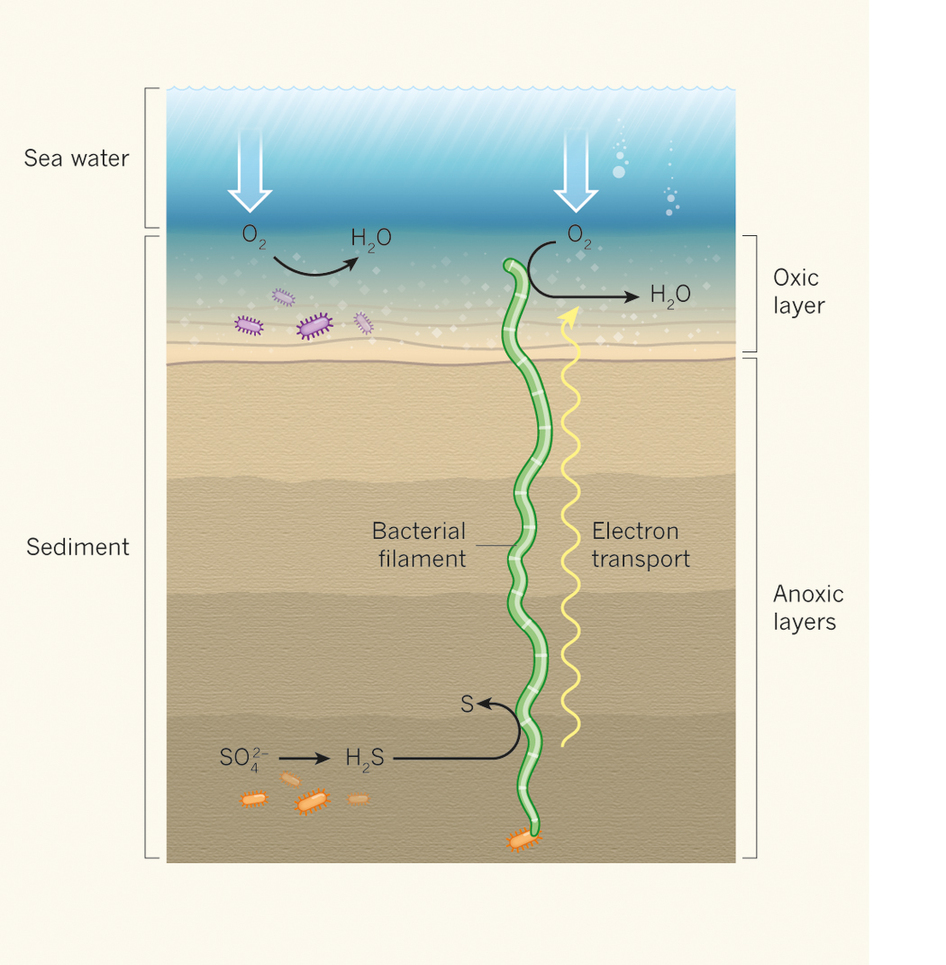
Microorganisms (purple) in the upper layers of marine sediments use oxygen (O2) that diffuses from sea water as an acceptor of electrons, which they produce in energy-generating metabolic reactions. As a result, other microbes (orange) in deeper, anoxic layers (where oxygen is scarce or absent) have to use other electron acceptors such as sulphate (SO42−) for growth. Transfer of electrons to oxygen results in the formation of water, whereas electron transfer to sulphate produces hydrogen sulphide (H2S), which is poisonous to many organisms. Pfeffer et al. provide evidence that long bacterial filaments could transport electrons generated when hydrogen sulphide is converted into sulphur (S) at the bottom of the sediments and use them to consume oxygen in the upper layers. (Credit: Gemma Reguera/Nature)
A multinational research team has discovered filamentous bacteria that function as living power cables that transmit electrons thousands of cell lengths away.
The Desulfobulbus bacterial cells, which are only a few hundreds of a nanometer long each, are so tiny that they are invisible to the naked eye. And yet, under the right circumstances, they form a multicellular filament that can transmit electrons across a distance as large as 1 centimeter as part of the filament’s respiration and ingestion processes.
“To move electrons over these enormous distances in an entirely biological system would have been thought impossible,” said Moh El-Naggar, assistant professor of physics at the USC Dornsife College of Letters, Arts and Sciences, and co-author of the Nature paper.
Aarhus University scientists had discovered a seemingly inexplicable electric current on the sea floor years ago. The new experiments revealed that these currents are mediated by a hitherto unknown type of long, multicellular bacteria that act as living power cables
“Until we found the cables we imagined something cooperative where electrons were transported through external networks between different bacteria. It was indeed a surprise to realize, that it was all going on inside a single organism,” said Lars Peter Nielsen of the Aarhus Department of Bioscience, and a corresponding author of the Nature paper.
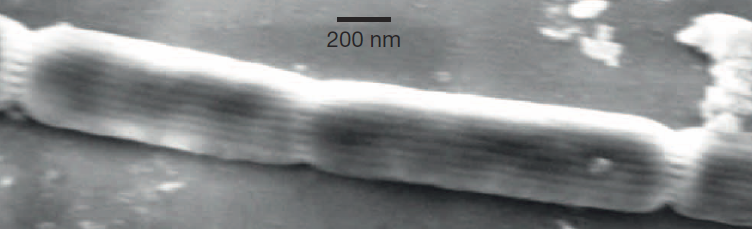
SEM image of four filamentous_Desulfobulbaceae bacteria cells (Christian Pfeffer et al./Nature)
The team studied bacteria living in marine sediments that power themselves by oxidizing hydrogen sulfide. Cells at the bottom live in a zone that is poor in oxygen but rich in hydrogen sulfide, and those at the top live in an area rich in oxygen but poor in hydrogen sulfide.
The solution? They form long chains that transport individual electrons from the bottom to the top, completing the chemical reaction and generating life-sustaining energy.
“You have feeder cells on one end and breather cells on the other, allowing the whole living cable to survive,” El-Naggar said.
Aarhus and USC researchers collaborated to use physical techniques to evaluate the long-distance electron transfer in the filamentous bacteria. El-Naggar and his colleagues had previously used scanning-probe microscopy and nanofabrication methods to describe how bacteria use nanoscale structures called “bacterial nanowires” to transmit electrons many body lengths away from cells.
This research was funded by European Research Council, the Danish National Research Foundation, the Danish Foundation for Independent Research and the German Max Planck Society.