Lost in space: rogue planet spotted?
November 16, 2012
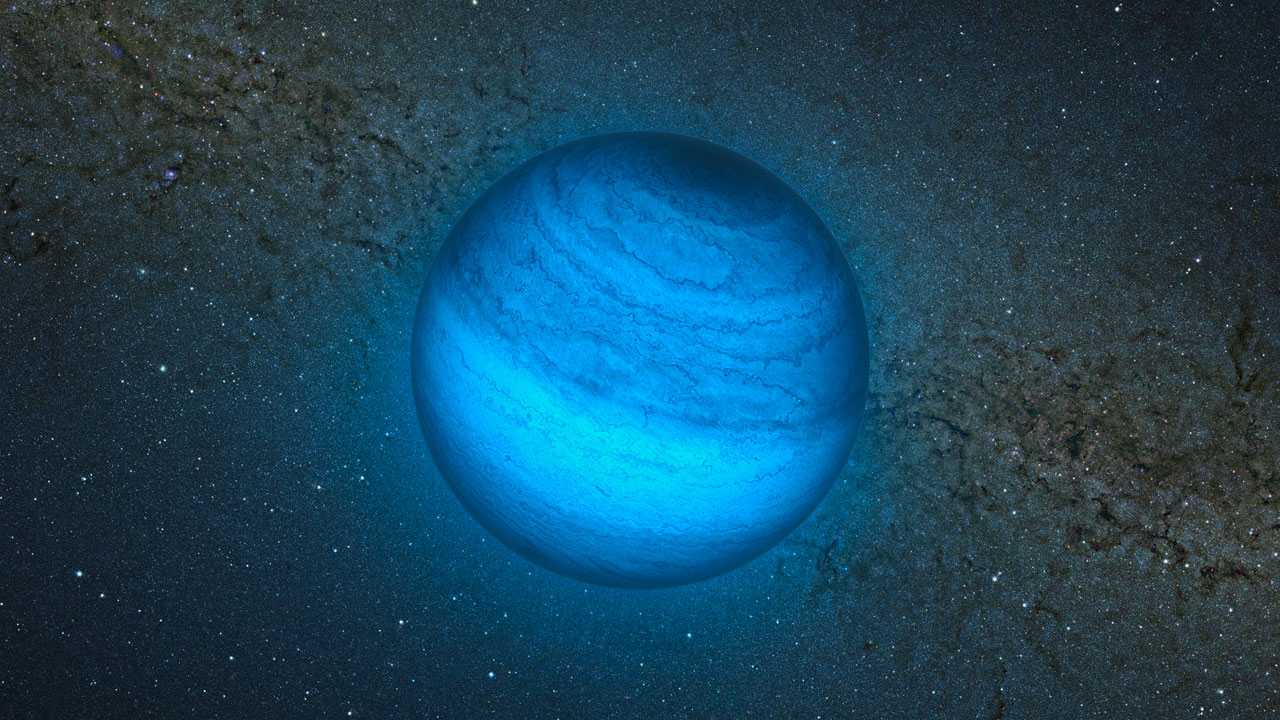
Artist’s impression of the free-floating planet CFBDSIR J214947.2-040308.9 (credit: ESO)
Astronomers have identified an object that could be a planet wandering through space without a parent star at a distance of about 100 light-years. Its closeness and the absence of a nearby bright star have allowed the team to study its atmosphere in great detail.
Free-floating planets are planetary-mass objects that roam through space without any ties to a star. Possible examples of such objects have been found before, but without knowing their ages, it was not possible for astronomers to know whether they were really planets or brown dwarfs — “failed” stars that lack the bulk to trigger the reactions that make stars shine.
But astronomers have now discovered an object, labelled CFBDSIR2149, that seems to be part of a nearby stream of young stars known as the AB Doradus Moving Group. The researchers found the object in observations from the Canada-France-Hawaii Telescope and harnessed the power of ESO’s Very Large Telescope to examine its properties.
The AB Doradus Moving Group is the closest such group to the Solar System. Its stars drift through space together and are thought to have formed at the same time. If the object is associated with this moving group — and hence it is a young object — it is possible to deduce much more about it, including its temperature, mass, and what its atmosphere is made of. There remains a small probability that the association with the moving group is by chance.
The link between the new object and the moving group is the vital clue that allows astronomers to find the age of the newly discovered object. This is the first isolated planetary mass object ever identified in a moving group, and the association with this group makes it the most interesting free-floating planet candidate identified so far.
Free-floating objects like CFBDSIR2149 are thought to form either as normal planets that have been booted out of their home systems, or as lone objects like the smallest stars or brown dwarfs. In either case these objects are intriguing — either as planets without stars, or as the tiniest possible objects in a range spanning from the most massive stars to the smallest brown dwarfs.