Low-cost design makes ultrasound imaging affordable to the world
September 17, 2012
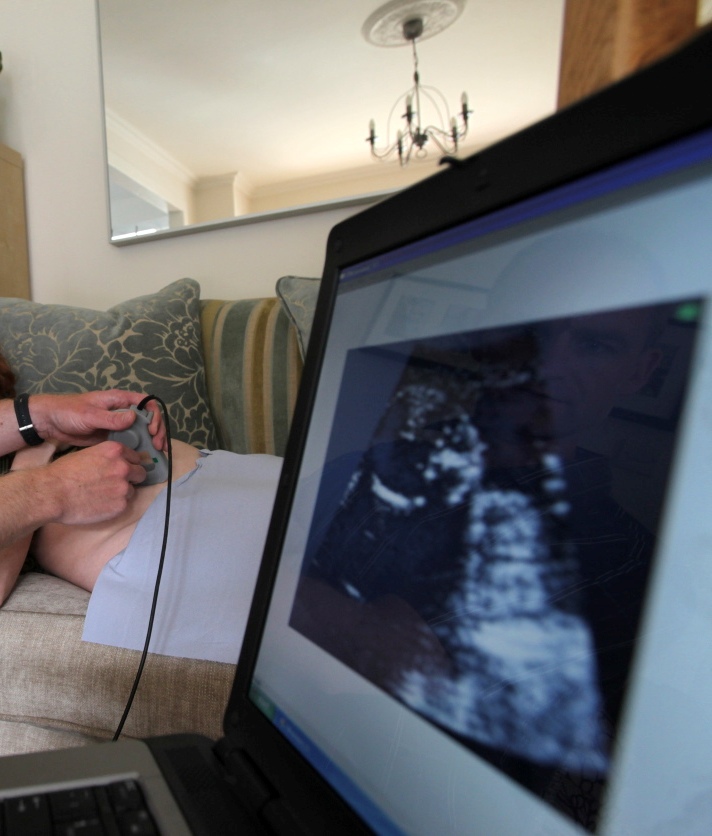
An ultra-low cost scanner that can be plugged into any computer to show images of an unborn baby has been developed by Newcastle University engineers.
The handheld USB device — roughly the size of a computer mouse — works like existing ultrasound scanners, using pulses of high frequency sound to build up a picture of the unborn child on the computer screen.
However, unlike the technology used in most hospitals across the UK costing anywhere from £20,000-£100,000, the scanner created by Jeff Neasham and Research Associate Dave Graham at Newcastle University can be manufactured for as little as £30-40.
Tested by experts in the Regional Medical Physics Department at the Freeman Hospital, part of the Newcastle upon Tyne Hospitals NHS Foundation Trust, the scanner produces an output power that is 10–100 times lower than conventional hospital ultrasounds.
Accessible by medical teams in poorest nations
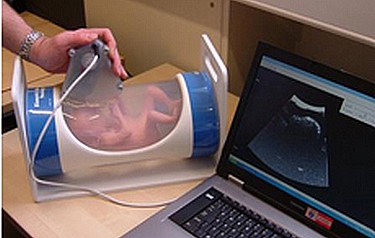
Ultrasonic scanner with “phantom” (used in hospitals to train doctors and sonographers and mimics the real conditions of the womb) (credit: Newcastle University)
The engineers hope the device will be used to provide medical teams working in the world’s poorest nations with basic before-birth information that could save the lives of hundreds of thousands of women and children.
“Here in the UK we take these routine, but potentially lifesaving, tests for granted,” explains Mr Neasham, a sonar expert based in the University’s School of Electrical and Electronic Engineering.
“Imaging to obtain even the simplest information such as the child’s position in the womb or how it is developing is simply not available to women in many parts of the world.
“We hope the very low cost of this device and the fact that it can run on any standard computer made in the last 10 years means basic antenatal imaging could finally be made available to all women.”
Neasham said the original aim had been to make something portable and easy to use that would be affordable in developing countries as well as for some applications in the UK where ultrasound is still considered cost prohibitive.
“Cost was the key,” he explains. “The goal was to produce a device that could be produced for a cost similar to handheld Doppler devices (fetal heart monitors) used by most community midwives. Not an easy task when you consider a £20,000 scanner is generally classed as low cost.”
An expert in underwater sonar technology, Neasham has developed systems for imaging the seabed — looking for ship wrecks or specific geographical features — as well as underwater communications and tracking systems.
Drawing on his expertise in sonar signal processing, the design keeps components and hardware costs to an absolute minimum, and works by manually sweeping a transducer over the skin while a focused image is formed by the PC software.
Funded through an Engineering and Physical Sciences Research Council (EPSRC) Knowledge Transfer Account (KTA) and a Proof of Concept loan from NorthStar Ventures, the scanner requires nothing more than a computer with a USB port. Neasham said the beauty of this device was that it would complement — rather than replace — the high performance scanners available in hospitals.
“It was my own experience of becoming a father and going through the whole antenatal process that prompted me to start the project,” explains the father-of-two.
“I was sat with my wife looking at our child on the screen, we realised how privileged we were to have access to this kind of care and it was my wife who suggested that I could apply my knowledge from sonar research to try to make this more affordable.”
UN statistics estimate more than 250,000 women die annually from complications during pregnancy or childbirth, almost all of them — 99 per cent — in developing countries. Tragically, most of these deaths are avoidable and a lack of access to equipment is cited as one of the key factors.
Neasham adds: “There is obviously the potential to use it to go beyond obstetrics by using it to diagnose conditions such as gallstones, or other conditions that readily show up with ultrasound imaging. Even vets and farmers are interested in affordable imaging.”
UPDATE 9/17/2012: Jeff Neasham, Senior Lecturer, Newcastle University adds (in an email to KurzweilAI): ”The technology has progressed to the point where we have prototype units that are being evaluated for different clinical applications. Image quality is also increasing on almost a daily basis as we continue to improve transducer construction and signal processing, whilst maintaining the low manufacturing cost. We are now considering routes to manufacture and distribute the technology worldwide.” (Image added)

Comments (12)
by Dana
Jon, well put.
New medical imaging technology holds the promise of benefiting more people than it will hurt. Innovations in the field are bringing down the costs of diagnostic imaging to make it more accessible to patients around the world (information here: http://bit.ly/UgFrOx). The potential for abuse will be there no matter what, however, I think overall a low-cost scanner like this has the potential to save lives and improve care.
by Editor
UPDATE 9/17/2012: Jeff Neasham, Senior Lecturer, Newcastle University adds (in an email to KurzweilAI): “The technology has progressed to the point where we have prototype units that are being evaluated for different clinical applications. Image quality is also increasing on almost a daily basis as we continue to improve transducer construction and signal processing, whilst maintaining the low manufacturing cost. We are now considering routes to manufacture and distribute the technology worldwide.” (Image added)
by Dan Robinson
Bottom line, is there any real evidence that medical ultrasound has effects on a growing embryo? How about possible good effects? Meanwhile, how about for non-embryos? How about, when the price comes down, we one to keep next to the oral thermometer? How about in schools where kids can examine their own internal organs, and maybe find new ways to use it?
by GatorALLin
Maybe we can get Tom Cruise to donate to this project?
http://www.wired.com/bodyhack/2006/05/ultrasound_for_/
by Gorden Russell
This is a great breakthrough that will extend lives all over the world.
by SpottedMarley
personally, i think the only sound frequencies you should be radiating your developing baby with is your own voice or maybe some classical music. one day more people will understand how sound effects everything, particularly at the cellular level of biology. it scares me to think many ignorant people will probably be blasting frequencies at their developing babies all day long with this sort of technology because they want to watch their baby on tv, or they want to make videos to share and watch online, all the while having no inkling or intuition of the type of damage they could be inflicting.
“Hey everybody, we’re gonna put the baby up on the big screen again! Come look!”
by Editor
It’s a valid question. The sound level is much lower than in commercial devices, which will help.
by Mike
I would guess that the frequency of the ultrasound is not in the range that is audible to human hearing.
Also, at least in America, it would not be available to non-healthcare providers unless it was deemed safe to be used by naive people.
by SpottedMarley
you mean deemed safe to use BY naive people. the range of frequencies need not be anywhere near the human audible range to effect cell division. microwave frequencies, for instance, do not need to be heard in order to have a very physical effect on biology. all frequencies are sound, not just the stuff you hear. the entire electromagnetic spectrum is sound frequency. ultra-sound.. is sound, whether or not you hear it. It’s physical impact on cell processes may very well have detrimental effects that won’t easily be linked back to in-utero frequecy irradiation when the symptoms appear after birth or later in life. it’s just a really bad idea. it’s bad enough to do it once or twice when performed by a doctor. but this will open the door to unborn children being washed in harmful noise pollution by their clueless parents.
deemed safe. those words reek of catastrophe
by Jon
You don’t have any data.
“It’s physical impact on cell processes may very well have” , etc etc.
It’s deemed safe. It’s more likely to not be harmful than harmful. We don’t know for sure.
I like this development. Modern technology saves lives, especially in infants. I like to see it become more widespread. The potential for abuse is always present, in any technology that works. Though something to keep in mind, it’s not all that relevant. The good far outweighs the bad.
by Bri
With that line of reasoning, you’d better not use a cell phone or be near a tower. Maybe those cars with the thumping base could be slowly killing us all!
by Mike Hunt
The electromagnetic spectrum has nothing to do with sound, it has to do with the energy of photons. Sound is waves of pressure traveling through matter. I couldn’t find much information online about the decibel output of ultrasound machines, but one source said it was around 100 dB for modern scanners. That means the one in the article would produce roughly 10 dB at the most, which is basically equivalent to a pin dropping in a quiet room.
Regardless of all that, any advancements in technology are welcome. It can only increase quality of life. I wouldn’t worry about pregnant mothers abusing the technology either. If anything the ultrasound scanner can come with a warning telling pregnant mothers not to use it for prolonged periods of time.