Low-power chips to model a billion neurons
August 1, 2012
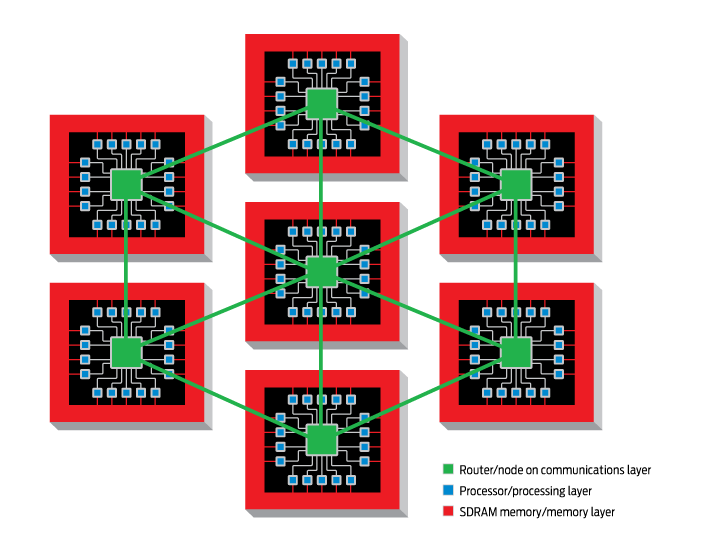
SpiNNaker’s machine architecture is divided into three fundamental layers. Each chip contains 18 cores that act like neurons, sending and receiving signals. All information on the connections’ delays and strengths is stored in a layer of synchronous dynamic RAM (SDRAM) on each chip, and all signals pass through a separate router layer. (Credit: APT Advanced Processor Technologies Research Group)
A miniature, massively parallel computer, powered by a million ARM processors, could produce the best brain simulations yet, Steve Furber suggests in IEEE Spectrum.
With traditional digital circuits, that would require a supercomputer that’s 1000 times as powerful as the best ones we have available today. And we’d need the output of an entire nuclear power plant to run it.
Fortunately, there are at least half a dozen projects dedicated to building brain models using specialized analog circuits that can model brain activity as fast as or even faster than it really occurs, and they consume a fraction of the power.
But analog chips do have one serious drawback — they aren’t very programmable.
“To help things along, my colleagues and I are building something a bit different: the first low-power, large-scale digital model of the brain,” says Furber. “Dubbed SpiNNaker, for Spiking Neural Network Architecture, our machine looks a lot like a conventional parallel computer, but it boasts some significant changes to the way chips communicate. We expect it will let us model brain activity with speeds matching those of biological systems but with all the flexibility of a supercomputer.”
Over the next year and half, Furber’s team plans to create SpiNNaker by connecting more than a million ARM processors, the same kind of basic, energy-efficient chips that ship in most of today’s mobile phones. When it’s finished, SpiNNaker will be able to simulate the behavior of 1 billion neurons. That’s just 1 percent as many as are in a human brain but more than 10 times as many as are in the brain of one of neuroscience’s most popular test subjects, the mouse.
“With any luck, the machine will help show how our brains do all the incredible things that they do, providing insights into brain diseases and ideas for how to treat them. It should also accelerate progress toward a promising new way of computing.”
There have actually been some pretty impressive (but slow) supercomputer models that have managed to reproduce neuron operation with great fidelity, like the ongoing Blue Brain Project.
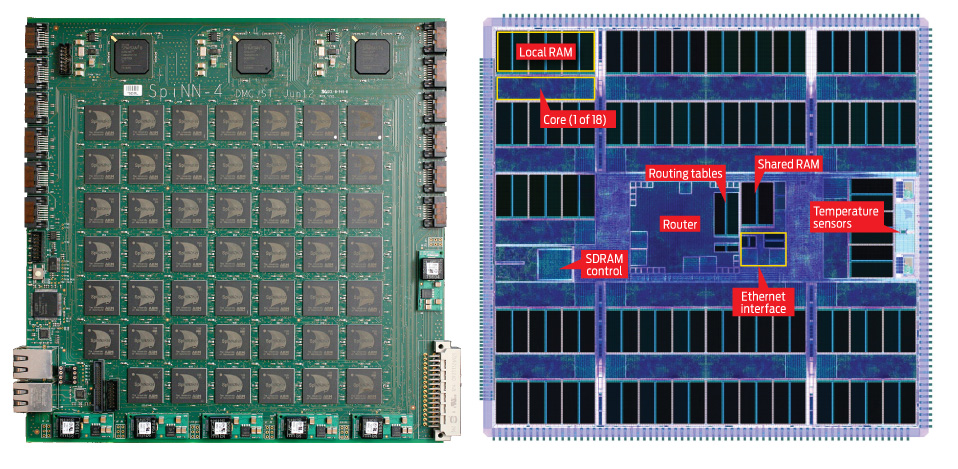
To keep SpiNNaker as compact as possible, the machine’s chips are packed together in sets of 48 onto 23-centimeter-square boards [left]. A SpiNNaker chip contains 18 ARM9 cores [above], each with local RAM. Cores communicate with one another and with more-distant cores via a router at the center of each chip. All the information on the connectivity of the system is uploaded to these routers. (Credit: left: Norcott Technologies Limited; right: University of Manchester)
But as speedy and efficient as analog circuits are, they’re not very flexible; their basic behavior is pretty much baked right into them.
And that’s unfortunate, because neuroscientists still don’t know for sure which biological details are crucial to the brain’s ability to process information and which can safely be abstracted away.
“In 2005, my colleagues and I set out to find a good compromise between the shortcomings of the traditional digital and analog approaches to brain modeling. We wanted to come up with a system that would be capable of modeling brain activity in real time, as analog circuits do, yet be as programmable as a general-purpose digital computer.”
The result: SpiNNaker, which received £5 million ($8 million) from the United Kingdom’s Engineering and Physical Sciences Research Council in 2006. Four U.K. universities — Cambridge, Manchester, Sheffield, and Southampton — are involved in the project, along with three industry partners, ARM, Silistix, and Thales, which contributed the processor and interconnect technologies.
The machine will consist of 57 600 custom-designed chips, each of which contains 18 low-power ARM9 processor cores. Such chips are, of course, eminently programmable. At the center of each chip, we place a specially designed router that receives and directs all the packets coming from the cores and forms links with neighboring chips. We stack 128 megabytes of synchronous dynamic RAM, or SDRAM, on top of each chip to hold the connectivity information for up to 16 million synaptic connections.
As with most other brain models, SpiNNaker’s operation is centered on the “spike” — an idealization of the electrical impulse sent out by firing neurons. The information needed to model a spike is tiny: You can condense it down to a single packet containing just 40 bits.
But things get complicated when you set out to pass around as many of those packets as the brain does. To model even 1 percent of the human brain could involve wrangling 10 billion packets a second, each of which might need to be sent along to dozens of other chips containing hundreds of processors.
The team eliminated this problem by taking those routing responsibilities away from the processors. In SpiNNaker, a processor modeling a spiking neuron sends a small packet that uniquely identifies the neuron to the router at the center of the chip.
When a router receives a packet, it looks up the packet’s unique identifier in a precomputed table that lists all the connections between neurons. Then the router passes copies of the packet out to other processors on the same chip or to routers on six adjacent chips. All the processors do is receive spikes and, if the total spike input is strong enough, generate new spikes.
“In SpiNNaker we cannot implement anything like the hundreds of thousands of physical connections that are sometimes found among individual neurons. However, we can make up for that weakness by exploiting the computational power of the cores as well as the millionfold speed advantage that signals moving along metal wires have over biological ones.
“Because modeling a single spike requires only a fraction of the core’s time, we can save on space and power by packing about a thousand simulated neurons onto every processor. The output signals generated by the interaction of those thousand neurons come in the form of spikes, which we send out using only the wires that connect each of the processors and routers. We can keep all these overlapping signals in order by using careful multiplexing.
“The basic operation of SpiNNaker involves mapping a problem onto the machine — setting up the connectivity graphs in the machine’s routing hardware — and then letting the model run with the spikes flying where and when they may.
“With SpiNNaker, there is effectively no difference between communicating with a nearby processor and one that’s many chips away. We can upload any neural network we’d like, and the exact way that processors are connected should have no bearing on how fast that neural network can be modeled.
“In a sense, the SpiNNaker machine could be considered a rewirable computer — an enormous version of the field-programmable gate array chip, or FPGA, specialized for neurons. With appropriate tweaking, it should be able to model any part of the brain we choose.
“SpiNNaker won’t get us all the way to full-scale simulations of the human brain. But the machine’s communications architecture could help pave the way for better-networked analog chips that could get us there. It will also help show us what information we need to make good models. Then we can really put our brains to use.”
Comments (18)
by ben951
“With traditional digital circuits, that would require a supercomputer that’s 1000 times as powerful as the best ones we have available today. And we’d need the output of an entire nuclear power plant to run it.”
Really I thought Ray said IBM Sequoia would already have the power to simulate the human brain if we had the right software.
by Editor
I’ll check with Furber. Sounds like his model is at a more granular level.
by Mumen
If intelligence was just a fact of “quantity of something”, the AI would be real since the 80′s…
Looks to me brain simulation is a lot further than what we dare to imagine, and it is not only a question of computerized algorithm, it is something else.
Try to compare a horse with it’s modern replacement, the car and you will have a neat image of this unbearable fact. So unbearable that one prefers not to see it, and dream than our inventions might magically contain some “intelligence” not petrified that would not directly come from us, the humains. This is a naive belief.
If it is only a question of power and watts, why not try first to reproduce the cleverness of any insect in a computer, with it’s adaptability ? In fact, such searchers will see that really Descartes was wrong, they will see that body and mind cannot be separated, because at a certain point they will have to think about the support – its reproduction and mutation – instead of oversimplifying the reality with the Scalpel Cartesian.
In saying that I am not denying those brilliant researches. I just want to emphasize the wrong vocabulary which is (it seems to me) driven by the sensationalism (and maybe the need for credits) and which have the power to mislead the searchers themselves.
by Spikosauropod
Mumen: “Try to compare a horse with it’s modern replacement, the car and you will have a neat image of this unbearable fact.”
If only I had a dollar for every time I have heard the old horse/car bromide.
The problem is that a car is not a replacement for a horse. A car is merely an alternate form of transportation that is now preferred to a horse. A better example of attempting to replace a horse with a machine would be Boston Dynamics’ Bigdog. Since the success of Bigdog is actually reliant on computer programming, you could say that we are actually in the same position with respect to replacing a horse with a robot as we are with replacing a horse’s mind with a computer. They are actually the same problem.
Similarly, Petman might be a good indicator of where we are with respect to duplicating a man. As with the horse, a better computer algorithm will lead to a better robot duplicate. The SpiNNaker project, if successful and sufficiently miniaturized, could transform Petman into Cyberman. Of course, Petman is not the only model of a man we have to work with. We also have Watson and a handful of other science projects which have never been integrated. We have many of the parts of a man which, when successfully miniaturized and integrated, may bring us closer to a man.
Also, there is no argument that can be made that we had sufficient raw computing power in the 80’s to equal a human brain. We won’t have that kind of raw power for another decade.
by Promethean
“The problem is that a car is not a replacement for a horse.”
This. Some of Toronto’s police are on horseback — not for ceremonial purposes like with the Mounties, but because horses are the best way to get through the woods and around ditches.
by Peter van der Made
Since 2004 I have been working full-time in the development of a new Artificial Intelligence paradigm. I started after the sale of my Computer Immune System vCIS to ISS (now IBM) with my simple RISC processor core that I patented in Europe in 1986. The advantage of that core is its simplicity, and that I can put many on a single chip. The problem I found in this approach is that each core needs memory, ROM, and I/O. Each core is still a sequential ‘von Neumann’ computer. The brain does not compute, it associates incoming information, in the shape of temporal pulse streams. These pulse streams directly address memory, which is processed by the neuron. Its kind of back to front to the method used in a computer.
I came up with the idea of using many cores to simulate the brain in 2005.
The overhead in programming and peripheral circuitry made me think that there must be a better way. Instead of programming a processor to behave like a digital neuron I came up with the solution to build a digital neuron and synapses from logic gates, and to put 15,000 of those on a single chip. I tested that idea in FPGA (programmable logic gates), and found that the simulated dynamic neural matrix learned very quickly. I exposed the FPGA to 10 frequecies, and the neural matirix learned to recognise those frequencies in speech patterns. This was a simple test, because the FPGA can only contain a small part of the intended chip. I concluded that the way forward lies in learning machines that are modeled on the brain’s and structure – not larger and faster ‘von Neumann’ computers. We become an intelligent entity through learning – and I don’t mean academic learning. We learn from the moment the brain is formed. A baby learns how to move its limbs through preprioception – feedback from the muscles and tendons in that limb. At the moment I am looking for funding to scale my design to emulate a single cortical column. I am also publishing a book on my findings of the last 8 years, called ‘Higher Intelligence’
by Zack
It sounds like your interests and work lie in the same domain as Jeff Hawkins. I’m sure you are familiar with his work, and his book ‘On Intelligence’. He is very interested in modelling cortical columns, like yourself, and has much knowledge in the fields of neuroscience and electrical/computer engineering. It sounds like you guys are working on the same thing. Which is good… because in my opinion this task is among the most important tasks faced by humanity right now.
by someday69
Just another day at the office’,,,Spin’naker…sounds like some’thing on ah’sail’boat..some’kind of sail”that gets’ unfurl’ed out front…off the bow–
Sail’on”’brother’s an”sister’s…
by Spikosauropod
They may find that an efficient algorithm more than makes up for the lack of raw processing power. This could be more effective than anyone suspects.
by AZryan
“This could be more effective than anyone suspects.”
Impossible since you yourself apparently suspect it.
Just kidding, but it is similar to how people misuse the word ‘literally’ literally all the time. heh
by John
Well, the point was, this can be more effective than anyone suspects, including himself. It could be so effective, he himself would be awed and said ‘God, i knew this would be big, but this is even bigger!’. No contradiction here.
by Spikosauropod
If I had it to do over again, I would have used “expects” instead of “suspects”.
by Bri
Looks to me like whole brain simulation is a lot closer than we think. True AI could be just ahead. As I’ve said before, look at a jumping or tree spider, with a head the size of a pin. Able to model a constantly moving world of leaves. If you have ever watched one, it’s surprising how smart they are. This chip configuration probably has many more times the neuronal capabilities of the spiders tiny brain. We are very close to true AI.
by John
Well said.
by MrFriendly
Biological neurons have millions of molecular interactions within them, so creating a spiking model is just the first, important step. The brain is “computing” even when no spikes are being sent.
Also, I find it interesting that Furber is using the Izhikevich equations for his spike dynamics. That’s a really successful and computationally efficient model that could, at this large scale, powerfully solve many narrow AI problems, such as object/facial recognition.
by Peter van der Made
You are right, but I don’t believe that computers are the way forward. Their technology is based on fetching instructions and executing them. I built a circuit that behaves like a Izhikevich neuron, but that is only a part of the solution. The real power of the brain is in its dynamic synapses. Memory stored in dynamic synapses is processed by the neuron. The output from the post-synaptic neuron updates the synapses. I built a learning machine using this method. Using this technology, a mere 25 wafers could contain the entire human brain. I added a parallel inteface to my neuron so that each synapse in the matrix can read by a computer. The entire system learns like a child learns, formats itself during early childhood, and has a 100 trillion synapses. All I need now is the money to build this machine….I simulated part of the design in FPGA with very encouraging results
by Promethean
Actually, some neuroscientists think a spiking neural net may be enough for mind uploading (see http://www.philosophy.ox.ac.uk/__data/assets/pdf_file/0019/3853/brain-emulation-roadmap-report.pdf pages 13-14). Even if they’re wrong, there are plenty of experiments with spiking neural nets that could advance neuroscience radically. A failed attempt at mind uploading would be one; a replication of http://www.ncbi.nlm.nih.gov/pubmed/21397213 with a more humanlike model would be another.
by asiwel
There are many ways to define or conceptualize “intelligence” – natural or “artificial.” This one, which I often prefer, is a measure of an agent’s ability to recognize features of a context and selectively take advantage of those (vis-a-vis its own interent abilities) that will facilitate the achievement of a goal. The faster and “better” that spider (or for that matter a human being) can do this, the “smarter” we might conclude it is.