Mapping brain circuits for specific functions
October 19, 2012
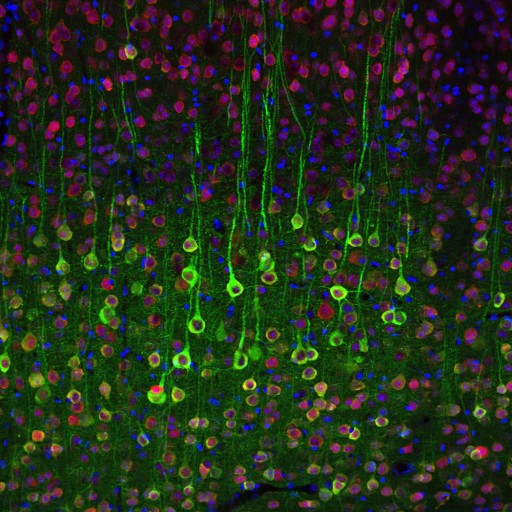
MIT neuroscientists used calcium imaging to label these pyramidal cells in the brain (credit: Qian Chen/MIT)
A team led by MIT neuroscientists has developed a way to monitor how brain cells coordinate with each other to control specific behaviors, such as initiating movement or detecting an odor.
The researchers’ new imaging technique, based on the detection of calcium ions in neurons, could help them map the brain circuits that perform such functions.
It could also provide new insights into the origins of psychiatric diseases, says Guoping Feng, senior author of a paper appearing in the Oct. 18 issue of the journal Neuron.
“To understand psychiatric disorders we need to study animal models, and to find out what’s happening in the brain when the animal is behaving abnormally,” says Feng, the James W. and Patricia Poitras Professor of Neuroscience and a member of the McGovern Institute for Brain Research at MIT. “This is a very powerful tool that will really help us understand animal models of these diseases and study how the brain functions normally and in a diseased state.”
Lead author of the Neuron paper is McGovern Institute postdoc Qian Chen.
Performing any kind of brain function requires many neurons in different parts of the brain to communicate with each other. They achieve this communication by sending electrical signals, triggering an influx of calcium ions into active cells. Using dyes that bind to calcium, researchers have already imaged neural activity in neurons.
Targeting specific cell types
However, the brain contains thousands of cell types, each with distinct functions, and the dye is taken up nonselectively by all cells, making it impossible to pinpoint calcium in specific cell types with this approach.
To overcome this, the MIT-led team created a calcium-imaging system that can be targeted to specific cell types, using a type of green fluorescent protein (GFP). Junichi Nakai of Saitama University in Japan first developed a GFP that is activated when it binds to calcium, and one of the Neuron paper authors, Loren Looger of the Howard Hughes Medical Institute, modified the protein so its signal is strong enough to use in living animals.
The MIT researchers then genetically engineered mice to express this protein in a type of neuron known as pyramidal cells, by pairing the gene with a regulatory DNA sequence that is only active in those specific types of cells. Using two-photon microscopy to image the cells at high speed and high resolution, the researchers can identify pyramidal cells that are active when the brain is performing a specific task or responding to a certain stimulus.
In this study, the team was able to pinpoint cells in the somatosensory cortex that are activated when a mouse’s whiskers are touched, and olfactory cells that respond to certain aromas.
The researchers are now developing mice that express the calcium-sensitive proteins and also exhibit symptoms of autistic behavior and obsessive-compulsive disorder. Using these mice, the researchers plan to look for neuron firing patterns that differ from those of normal mice. This could help identify exactly what goes wrong at the cellular level, offering mechanistic insights into those diseases.
“Right now, we only know that defects in neuron-neuron communications play a key role in psychiatric disorders. We do not know the exact nature of the defects and the specific cell types involved,” Feng says. “If we knew what cell types are abnormal, we could find ways to correct abnormal firing patterns.”
The researchers also plan to combine their imaging technology with optogenetics, which enables them to use light to turn specific classes of neurons on or off. By activating specific cells and then observing the response in target cells, they will be able to precisely map brain circuits.
Comments (16)
by CD Gulabau
You must change the subtitle of this article immediately. Autism is not a psychiatric condition.
by Editor
Fixed, thanks for the catch.
by erichlof
The photo at the top of this story is remarkably close in style to a Gustav Klimpt painting from the early 20th century:
http://www.klimt.com/en/gallery/landscapes/klimt-italienische-gartenlandschaft-1913.ihtml
It also reminds me of late Monet water-lilies. Just thought that was interesting that a section of brain could conjure up thoughts of art.
by melajara
Seems we are at least 2 here having the same reaction to this picture.
I had the following comment ready yesterday but for whatever reason, I didn’t leave it.
This beautiful image reminds me of a Monet painting. Mingling art with science, yet again from an Asian mind cf http://www.kurzweilai.net/nanoflowers-increase-battery-and-supercapacitor-storage-capacity
by John
Maybe you both had this art association because of the “Scream” picture nearby ;)
by melajara
Actually I didn’t think of Monet just because of the colors but because of the soothing effect of this image, quite intriguing.
by MrFriendly
Considering that most neuroscientists seem to think it’s going to take nearly a century to reverse-engineer the brain, I’m not that optimistic.
I’ll be happy if they can figure out how an insect’s brain works in my lifetime.
by Bri
This bolsters Ray,s argument, that new imaging tools will come along and speed up, the brain reverse engineering process.
by GAUSS
Agreed. Exponential progress in all areas means every bit of progress goes into a feedback loop, enhancing and accelerating the actions of the next time step. Very exciting times to live in!
by Bri
Despite Paul Allens views on brain research, I think Ray is right , to bring in the analogy of the human genome project. It was all gloom and doom, till Craig Ventor came along. This time around, there are so many different types of researches, focusing on so many different aspects, and they are much mote connected to each other.
by Mr.X
Well, I had the impression that Mr.Allen just ignored some of Mr.Kurzweil’s arguments.
Maybe he has lost the eye of the tiger concerning technology et al. ;) Just kidding.
by MrFriendly
Paul Allen is making his judgments based on what neuroscientists are telling him. When the vast majority of them say that the reverse-engineering of the brain in this century is a virtual fantasy, any reasonable person will take that to heart.
Besides, even if they do figure out how it all works, modeling it will not be possible with digital computers. Bruce Damer has even said that we’re several generations of supercomputers away from being able to model ONE neuron at the molecular level.
by Jerry
I can’t find much info on this Bruce Damer guy, but his view on us being incapable of modelling a neuron at the molecular level is laughable. Being a programmer with a keen interest in neuroscience and quantum physics I am incapable of seeing how this is true.
For me, I follow those that believe if we had the right code we could run a Strong AI on today’s home computers. A vast amount of simplicity giving rise to complexity. Look at Conway’s Game of life to see the perfect example of complexity arising from simplicity. We won’t likely discover this code at first, it’ll be the simulation of neurons at the cell level that’ll achieve that imo.
I am open to all research so feel free to recommend me studies or books by Damer, maybe he’s on to something I’m yet aware of.
by Editor
Bruce Damer, http://www.damer.com/background/bio.html, is co-creator of EvoGrid, a project to create a simulation of the chemical origins of life on Earth.
http://www.evogrid.org/index.php/Main_Page
by MrFriendly
http://www.slideshare.net/bdamer/the-singularity-is-far-singularity-u-presentation-by-bruce-damer-aug-2010
Simulating protein folding requires supercomputers. There are hundreds of millions of proteins in a single neuron, and they react in many different ways – ways which aren’t understood well, at all. Even Henry Markram has said that there are no supercomputers right now that can simulate an entire neuron at the molecular level.
Btw, strong AI on a desktop computer? Who said that is possible? Seems a bit optimistic, to me.
In any case, I just think that AGI will happen without a full understanding of the brain, but that what will be learned in the coming decades will greatly help.
by John
If indeed this allows mass-monitoring of many neurons concurrent activity as shown in video, this is HUGE..