Mars rover already doing science
August 7, 2012
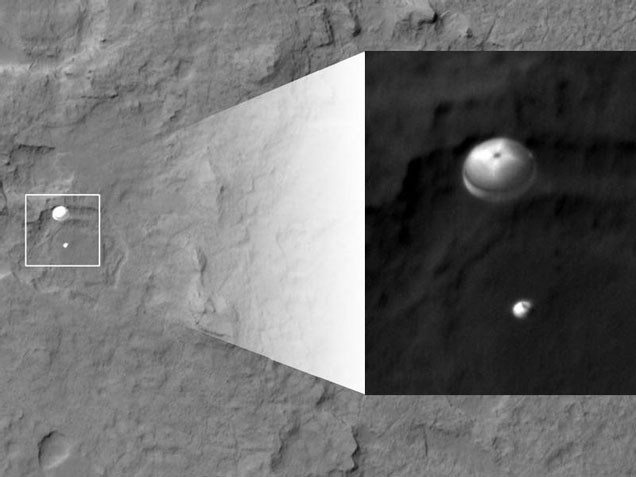
Curiosity on its Way. From 340 kilometers away, the HiRISE camera on the Mars Reconnaissance Orbiter caught the Curiosity rover inside its entry vehicle dangling from its parachute. The chute had been ejected from the entry vehicle by an explosive charge after atmospheric drag had slowed it to Mach 2. The descent vehicle with the rover tucked inside would soon drop out to fire its retrorockets. (Credit: NASA-JPL/Caltech)
NASA’s new Mars Rover has already returned scientific data in its first day on Mars, Science Now reports.
The uniform size of the small gravel at the surface suggests material carried from the crater rim by water rather than debris blown out of nearby smaller impact craters. The wheel’s failure to dent the surface on landing shows the surface to be relatively hard.
Comments (18)
by GatorALLin
This link to pictures was cool, check them out here.
http://mars.jpl.nasa.gov/msl/multimedia/images/
by Dan Robinson
This seems like a wasted trip, unless it can show how former martians destroyed their biosphere, and how we might avoid same. I’d rather see such a craft carrying mining and building equipment to start building solar cells and greenhouses in preperation for our immigration.
by ajrb
I agree. It’s like people completely forgot about Spirit and Opportunity which essentially did the same thing.
by Danko
Elon Musk should do this. I don’t care if only the rich one percent (which I am not part of) get to colonize Mars first. Mars colonization is long overdue.
by anthrobotic
About this Mars mission: What’s up here? Why is it so much more exciting this time? Maybe just the global convergence of social media around an aggressively virile meme? Ideas? Suggestions? Derision? http://goo.gl/Q4KLe
by Lord Penguin
While this is the most advanced rover yet, the publicity is more due, I think, to a rise in popularity for space in general. While space has always appeared in the news frequently, it seems to appear more and more since the public interest wore down after the space race. Hopefully we’ll get a new wave of space popularity comparable to that of the Space Race that will cause governments to greatly increase their space programs.
by Eldon J. Bloedorn
Many years ago, I listened to my grandmother’s excitement about seeing her first car, airplane and then television. Each generation has several marvels to enjoy. Who worries about death when life is so exciting?
by Ben
Once investors realize the economic potential of a planet like Mars over a long period of time, corporate entities and space programs will explode. It’s like Diamandis said at a speech at Harvard: the first trillionaires will be made in space. Anyway I figure that space tech, in combination with emerging materials science advances, will be subject to the same priice deflation that we experience with Moore’s Law. :D
by Khannea Suntzu
This isn’t just science – it signified H O P E. Beauty.
by Gorden Russell
I can’t wait until they drill down under the surface. There just might be something growing down there. Can you imagine what the newscasts from NASA will look like if they find living bacteria? All those engineers will be jumping up and down shouting like Victor Frankenstein — “It’s alive! It’s alive!”
by Barrett Hoffarth
Well said Josh. I too have always dreamed of being an astronaut. I hope the new scientific knowledge gained in these kinds of missions and advancing technology will make it possible for my children to be able to achieve this goal if they so choose.
by Gorden Russell
It all depends on just how old your kids are, Barrett. My kids are in their 40s so they are too old to make the trip until after the singularity, when they can grow young again.
Of course, if that historian from the earlier article is right, nobody will be making the trip until well after 2020. We’ll have to depend on the robots built by those asteroid miners at Planetary Resources. If those visionary billionaires just keep their nerve up during the coming troubles, they will have the assets in space to go to Mars.
by Josh Wolfgram
This mission is of such scientific importance in the spectrum of advancement in space exploration. Having actual pictures from the ground of another planet is mind blowing. Space holds so many eerie questions of what distant objects look like on the surface. This mission definitly has reached the level of the moon landing, voyager, hubble. And is a great unifying positive national scientific achievment. I still dream of being an astronaut some day.
by Graham Reed
This marvellous achievement has people yearning for a return to manned missions. It has been almost half a century since the moon was in our eyes. Columbus made 4 journeys with 32 ships over only a decade. What is wrong with us?
by Gorden Russell
Just keep up your health until after the Singularity, Josh, and you will certainly make the trip to Mars…and the moons of Jupiter and Saturn. Myself though, I wouldn’t want to go to Mercury. Too damn hot. I don’t even want to take my wife to visit her brother in Orlando. Well, maybe in January. Do they even have January on Mercury?
by Mindsight
Mercury has almost no axial tilt, so its northern and southern hemispheres share the same “season” throughout its short year. But it makes a huge difference whether you’re on the sunny side or the “dark” side. Facing the sun (at the equator) it can get as warm as 800 deg. F, but when that side spins away from the sun, it gets as cold as -300 deg. F on the surface. [Sources: Wikipedia & WolframAlpha.]
(Given the vast difference in day/night temperatures, I suppose that’s kind of a “Janus”-like situation, even if there’s no “January” there?)
Visiting Mercury would be fun, as a scientist, or at least as a heavy-duty science robot. Returning from Mercury would pose a serious problem, though, as it would take enormous acceleration to escape the gravity of the Sun that far down the gravity well.
Beaming in temporarily via telepresence–or, to avoid communication lag, just downloading your mind, or a copy of your mind, or a part of your mind, etc.–to a high-functioning robot already on the planet, might be the best way to experience Mercury firsthand, while completely avoiding those crazy high fees for carry-on luggage.
by Marcos Marin
Then maybe one could “ride the twilight” so to speak (wow, i should copyright that term!) and stay in a cool 20 deg.C between the 800deg.F and the -300deg.F. :-D
by Mindsight
Ha! Yes! Long-term Mercurians (Mercurials?) can surely find a way to make do.
Now that you mention it, I remember Charles Stross writing about almost exactly this kind of solution. (Maybe in Saturn’s Children? Or perhaps I’m thinking of another story by a different writer?) In the story as I recall it, there’s a whole city that rides on an enormous set of rails that encircle the planet.
(Presumably the rails are made of some material that doesn’t melt in the extraordinary heat!)
The whole city is like a slow-moving train car, keeping just ahead of the Sun, “riding the twilight,” as you put it.
No idea what, if any, backup plans they had, in the event that the city couldn’t keep pace with the edge of night. An hermetically (pun not intended, but having noticed it, I’m keeping it) sealed megastructure like that could quickly turn into the solar system’s largest pressure-cooker.