Moore’s Law threatened by lithography woes
October 9, 2012
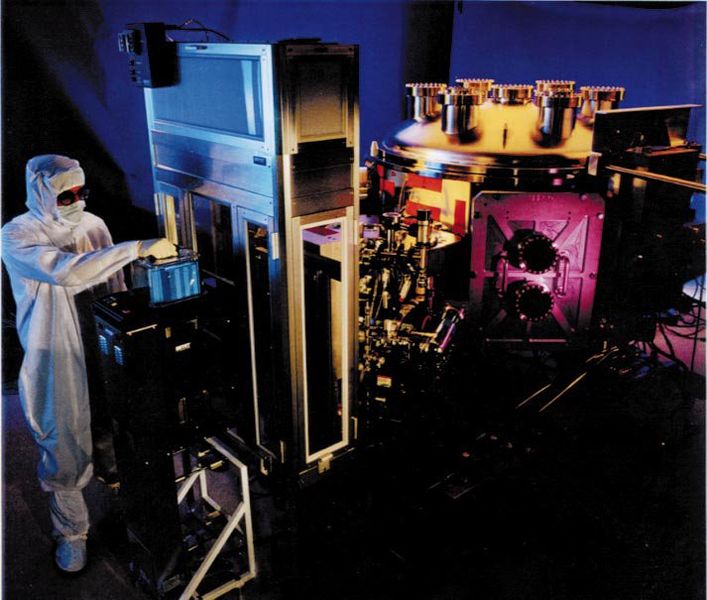
Extreme ultraviolet lithography tool (credit: Lawrence Livermore National Laboratory/Wikimedia Commons)
Moore’s Law is losing steam due to delayed introduction of next-generation extreme ultraviolet lithography (EUV), said experts at the 2012 International Symposium on Extreme Ultraviolet Lithography, EE Times reports.
EUV systems need light sources that are nearly 20 times more powerful than the ones used today to lay down patterns on next-generation chips that target sizes as small as 14 nm. Lithography experts said that they hope to have the 200W EUV light sources by 2014 — but it may take more time.
Researchers have improved the power of light sources 20-fold over the past three years. But they must make similar heroic improvements in the next two years before EUV is ready for production, said Kurt Ronse, IMEC’s director advanced lithography program. The group called for development of 500-1,000W EUV light sources by 2016.
As a result of the EUV delays “the [semiconductor] industry is no longer taking full steps, but implementing half nodes,” Ronse said. “They still call it 14 nm but it’s probably more like 16 or 17 nm,” he said.
For example, SRAM cells won’t get a full 50 percent shrink at 14 nm without EUV, Ronse said. That’s because multiple patterning has some limits in how closely it can place features.
Intel also recently said it expects to make 14-nm chips next year and could make 10-nm processors in 2015 using existing immersion lithography. Without EUV, Intel believes it will have to write as many as five immersion patterns on a chip which will take more time and money but is still economical.
Comments (24)
by J.D.
As I read the article (and some of the comments) I percieved a process design issue – you know time to change the system? I believe that since Intel will already be forced to re-engineer their fab process and machinery, that it would make better sense to add exposure elements to the system – in other words… you want brighter? Add more bulbs. Wouldn’t it be more efficient to increase the number of bulbs used in exposure and increase the etching efficiency and throughput ONCE – to 10 nm – rather than to go through pointless exercises of produce-standdown-upgrade-produce-etc.?
by J.D.
Additional information, it seems as though something like I suggest above is already in practice?
http://www.extremetech.com/computing/132604-intel-invests-in-asml-to-boost-extreme-uv-lithography-massive-450mm-wafers
by tim the realist
I’ll explain this a little better than the article does.
10nM feature etching is possible today. it’s all a matter of focusing the light onto a pattern. The brighter the light source, the larger the pattern that can be etched at one time. if a light source is dimmer than it takes several exposure patterns to complete one entire circuit layout. This takes additional time on the equipment for each chip so there is less throughput / yield from a fab.
by Sean Brazell
Moore’s Law is NOT losing steam – it’s a problem with mass production – not invention.
by Editor
… or with the laws of physics: the diffraction limit, in this case.
by Mark
Does this mean that the Singularity is cancelled?
by Editor
Yes, we apologize. We are replacing it with Mayan predictions. We advise preparing for the end of the world on Dec. 21. :)
by Bri
I forget which one this is supposed to be. Is it the end by jaguars?
by alliwant
Sounds as though the end for EUV is approaching. Does anyone know the theoretical max resolution?
by Marcos Marin
Yes, let us continue dripping tech on the undeserving unwashed masses instead of simply coming out with the 3D designs we already have…
by snake0
The article contradicts itself – it says that ‘real’ 14nm isn’t actually possible without EUV and yet Intel can shrink to 10nm WITHOUT it. So which is it??
by Marcos Marin
Good point, I would say none! This is probably a tantrum to scare the industry into getting them more funding.
by Editor
Added “Without EUV, Intel believes it will have to write as many as five immersion patterns on a chip which will take more time and money but is still economical.”
by mikandrial
“Without EUV, Intel believes it will have to write as many as five immersion patterns on a chip which will take more time and money but is still economical.” – which to me means they can, but not without great cost; a stop gap measure till they can use the real thing.
by Editor
Yes, and it will be interesting to see if that cost will be passed along down the chain to users.
by Dudegonebad
Quantum computing is getting thefunding the advances warrant. Sorry – no quantum laptop anytime soon – let’s get on with the EUV.
by Bri
Don’t they have to cool the quantum computers down to near zereo. That would be one cold laptop!
by MrFriendly
This is good. Maybe now, quantum computing, neuromorphic engineering, and other novel computing techniques will get some of the big money spent on digital devices.
by Editor
Not likely
by Uri
so we got to wait longer? ;(
by MrFriendly
“Not likely”
Why? We’re already seeing huge amounts of money being thrown at quantum computing research.
by Editor
“Maybe now, quantum computing, neuromorphic engineering, and other novel computing techniques will get some of the big money spent on digital devices”… “huge amounts of money being thrown at quantum computing”
I assume you are referring to the recent $30 million investment in D-Wave? A tiny percentage of the billions spent on chip development and computers (and other digital devices). Will not meeting arbitrary marketing dates have serious impacts? I don’t know. And I don’t have data for spending on neuromorphic engineering, but it’s for R&D, so in the low millions and over many years. I don’t know of any studies predicting development of marketable devices based on speculative quantum and neuromorphic technologies in this decade. If you have better numbers and market research studies on this, I would greatly appreciate updates.
by melajara
Not before general availability of the memristor.
This was planned for 2013. Still on schedule?
by melajara
I’ll answer my own question. I don’t think memristors will be GENERALLY available next year. Initially I estimated their impact on neuromorphic computing for 2015, now say 2017 for actual products.