More than glue: Glia cells found to regulate synapses
December 30, 2011
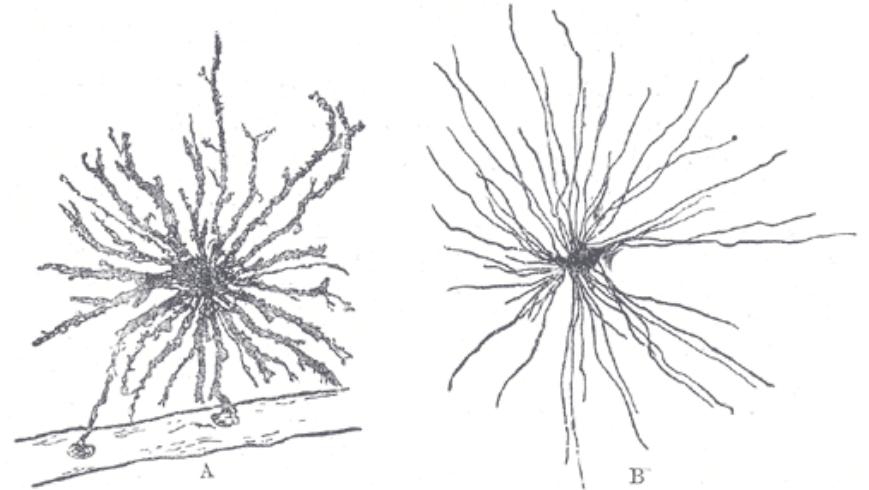
Glia cells: the brain's supervisors (credit: Gray's anatomy/Wikimedia Commons)
Glia cells are central to the brain’s plasticity, Tel Aviv University researchers have found, controlling how the brain adapts, learns, and stores information — and their design can be implemented in neuromorphic computer chips.
Glia cells (Greek for “glue,” also known as glial) hold the brain’s neurons together and protect the cells that determine our thoughts and behaviors. But glia cells have now been found to do much more: a mechanism within the glia cells also regulate the synapses, sorting information for learning purposes, according to Ph.D. student Maurizio De Pittà of TAU’s Schools of Physics and Astronomy and Electrical Engineering.
“Glia cells are like the brain’s supervisors. They control the transfer of information between neurons, affecting how the brain processes information and learns.”
De Pittà’s research, led by his TAU supervisor Prof. Eshel Ben-Jacob, along with Vladislav Volman of The Salk Institute and the University of California at San Diego and Hugues Berry of the Université de Lyon in France, has developed the first computer model that incorporates the influence of glia cells on synaptic information transfer.
The model can also be implemented in technologies based on brain networks such as microchips and computer software, Prof. Ben-Jacob says, and can aid in research on brain disorders such as Alzheimer’s disease and epilepsy.
Regulating the brain’s “social network”
The brain is constituted of two main types of cells: neurons and glia. Neurons fire off signals that dictate how we think and behave, using synapses to pass along the message from one neuron to another. Scientists theorize that memory and learning are dictated by synaptic activity because they are “plastic,” with the ability to adapt to different stimuli.
But Ben-Jacob and colleagues suspected that glia cells were even more central to how the brain works, particularly the astrocytes (a form of glia cells) in the hippocampus. Glia cells are abundant in the brain’s hippocampus and the cortex, the two parts of the brain that have the most control over the brain’s ability to process information, learn and memorize. In fact, for every neuron cell, there are two to five glia cells. Taking into account previous experimental data, the researchers were able to build a model that could resolve the puzzle.
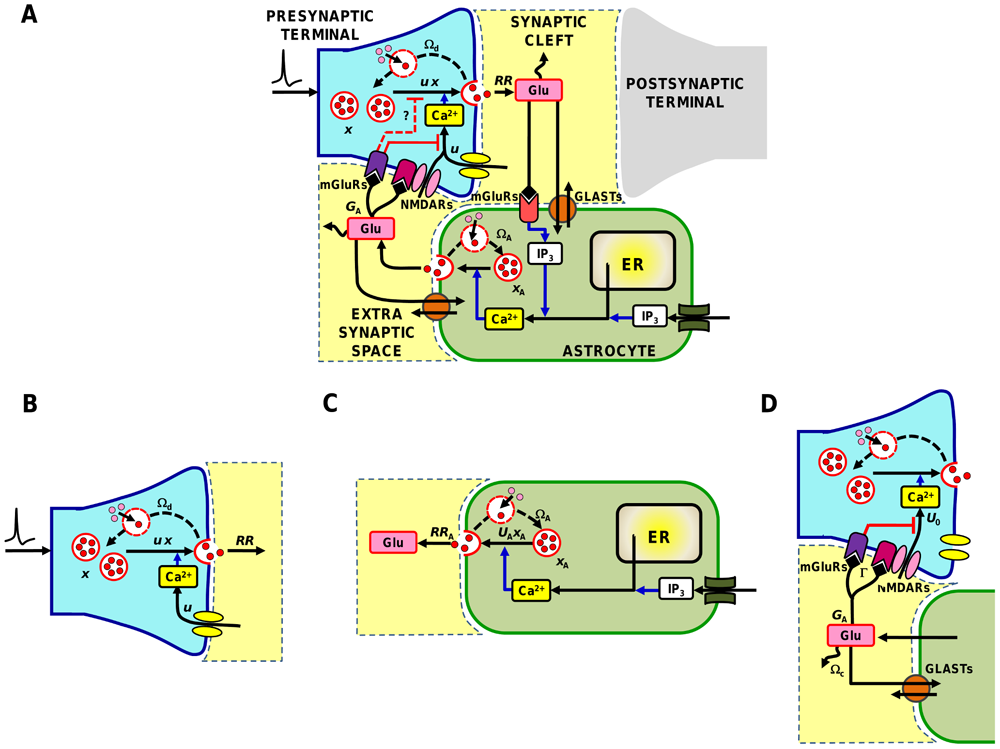
Astrocyte (glial cell) regulation of synapses in the hippocampus (credit: Tel Aviv University/PLoS Computational Biology)
The brain is like a social network, says Prof. Ben-Jacob. Messages may originate with the neurons, which use the synapses as their delivery system, but the glia serve as an overall moderator, regulating which messages are sent on and when. These cells can either prompt the transfer of information, or slow activity if the synapses are becoming overactive. This makes the glia cells the guardians of our learning and memory processes, he notes, orchestrating the transmission of information for optimal brain function.
New brain-inspired technologies and therapies
The team’s findings could have important implications for a number of brain disorders. Almost all neurodegenerative diseases are glia-related pathologies, Prof. Ben-Jacob notes. In epileptic seizures, for example, the neurons’ activity at one brain location propagates and overtakes the normal activity at other locations. This can happen when the glia cells fail to properly regulate synaptic transmission. Alternatively, when brain activity is low, glia cells boost transmissions of information, keeping the connections between neurons “alive.”
The model provides a “new view” of how the brain functions. While the study was in press, two experimental works appeared that supported the model’s predictions. “A growing number of scientists are starting to recognize the fact that you need the glia to perform tasks that neurons alone can’t accomplish in an efficient way,” says De Pittà.
The model will provide a new tool to begin revising the theories of computational neuroscience and lead to more realistic brain-inspired algorithms and microchips, which are designed to mimic neuronal networks, the researchers say.
Ref.: Maurizio De Pittà et al., A Tale of Two Stories: Astrocyte Regulation of Synaptic Depression and Facilitation, PLoS Computational Biology, 2011 [doi: 10.1371/journal.pcbi.1002293]