Neuroprosthesis gives rats the ability to ‘touch’ infrared light
February 14, 2013
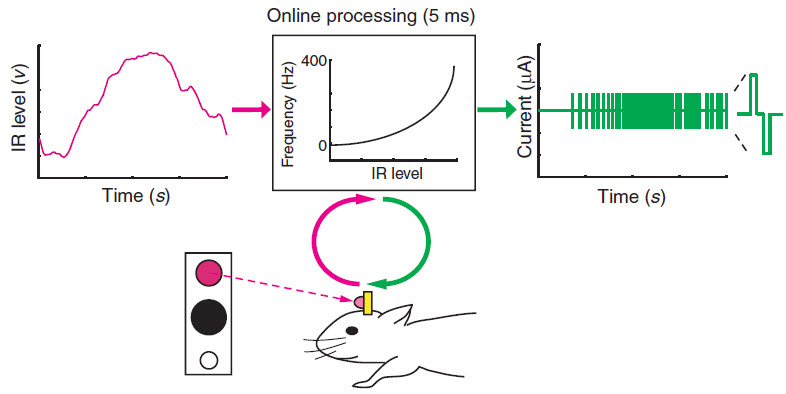
Coupling infrared levels with a microstimulator in rat’s brain. On each trial, the IR light (red) turns on, which activates the IR detector mounted on the rat’s head. Processing converts the detected IR level into a stimulation frequency. This value is sent to the microstimulator, which produces the desired current pulses, resulting in perception. (Credit: Nicolelis Lab)
An experiment by Duke University Medical Center researchers has implications for both remediating sight and augmenting perception in the future.
Nicolelis Lab researchers attached a head-mounted infrared (IR) sensor to rats and connected it to the whisker area of the brain (somatosensory cortex), using electrical microstimulation.
Despite the fact that the IR sensations were very different from whisker sensations, the rats readily learned to use this new information source, without losing their whisker senses, and were able to use infrared to discriminate among IR-visible objects in their environment.
The Helen Keller effect
This experiment was an extension of the classic “sensory substitution” experiments, in which visual stimuli were projected onto the skin via mechanical actuators, allowing congenitally blind patients to experience a visual world for the first time.
But the researchers bypassed the skin, connecting directly to the somatosensory cortex and further demonstrating the brain’s amazing plasticity (ability to rewire itself).
The researchers note that, in principle, this any novel stimulus (for example, magnetic or radio waves) could be used, instead of infrared light.
Introduction to the structure of the task. Two views of a rat performing a single trial of the IR-discrimination task. The IR light comes on, and when the rat orients toward the stimulus, an IR-signal is registered by an IR-detector on the rat’s head, and S1 (somatosensory cortex) is stimulated with a frequency that depends on detector’s output. Guided by microstimulation, the rat approaches the reward port to receive water. In the floor-level view, you can see the infrared detector attached to the rat’s head. The audio track is the output of the microstimulator, which is not available to the rat.
Example of rat performing IR discrimination (top-down view). Movie shows three trials in a well-trained rat navigating the chamber actively foraging for IR sources. The ports are 90 degrees apart.
Example of IR-discrimination in difficult version of task. Multiple trials in a well-trained animal on a more difficult version of the task than shown in Movie 2: the reward ports are only 30° apart. Correct and incorrect trials are indicated.
Sample trials from a session with “blank” trials interleaved. On random trials the IR light is activated, but is uncoupled from the (somatosensory cortex stimulation. Trial types (“stim” versus “no-stim” trials) are indicated before each trial.