New hope for the blind from neuroscientists?
October 22, 2012
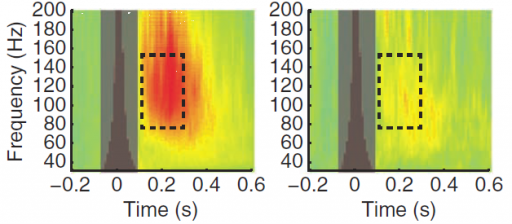
Patients perceived phosphenes (flashes of light) when certain electrodes (left) were used to stimulate different parts of the visual cortex of epileptic patients, but not in other parts (rights). The phosphenes long occurred when gamma signals (high-frequency brain waves) were recorded in the temporoparietal junction of the brain
Scientists in the Texas Medical Center believe that there may be a way to use mental images to help some of the estimated 39 million people worldwide who are blind.
Scientists in the laboratories of Michael Beauchamp, Ph.D., an associate professor of neurobiology and anatomy at the The University of Texas Health Science Center at Houston (UTHealth) Medical School, and Daniel Yoshor, M.D., an associate professor of neurosurgery and neuroscience at Baylor College of Medicine, have discovered a neural mechanism for conscious perception that could use the brain’s image-generating ability.
“While much work remains to be done, the possibilities are exciting,” said Beauchamp, the study’s lead author. “If successful, we would in essence bypass eyes that no longer work and stimulate the brain to generate mental images. This type of device is known as a visual prosthetic.”
What do you see, when you turn out the light?
“With all the remarkable advances in computers and technology in recent years, the time is now ripe to develop a visual prosthetic. A key obstacle to progress right now is our limited understanding of how brain activity leads to visual perception. This new study is a step toward our goal of better understanding visual perception, so we are better able to make a useful visual prosthetic,” said Yoshor, the study’s senior author.
The Houston team and others working in the field of neural engineering are focused on repairing disorders of the brain and nervous system.
In the study, scientists directly stimulated the brain to create the illusion of a flash of light, called a phosphene. Right now, researchers can generate one flash at a time but many more will be needed to create useful images.
The occipital lobe (the part of the brain at the back of the head) is responsible for vision and mental images. The brain uses tiny electrical charges to relay information among nerve cells. By electrically stimulating the occipital lobe, the brain can be fooled into perceiving things that are not actually there.
The key finding in the new study was that electrical stimulation only results in the illusion of a flash when there is activity in another region of the brain, the temporoparietal junction. When there was much activity in this other area of the brain, participants always perceived the flashes. Conversely when there was little activity, subjects never did.
The three patients who volunteered to participate in the study ranged in age from 18 to 47 and they were being treated for epilepsy at St. Luke’s Episcopal Hospital, where Yoshor serves as chief of neurosurgery. As for a next step, Beauchamp and Yoshor plan to conduct a larger patient study and create multiple flashes of light at the same time. Twenty-seven or so simultaneous flashes might allow participants to see the outline of a letter, for instance.
The study was supported by grants from the United States National Institutes of Health and the Veterans Health Administration.