New injectable hydrogel encourages regeneration and improves functionality after a heart attack
February 22, 2013
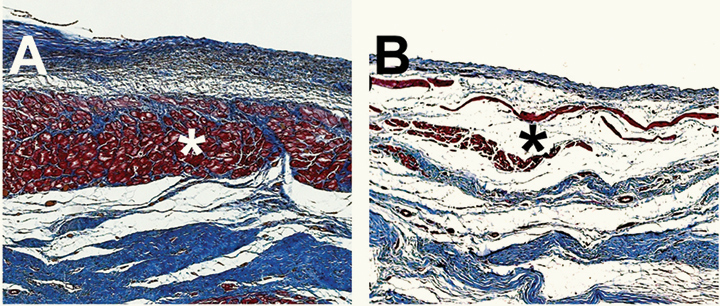
Microscopic images of pig hearts damaged by heart attack show the growth of new heart muscle tissue (Shown in Red, Figure A) after treatment with an injectable hydrogel compared to a heart left untreated (Figure B, right) (credit: Karen Christman/UC San Diego Jacobs School of Engineering)
University of California, San Diego bioengineers have demonstrated in a study in pigs that a new injectable hydrogel can repair damage from heart attacks, help the heart grow new tissue and blood vessels, and get the heart moving closer to how a healthy heart should.
The gel is injected through a catheter without requiring surgery or general anesthesia — a less invasive procedure for patients.
There are an estimated 785,000 new heart attack cases in the United States each year, with no established treatment for repairing the resulting damage to cardiac tissue.
Lead researcher Karen Christman, a professor in the Department of Bioengineering at the UC San Diego Jacobs School of Engineering, said the gel forms a scaffold in damaged areas of the heart, encouraging new cell growth and repair. Because the gel is made from heart tissue taken from pigs, the damaged heart responds positively, creating a harmonious environment for rebuilding, rather than setting off a chain of adverse immune system defenses.
“While more people today are initially surviving heart attacks, many will eventually go into heart failure,” said Christman. “Our data show that this hydrogel can increase cardiac muscle and reduce scar tissue in the region damaged by the heart attack, which prevents heart failure. These results suggest this may be a novel minimally invasive therapy to prevent heart failure after a heart attack in humans.”
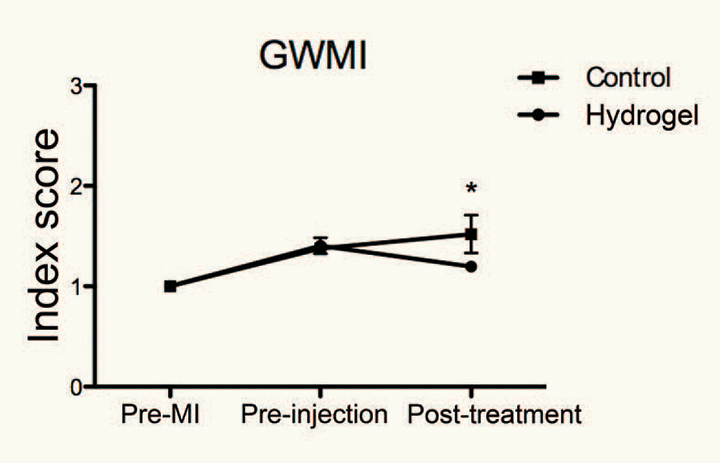
UC San Diego bioengineers demonstrated in a study in pigs that a new injectable hydrogel gets hearts moving more like they should — as measured by the Global Wall Motion Index (GWMI) — in hearts following heart attack. After a heart attack, the score was elevated; however, for pigs that were treated with the hydrogel, this index score dropped back closer to normal. (Credit: Karen Christman/UC San Diego Jacobs School of Engineering)
The hydrogel is made from cardiac connective tissue that is stripped of heart muscle cells through a cleansing process, freeze-dried and milled into powder form, and then liquefied into a fluid that can be easily injected into the heart.
Once it hits body temperature, the liquid turns into a semi-solid, porous gel that encourages cells to repopulate areas of damaged cardiac tissue and to improve heart function, according to Christman.
The material is also biocompatible; animals treated with the hydrogel suffered no adverse affects such as inflammation, lesions or arrhythmic heart beating, according to safety experiments conducted as part of the study.
Further tests with human blood samples showed that the gel had no affect on the blood’s clotting ability, which underscores the biocompatibility of the treatment for use in humans.
San Diego-based startup, Ventrix, Inc., which Christman co-founded, has licensed the technology for development and commercialization. Christman also serves on the company’s board. “We are excited and encouraged by the results of the study leading to a novel regenerative medicine solution for cardiac repair. The technology offers the potential for a longer and better quality of life for millions of heart attack sufferers,” said Adam Kinsey, the CEO of Ventrix.
Comments (10)
by Ed
god.. I sure hope this treatment isn’t delayed for another unbearably long twenty years like it seems most treatments are..
I have some people that I love very much who would benefit from this greatly. please guys, hurry up and get it out there in general use. Here’s one case just like the polio vaccine – where ‘safe’ trials had much more of a downside than just getting it out there. Doing that with the polio vaccine saved countless lives – just as it would here.
by tim the realist
Oasis wound matrix is a similar product currently in use. Similar scaffolds are also being used in research to grow replacement organs from stem cells. 3D printing techniques, stem cells, scaffolds, differentiation chemicals are huge areas of investigation with many exciting discoveries to come.
by Ian Clarke
This is great news. Once you’ve had a heart attack, you’re pretty much living on borrowed time – no more, it seems!
by Camaxtli
Since it is derived from the patient’s tissue, the FDA hopefully won’t have a lot of authority over it. That’s the big question for me though: how does the FDA regulate this sort of treatment? Hopefully this will not suffer too many roadblocks in development.
by Frank
I wonder if this technology might be applicable to heart conditions such as a leaky heart valve or bridging a gap in a leaking valve.
by beatriz valdes
Good question, hope an expert answers. But probably not, as the leaky heart valve is usually genetic, we are born with it, and the gel might simply facilitate recovery of precious condition of the heart, or other organ. But wonderful things are happening in cardiac medicine.
by Bruce Wright
There are numerous conditions that can result in a leaky heart valve that aren’t genetic – rheumatic fever, for example. However from the description it sounds like it’s most useful for regenerating heart muscle rather than things like valves, especially since it has to be directly applied to the damaged areas; this would seem to make valve repair using the catheter technique difficult, though it might be possible using open-heart surgery. Hopefully someone familiar with this specific research project is reading this and could respond.
by hal
would organ specific attributes preclude this process from working in other situations such as knee meniscus one wonders. pigs.
by Bri
They are using the connective tissue. If there are substantial differences in this material in relation to different organ types, I would think the connective tissue from those other organ types could be used to fabricate gels specific to those organs. This sound like the” pixie dust” that is being used for skin and muscle repair. It is fabricated from the stomach lining of pigs if I’m not mistaken. I’m not sure if there are differences. That material doesn’t induce rejection responce’s. It’s full of peptides that seem to stimulate cell responce’s. In particular it attracts stem cells. These materials will be a bridge technology till nanobotic cellular control is achieved.
by hal
Thanks for the info. Sounds right. Thin meniscus precludes the added gravity of running. Walking is allowed. haha. No advantage to the metal knee replacement as it allows walking. The science is close in stem cell work to material like collogen more like cartilage cushion, a rubber bumper that prevents bone on bone. Not Adrain Peterson’s ACL. Currently best practice are variations of hyaluronic acid which provide a limited partial remedy. Runners need the cushion solution which is close but so far no banana. one of the reasons i love Ray’s newsletter as it is so wide ranging and up to date just by charting his so called G.R.I.N. These are the important arenas. Politics and religion have the appearance of being center stage but actually are trailing along behind Copernicus and all his friends before and after him.