New self-driving car system tested on UK roads
February 20, 2013
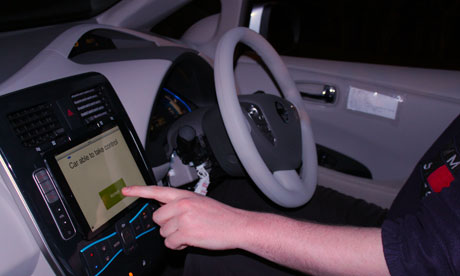
The self-driving car halts for pedestrians and could take over tedious parts of driving (credit: Oxford University Department of Engineering Science)
Scientists at Oxford University have developed a self-driving car that can cope with snow, rain and other weather conditions. The system can be fitted to existing cars and could one day cost just £100 (US$150), The Guardian reports.
The new system has been installed in a Nissan Leaf electric car and tested on private roads around the university. It will halt for pedestrians, and could take over the tedious parts of driving such as negotiating traffic jams or regular commutes.
The ystem has been demonstrated on public roads — and as long as there is a licensed driver in the driver’s seat, “there’s no obvious legal barrier to using it on roads now,” professor Newman told the Guardian. “It’s essentially an advanced driver assistance system.”
Newman thinks that it could be only 15 years before self-driving systems become commonplace in cities as the price of installing the systems drops: “At present it costs about £5,000, but we’re working to reduce that to £100,” he said.
The car has been tested running at up to 40mph, said Newman.
Rather than using the GPS navigation system, which can be unreliable in cities where “urban canyons” caused by buildings block signals, and only accurate to a few metets, the British-developed system uses 3D laser scanning allied to computer storage to build up a map of its surroundings, which is accurate to a few centimeters.
The auto-drive system works by recognizing where it is, based on a laser scanner on the front of the car, comparing its surroundings to its stored data. That’s different from Google’s system, which uses a combination of GPS, laser guidance — from a roof-mounted laser — and mapping to determine its location and route.
The Oxford system, developed through funding from the Engineering and Physical Sciences Research Council, could be extended so that each car downloads data from passing cars, or over the internet via 3G and 4G connections to a central system.
Comments (36)
by Chrisf
It’s certainly misunderstood by you two! At day seven, you have an increase of 7.2%… Doubling would take 70 years not 7
by Cybernettr
Exactly what comment are you replying to?
by SmartAndSober
Charles Abraham and me.
by Paul in Vancouver
Driverless technology is already here, and it can go mainstream within five years if we wanted. The obstacles are no longer technological; they are political and consumer resistance.
by SmartAndSober
Many people don’t know that Google is making and selling self-driving cars.
How fast will BMW/Ford/Toyota/Mitsubishi/Tesla Motors etc catch up?
by SmartAndSober
BTW, I don’t think the “Consumer Resistance” is a major factor. At most a few years (surely less than 1 decade) majority of cars will be Self-Driving.
by Cybernettr
According to PopSci (certainly not one known for modesty in making predictions), We simply won’t have the wireless infrastructure needed to link all our cars with all our traffic tech by the end of this decade. By this reasoning it will be well into the next decade before the majority of cars will be Self-Driving.
by Editor
“We simply won’t have the wireless infrastructure needed to link all our cars with all our traffic tech by the end of this decade.”
I’m not familiar with that forecast. Is there a citation?
by SmartAndSober
In Ray’s book, “The Singularity Is Near”, he predicted that *Human-Equivalent* AI will appear in late 2020s. So it is that date (or perhaps early 2030s) that is the Singularity. Not 2045.
Let us hope the AIs will be benevolent (like what the Singularity Institute is working hard to create) and provide humans with Mass-Uploading technology.
We will require no more traffics if everyone will become omnipresent (via the post-Singularity Internet).
by jefs99
Actually, in his book The Singularity is Near, Ray does state on pg. 136 that 2045 is the date for the Singularity. He bases that on extrapolating the computation power of computers today to the point in which they are 1 Billion times more powerful that all human intelligence today.
by SmartAndSober
” N times more powerful.” is unclear expression. I will clarify:
Today humanity is not well organized (the existing system/mode of human-cooperation, such as Internet, can be improved upon A LOT).
If we can be more organized (let’s say via cyborgization-enabled telepathy) a “Collective-Entity” appears, then we can measure the “Entity’s” IQ.
by SmartAndSober
Imagine 2 PERSONS (each IQ 100) work together. If they cooperate poorly (BAD team spirit, or perhaps GOOD team spirit but LACK good schedule/plan and good IT technology), the resulted “COLLECTIVE ENTITY”‘s IQ is not 100 * 2 = 200, but (I guess) LOWER than 200.
If their cooperation is optimal (best team-spirit/friendship, combined with best brainstorming/plan, and best technology (computers, Internet, communication tech)) the resulted IQ is HIGHER than 200.
If they have cyborgization that exploit the of HUMAN BRAIN’S QUANTUM-computing effect, combined with TELEPATHY, the IQ is MUCH HIGHER (EXPONENTIALLY) than 200.
by tim the realist
AIs won’t need to travel much in cars, they can send their eyes and ears and “helper bots” anywhere they want. We think very locally because we are restricted to body parts that are always connected to our bodies. Future beings will have no such restrictions.
I’m really glad people are finally realizing the potential of expanded cruise control systems. No legality or liability issues with a cruise control. It also does not eliminate the driver so fewer jobs will be displaced, only people who make a living off of the crashes will have reduced opportunity. Once all drivers are displaced, many unskilled personnel will be unable to find new jobs. Additionally, the legal system will undergo a huge downsizing once cars obey all laws. Also with fewer auto deaths, more people will survive and need jobs. It’s really complicated and no one can predict the societal ramifications.
by SmartAndSober
” … many unskilled personnel will be unable to find new jobs.”
There are free education on the Internet.
A list: Coursera (Coursera.com), Wikipedia (en.wikipedia.org), and Professor Hugo deGaris’s free Math/Phys/Comp video courses:
http://www.youtube.com/playlist?list=PL7637657C692EC948&feature=mh_lolz
When Cyborgization become common, these people will come back to workforce easier.
“… more people will survive and need jobs.”
*Everyone* Should survive. We should Not consider traffic death as a “Way to Balance Population”. I prefer *Immortality For Everyone*.
by Cybernettr
It’s not simply a matter of there being courses out there. It’s a matter of what somebody is suited for. If someone is a truck driver today, it’s probably because that’s what he’s best suited for. He isn’t ever likely to become a brain surgeon, no matter how much training he gets.
by SmartAndSober
Before we invent GI (GENERAL INTELLIGENCE), the only natural GIs are Human Beings. Human beings are precious resources (from EVEN a materialist viewpoint) because even a dumb human is much smarter than the smartest chimp.
It’s easier to Teach a human skills than create a robot to do jobs.
” It’s a matter of what somebody is suited for … ”
A lot people could have got Better Education and Have a Better Job, but Did not (for good example, Asian’s average IQ is 105, but during Cultural Revolution a lot bright Chinese youth WERE NOT PROPERLY EDUCATED, which means THESE PEOPLE (Chinese born in 1950s) COULD HAVE GOT BETTER JOBS TODAY, example including Prof deGaris’ own current wife).
Don’t give up on Humans.
by SmartAndSober
Also, we must remember that the “Ubiquity/Omnipresence” is enabled by hardwares. AIs cannot project themselves to where there is no available hardware.
Let us hope that such hardware can increase fast (or even Exponentially).
by KEnKC
Population is projected to top out before it reaches 10 billion
by andmar74
I’m a bit tired of reading about “exponential” growth, as to say it’s growing quickly. Exponential growth might be very slow..
by Charles Abrahams
If x grows in sales exponentially, starting at 1% growth per day then market saturation of 100% will be achieved by day 7. Slow huhh ?
by SmartAndSober
Thank you for the Excellent Example. The speed of A to the Power of B is ill understood.
by knpstr
1% is ~7 doublings away from 100%, but if it is growing constantly at 1% in 7 days it won’t be 100%
by snake0
15 years? But I want it nowww
by Ian Clarke
My apologies, Carol. Just checked my facts (which, of course, I should have done first!), and apparently population growth IS growing exponentially. Not sure where I picked up the idea that it wasn’t.
Regards,
Ian Clarke (Minister of Misinformation) :-)
by SmartAndSober
Exponential Growth of human population *Must* be coupled with Exponential Growth in Computing and Communication techs.
Before we create the first Artificial General Intelligence, the only General Intelligences existing are human beings.
We need more Computers and Communication tools to *channel* the Human Computing Power.
by Michael E. Arth
Actually, we’ll need less cars because few people will need to own cars. Most cars now are parked more than 90% of the time and they are just taking up space and costing their owners a lot of money. By the end of the decade (not 15 years) it will be possible to have a smaller fleet of robot taxis that continually circulate. You’ll be able to have the type of vehicle you want when you want it for less than the cost of ownership. We’ll also eliminate the terrible human suffering and financial burden exacted by millions of car accidents caused by clumsy humans. Humans will be able to be more productive with their time while being chauffeured around.
by Paul in Vancouver
We’re already starting to see this car-share concept in on-demand rental services such as Car2Go and ZipCars in dense urban areas. Give it a few years, and we’ll reach a critical mass in terms of availability of these cars on every street corner and that’s when consumers will realize it’s far more convenient and affordable to use a car-sharing service.
by Carol Hu
Wow~~!People are going lazier.With the exponential population growth, more vehicle are needed. what if the roads are covered by driverless cars but no space for any more new roads. When will the flying car come to us?
by Ian Clarke
Firstly, I don’t think people will become lazier – just have more time to indulge in pleasurable activities (which may include work). Secondly, global population growth is not growing exponentially. Let’s try to stop this sort of misinformation from being spread.
It’s weird to first read news happening in my own country from a US-based site. :-)
by SmartAndSober
” I don’t think people will become lazier.”
That’s right. I don’t consider physical inactivity to be real laziness.
What is real laziness is intellectual/creative laziness.
By freeing people from physical works, we can all spend more time learning (most importantly, science/technology) doing scientific discoveries and inventions.
More people with knowledge/skills means the science/technology progress will accelerate.
Singularity will come sooner.
by Bri
People are going crazy with population growth makes more sense. The trend isn’t exponential, thank heaven! I would expect more cars not less, per individual. Two things are stopping flying cars the costs of going airborne are too high and the risk of collisions and cars falling from the skies onto property below is too great.
by GFreeman
The fundental problem with flying cars is that flying cars must keep moving (flying) to be safe while land cars can stop to be safe. We will not have univeral flying cars unil we can separate inertial mass from gravitational mass (See Star Wars, Star Trek, Blade Runner and Superman).
by Bri
There was a recent system that used eight independent rotors( redundancy in case of engine failure) it worked like a Vertical takeoff plane so it was able to hover like a helicopter. I like the idea of negating mass. Ever hear of John Hutcheson? Tantalizing glimpses of that possibility.
by SmartAndSober
After the Singularity, the population growth *will* become exponential.
When large portion of Earth, and eventually the Solar System, is converted to computing-strcutures, the population of *infomorphs* (AIs and uploadees) will increase at a rate that is impossible in *meatspace*.
And the Singularity may arrive earlier than in 2045.
According to Vernor Vinge’s projection, it should come in (the latest) 2030.
by Cybernettr
And how does he figure that?
by SmartAndSober
Singularity is, by definition, a “Prediction-Wall” in human history. People should get (a lot of) education about this event.
Not preparing for Sing is worse than not preparing for WorldWarThree.