New solar cells increase solar panel efficiency by more than 25%
February 9, 2012
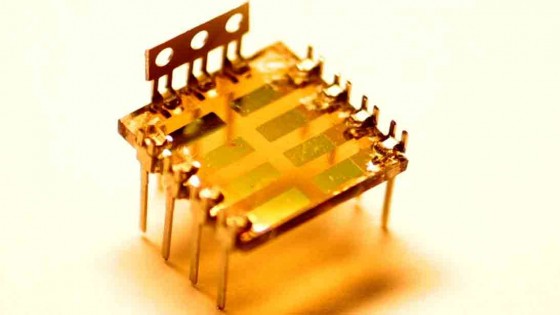
New solar cell (credit: University of Cambridge)
University of Cambridge scientists have developed hybrid solar cells that could increase the maximum efficiency of solar panels by more than 25%.
Typically, a solar cell generates a single electron for each photon captured. They added pentacene, an organic semiconductor, to harness the extra energy of blue light, allowing for generating two electrons for every photon from the blue light spectrum. This could enable the cells to capture up to 44% of the incoming solar energy.
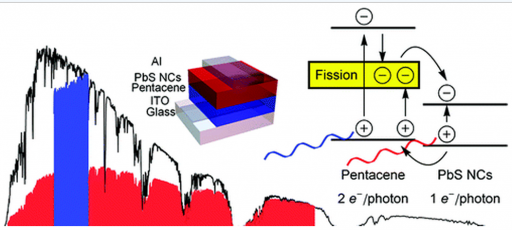
Hybrid photovoltaic device architecture. Infrared photons are absorbed using conventional lead sulfide (PbS) nanocrystals. Visible photons are absorbed in pentacene to create singlet excitons, which undergo rapid exciton fission to produce pairs of triplets. (Credit: ACS)
Ref.: Bruno Ehrler, et al., Singlet Exciton Fission-Sensitized Infrared Quantum Dot Solar Cells, NanoLetters, 2012; [DOI:10.1021/nl204297u]