Proposed satellite would beam solar power to earth
April 9, 2012 | Source: Space.com
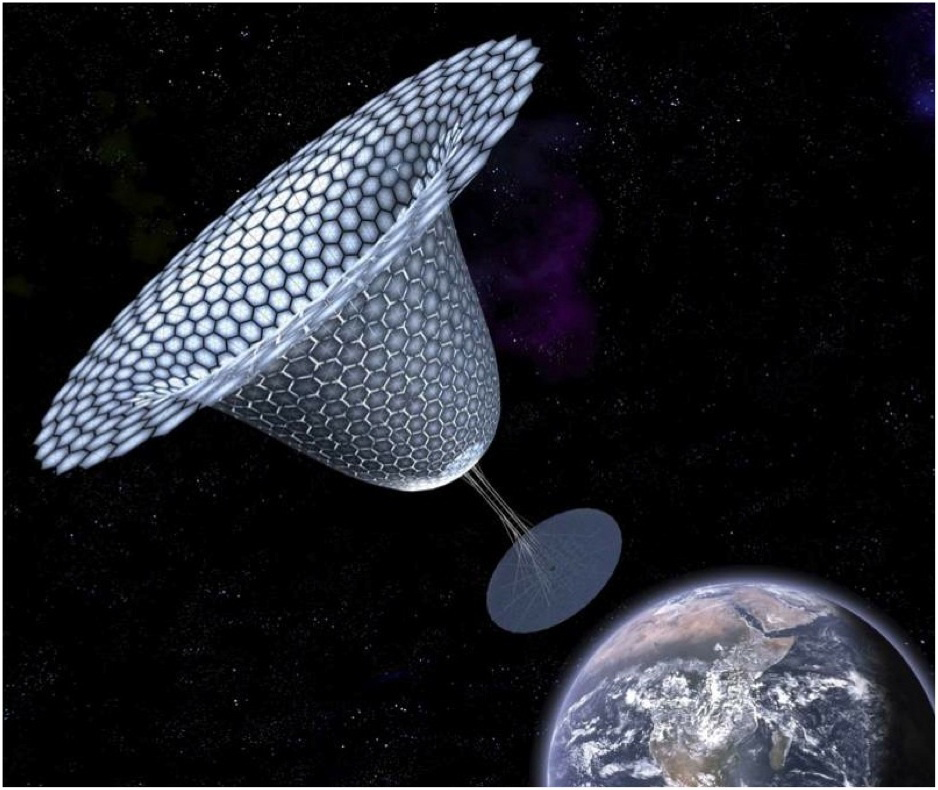
Space-based energy factory, SPS-ALPHA --- the Solar Power Satellite via Arbitrarily Large PHased Array (credit: John Mankins)
A NASA-funded new approach to power-beaming solar-power satellites has been developed by John Mankins, who led the first NASA solar-power-satellite development team in the 90s.
Called the SPS-ALPHA (Solar Power Satellite via Arbitrarily Large PHased Array), this “first practical solar-power satellite concept” uses a novel “biomimetic” approach.
Mankins said that this project would make possible the construction of huge platforms from tens of thousands of small elements that can deliver remotely and affordably tens to thousands of megawatts using wireless power transmission to markets on Earth, as well as missions in space.
SPS-ALPHA uses a large array of individually controlled thin-film mirrors, outfitted on the curved surface of the satellite. These movable mirrors intercept and redirect incoming sunlight toward photovoltaic cells affixed to the backside of the solar power satellite’s large array.
The Earth-pointing side of this large modular circular array is tiled with a collection of microwave-power transmission panels that generate the coherent, low-intensity beam of radio frequency energy and transmits that energy to Earth.
Moreover, the SPS-ALPHA concept, Mankins said, enables a solar-power satellite that can be assembled entirely from individual system elements that weigh no more than 110 to 440 pounds (50 to 200 kilograms), allowing all pieces to be mass produced at dramatically lower cost than traditional space systems.
Comments (13)
by Thomas B. Albright
Studies circa 1960s pointed out the extreme danger and damage in the presence of loss of control of the pointing system.
by wolfman141
If NASA can take a share of the profits from the sale of energy, it could make the enterprise self-sustaining.
by equsnarnd
How competitive is it with nuclear, or natural gas, or fuel cells? What I don’t want is another massive gov’t project centralizing power in the hands of a few. What I want is a cold fusion reactor for $1000 that will provide energy for my home or business for years and give me energy independence. Now CF may be a pipe dream but that is the kind of technology we need. Not these massive programs that leave something so important in the hands of a few and create the ground for massive corruption.
by James Lindelien
Interesting but what is the cost per watt compared to (albeit less efficient but cheaper to build and maintain) terrestrially deployed systems?
by gaoptimize
For cities like Moscow, Stockholm, Oslo, London, Toronto, Seattle, Tokyo, and Seoul, the economics of nearly 24X7, weather-independent might make it more competitive.
by Adam
The chief advantage is continuous supply which terrestrial systems only do with difficulty. The cost advantage is quite significant given sufficient low mass solar arrays in space.
by gaoptimize
Gerard K. O’Neill addresses the microwave safety issue in his seminal book “The High Frontier”
http://www.amazon.com/The-High-Frontier-Colonies-Apogee/dp/189652267X
Long before the antenna got large enough to put a dangerous spot on the ground, it’s size would give the intent away. The simple ground collectors for a reasonably large solar power satellite are typically several kilometers in diameter and the power density is safe for wildlife and air traffic.
by wildiris
“…the power density is safe for wildlife and air traffic.” Do you have any numbers to go with this assertion? Sunlight is about 1 KW per sq-meter. For this scheme to be any better than photovoltaic arrays, the power density would have to be considerably higher; on the order of 10 KW per sq-meter or higher. This is certainly high enough to cause burns if you have any metal on you. And I can’t imagine that long exposure at these levels could possibly be benign.
by Lord Penguin
Frequency is very important. The satellite wouldn’t just concentrate sunlight, it would transmit it at a radio frequency which wouldn’t be harmful to life at a fairly low concentration.
by Mortran
Couldn’t that be used as a weapon too?
Considering that the NASA would depend on Russia or China to deploy such a system in space, because NASA lacks the necessary carrier system, it is very unlikely that the Russians or Chinese would help them to establish such a potential weapon.
by Samcon
Mortran – the US would just contract spacex to take it into orbit.
by dad2059
You’re kidding, right? Ever hear of the Atlas V, Delta IV or even SpaceX’s Falcon 9 rockets?
You listen to too much propaganda.
by Lord Penguin
If NASA can get funding, they can develop the equipment to launch it. It might not seem that probable that they’ll get enough, but if they can convince the government that it can be used as a weapon, they wouldn’t have much trouble. The opposite applies with Russia/China, if they can convince them that it can’t be used as a weapon, such as by building it so that it can’t concentrate the transmission, they might be able to get their help. And the EU is an option as well.