ProtoHouse
October 26, 2012
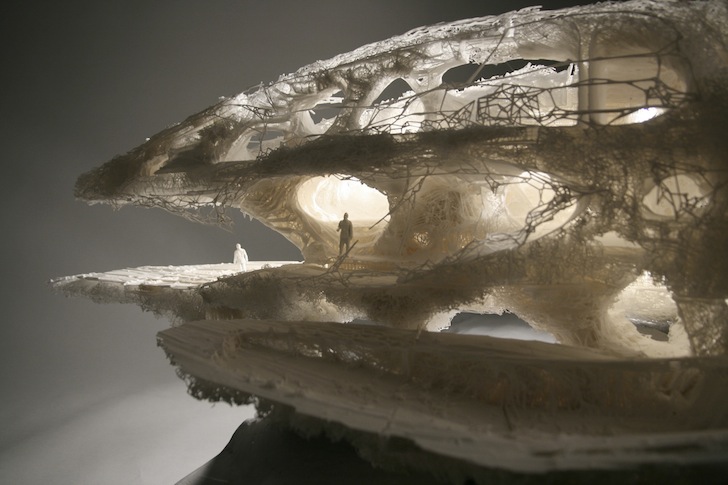
ProtoHouse (credit: Softkill Disign)
Softkill Design‘s ProtoHouse project investigates the architectural potential of the latest Selective laser sintering technologies, testing the boundaries of large scale 3D printing by designing with computer algorithms that micro-organize the printed material itself.
With the support of Materialise, Softkill Design produced a high-resolution prototype of a 3D printed house at 1:33 scale. The model consists of 30 detailed fibrous pieces that can be assembled into one continuous cantilevering structure, without need for any adhesive material.
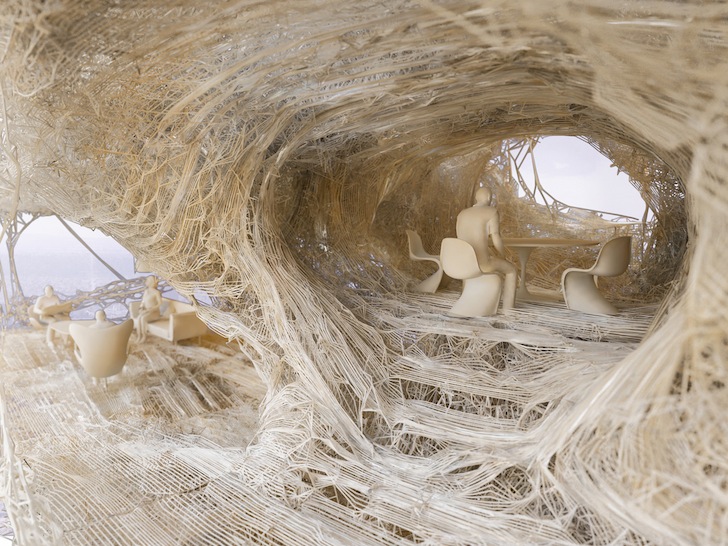
ProtoHouse (credit: Softkill Disign)
The arrangement of 0.7mm radius fibers displays a range of flexible textures and the ability to produce in-built architectural elements, such as structure, furniture, stairs, and façade, all in one instance. The Softkill house moves away from heavy, compression-based 3d printing of on-site buildings, instead proposing lightweight, high-resolution, optimized structures that, at life scale, are manageable truck-sized pieces that can be printed off-site and later assembled on-site.
This research was produced at the Architectural Association School of Architecture’s Design Research Lab in the studio of Robert Stuart-Smith. Research prototypes were generously supported by Materialise, with additional support from VoxelJet, and Sirris.
Comments (16)
by Aaron
Looks cool but think of all the bugs that would be living inside all those cracks if it were made for a real habitat.
by Vin
Intresting that the algorithm comes up with something that looks fibrous like bone.
by snake0
Not bad for a version 1.0. Can’t wait to see what improvements they can make on it.
by Bri
I think this will be great for Sci Fi movie sets. I wouldn’t recommend becoming a salesman for this design.
by Miroshka
shouldn’t the furniture be part of the house too?
by j
The next logical step would be printing little spider costumes for the people who live in this house.
by Greg
It looks like it wants to digest the inhabitants.
by Editor
Yes, that’s because it’s modeled on the zebrafish: http://www.kurzweilai.net/a-fluorescent-test-for-antioxidant-drugs
by Aaron
It’s the rodent Shangri La.
by TomZarek
Dusting would be a nightmare
by J
Cool, but looks like a spider web. Probably going to need to make this more aesthetically appealing as a home.
by lachlan
i’m assuming the idea is that the fibrous shell could be smoothed out or covered to be more wall-like.
by Jack Reeve
Now we can print our own loofah. Far out.
by dbamford
Nice, a new approach to structure design, and a way to print a “house” … or sorts. I could see the easy access to the interior being a benefit to plumbers and electricians… you could run pipe and power cables almost anywhere, but there would also be great opportunity for energy efficiency, new passive solar designs, and the like. For the marketplace this tech would have to be reined in to a more commonplace form, i.e., a box. Organic forms are nice to look at, but the reason people live in boxes is that flat surfaces are easy to walk on, and vertical walls function for storage as well as display/art space. If people did not want this, we would all already be living in hobbit holes. An easy first step would be to mimic the design of earth-style adobe houses from the southwest.
by Spikosauropod
I don’t want to live in a house that looks like the inside of a squash.
by peter g
how long until you can buy a piece of barren land and print a house onto it