Ray Kurzweil’s How to Create a Mind to be published Nov. 13
September 21, 2012
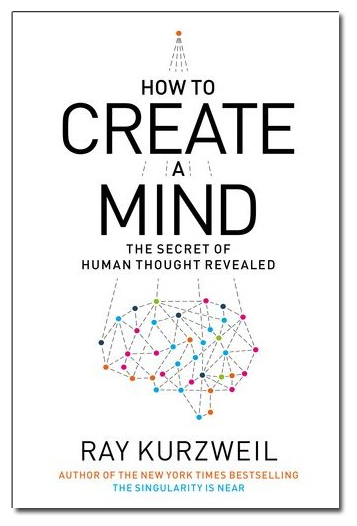
Ray Kurzweil’s next book — How to Create a Mind: The Secret of Human Thought Revealed* — will be published Nov. 13, Viking announced today. It can now be pre-ordered.
In the book, Kurzweil explores the most important science project since the human genome: reverse-engineering the brain to understand precisely how it works, then applying that knowledge to create vastly intelligent machines.
Drawing on the most recent neuroscience research, compelling thought experiments, and his own research and inventions in artificial intelligence, he describes his new theory of how the neocortex (the thinking part of the brain) works: as a self-organizing hierarchical system of pattern recognizers.
A roadmap to superintelligence
Kurzweil shows how these insights will enable us to vastly extend the powers of our own mind, and provides a roadmap for the ultimate creation of superintelligence — humankind’s most exciting next venture.
“We are now at the dawn of an era of radical possibilities in which merging with our technology will enable us to effectively address the world’s grand challenges,” he says. “We are already seeing artificial intelligence go mainstream with the recent innovations of IBM’s Watson, the iPhone’s Siri, and Google’s self-driving cars.
“The inevitable next step is that our brains will soon be merged with the intelligent technology we are creating. By around the 2030s, nanobots in our bloodstream and brains will keep us healthier and smarter, most of our thinking will be in the cloud — unhindered by the natural limits of our biological brain and easy to back up like a hard drive, and we will vastly speed up the learning process.”
How to Create a Mind is Ray Kurzweil’s seventh book, joining The Age of Intelligent Machines, The 10% Solution for a Healthy Life, The Age of Spiritual Machines, Fantastic Voyage: Live Long Enough to Live Forever, The Singularity Is Near, and Transcend: Nine Steps to Living Well Forever.
“One of the eminent AI pioneers, Ray Kurzweil, has created a new book to explain the true nature of intelligence, both biological and non-biological,” said AI pioneer Raj Reddy. ”The book describes the human brain as a machine that can understand hierarchical concepts ranging from the form of a chair to the nature of humor. His important insights emphasize the key role of learning both in the brain and AI. He provides a credible roadmap for achieving the goal of superhuman intelligence, which will be necessary to solve the grand challenges of humanity.”
Pre-ordering How to Create a Mind
How to Create a Mind can be pre-ordered on the book’s website, effective today. Pre-order benefits include: 34% off the retail cover price, inscribed bookplate (sticker) by Ray Kurzweil, How to Create A Mind t-shirt, free video streaming of the Transcendent Man: the Life and Ideas of Ray Kurzweil movie, a $1200 gift certificate toward attendance at Singularity University’s 7-day Executive Program at the NASA Ames Campus in 2013, and automatic entry to win a seat at this Executive Program (raffle drawing will take place on November 13th and the winner will be notified via email).
* Viking; November 13, 2012; ISBN: 9780670025299; 336 Pages; $27.95
Comments (140)
by Bruce
Gee, I kind of feel ripped off. When I first heard about this book I was skeptical, but decided to pre-order it at Amazon. Then I get an email where my pre-order was removed because the publication date of the book was pushed off. Most likely it was one of those things that Kurzweil in a speech at Google learned and needed to put in his book … I think he said he did that 6 times.
So anyway, if anyone is a supporter and fan of the book, it’s me, not to mention I bought the Audible and Kindle versions of the book.
Not enough graphs and pictures in my opinion. We need to see some block diagrams of this stuff so it makes more sense … but so far fascinating.
by Jon H
Hmm, still no Kindle option for those outside the US. This publisher is clearly not interested in selling books. Oh well.
by Christian
Dear KursweilAI
Is there any reason why you cannot buy the epub book in the Danish iTunes book store? You can buy the epub book in the US iTunes store but as a Dane I am not able to buy the book in the US iTunes store.
https://itunes.apple.com/us/book/how-to-create-a-mind/id520250049?mt=11
Br
C
by Some1
Why isn’t it possible to order more than one shirt with each pre-order of the book ? If someone is willing to pay for each shirt than why should it be a problem ?
by Editor
Checking with our marketing folks…
by Admin
At this time, the t-shirt is being offered exclusively as a gift with pre-order.
by Some1
1. You know, you could say that each book comes with one t-shirt for free, and any additional shirt will cost X$ amount of money. It looks a little ridiculous that if someone want to have 5 shirts he will have to order 5 books…
2. What is the last date for pre-ordering the book ?
3. Will Ray Kurzweil actually hold each one of this pre-ordered books in his hands and signed on it individually ? (sorry if it’s a stupid question)
Thanks!
by Admin
1. The t-shirts were only produced as a give-a-way with pre-order. We may offer the t-shirts for retail at a later date.
2. The last date to pre-order the book is October 26, 2012.
3. The books are shipping directly from a retailer. You will receive a separate package from Ray with the t-shirt and a self-adhesive bookplate signed by Ray to apply to the inside cover of the book.
by Some1
OK, Thanks!
by Dan
Hi Amara, why isn’t the book available also as an eBook ?
What if people want to read it on their Kindle ?
Or read it on their Laptop as a PDF file ?
Any good reason for this decision ?
by Editor
Your questions have been referred to the marketing rep for the book.
by Admin
Hi Dan, the ebook will be released on November 13, 2012.
by Dan
Thanks Amara.
Admin, thanks very much for your answer it’s really encouraging, but why when I’m looking at the book’s page on Amazon I see no clue about this option ?
http://www.amazon.com/How-Create-Mind-Thought-Revealed/dp/0670025291
The only options that I see are: Audio, CD, Audiobook, MP3 Audio, Unabridged. None of them is an electronic text of the book….
Where can I find an information about an eBook for this book ?
(again, I want a file with the text itself, not mp3 or audio)
I need it because I have a high quality TTS application (text to speech) and I want it to read the book for me, so I need it’s text…
Waiting for your answer, thanks!
by Admin
Hi Dan,
The Kindle option (i.e. ebook) is listed on the Amazon page. The ebook will also be available through Barnes & Noble, iTunes, and other major ebook retailers.
by Dan
This is very strange…. only when I’m using a server that hide my IP address then I can see the option of “Kindle” for this book…. is it possible that for some reason they don’t give this option for all countries ?
This is very frustrating….
Please let me know if you have an answer, Thanks very much.
by Vlad
Look at this video:
http://www.youtube.com/watch?feature=player_embedded&v=Sb1V_OKqRfc#!
And this site:
http://www.openworm.org/
So we still don’t have means to reverse engineer C. elegans nervous system (which has only 302 neurons and 7000 synapses, although C. elegans artificial neural networks has been around since 1986), so I’m skeptical about the idea that we will have strong AI by 2025, taking into account the power of exponential growth I think that reverse engineering of the human brain will be possible sooner or later but not in the 2020s.
by John
What you base your projections on?
Looks like you don’t really appreciate what exponential progress might do. Your thinking is linear :D
by MysticMonkeyGuru
Sorry, but I think Paul Allen demolished Kurzweil’s argument from “exponentially accelerating progress of brain reverse-engineering” quite nicely in his article for Technology Review.
The main caveat here is that progress in technology may resemble some sort of exponential, but scientific progress is linear.
by Mr.X
Maybe you want to read Mr.Kurzweils answer:
http://www.kurzweilai.net/kurzweil-responds-dont-underestimate-the-singularity
by Bri
I think ray responded to that article here. I’m not sure of which article your referring to, but All of Paul allens research is published on line. I would imagine ray is quite eager to see each advancement from all the research going on. If you examine what Paul Allen’s money is doing, it buys the most powerful recent advancement in tech , to bring them to bear on the problems at hand. All those technologies are increasing at an astounding rate. Look at today’s article about DNA bar codes. Optogenetics has been instrumental in recent advances in brain research. It is analogist to a logic probe for computer testing and reverse engineering a competitors system. The DNA bar codes will greatly speed up the number of circuits that can be probed at one given time. This will be automated and AI programs will assist in the processing of the mountain of data generated. If you continue this trajectory, as Ray has, it falls nicely on his charts. Paul Allen is stuck in linear thinking. Technological advances will continue at the rate Rays charts predict. Following those principals, it should be a very similar situation as what happened in the human genome project, where people like you and Paul Allen proclaim that the project will take a very long time. In reality , advances in tech will kick in according to Ray’s predictions, and achieve the results in accordance to a process of exponential growth.
by david
How is scientific progress linear? The amount of papers has been growing exponentially. Every year, we have more scientists created than the year before. Computers are allowing us to find solutions to certain problems faster than ever.
by Mr.X
I hear there is a certain pressure to “publish or perish” in academia.Many publications are not that valuable.Anyway, I agree with your conclusion that scientific progress is not linear.
In the end, for us who are practically oriented, technological progress is much more important.
by Bruce
Interesting point, but you should check out Kurzweil’s speech at Google where he talks about his predictions on the human genome. Once it got to the 1% done mark he predicted like 7 years from the LOAR (Law of Accelerating Returns) and was dead on.
Things happen non-linearly, which is another thing that RK talks about and the human brain has a problem with truly understanding that.
My problem with much of these technologies is that we never understand things are well as nature because we can never know the many many “lessons” nature learned in building stuff, we just get a slow very coarse view of things, and when we implement the stuff we miss always bites us in the butt.
Evolution throws everything against infinity and goes with whatever remains, then when we look at it there is no way we can see how it all fits together. We learn some tricks … enough to screw ourselves! ;-)
Knowledge, but not much wisdom.
by Samrat Patil
Why paper!?
An ‘affordable’ kindle edition please.
by GAUSS
A pay-what-you-can electronic release would be spiffy. :)
by Hoss
I think the timing of this book is perfect, and that the general public will embrace it. Just look at Apple’s success with Siri. If Apple were a country, it would have the 17th largest economy, and clearly much of their recent success is due to Siri’s popularity. People are slowly beginning to fear the machines that appear intelligent less, and are accepting them as tools more. If nothing else, sometime around Thanksgiving, Ray will have breathed new life into the Singularity movement, and will have likely extended the margins of the debate between the promises and perils of strong AI. This forum should be red hot by the end of November.
by Gabriel
My goodness, if people really are seeing machines that way in today’s day, and not in the typical technophobia/luddite sort of way, that would be unbelievable….lots of strife would be bypassed and people would love to see Strong AI.
Entire dystopian concepts are based around fundamentalist fears…we would avoid a huge amount of strife if people are truly being, not just open, but eager for more and more intelligent machines nowadays.
by Bri
Take me to you leader.
by Mr.X
Is a person a fundamentalist for pointing out that intelligent machines could increase existential risks to humanity?I think we should differentiate between this kind of people and “luddites”.
It really is easy to label others and throw them all into the same category, especially when we are enthusiastic about something and other persons voice concerns that are critical of our own views.They just stand in the way (of progress).Why even bother with them?
I think we as humans should not shy away from critic that’s honest and could be true -as far as we know- instead we should be able to explain why we think a good outcome to be more likely than a bad one.
If we can’t do this easily, this alone means we should give more thought to the critic.If this sounds unpractical to you, you are right.
I think we’d need a singularity FAQ, one to which we then easily can point after having answered a concern once and it should feature prominent where visitors can see it (in form of a link).I have already written about the core story concept, so I won’t repeat myself here, but a FAQ could take on that role.
It could have the most obvious concerns and objections at one place, so that common people are not overwhelmed when seeing the FAQ while their standard cultural objections get answered at once.This also shows that transhumanists are humanistic; care about others.
It would also have to be shorter and simpler, instead of being one of the tomes which clog the internet and are read only by those with special needs (like atheists afraid of death) or those are already hooked on the idea.
I have googled around and most presentations of transhumanism I saw tickle my “too long won’t read” reflex- which many people have, especially those with lower education, while telling me I learned 40% of Latin’s vocabulary and some Greek through the acquisition (^^) of my English alone:
“Emerging technologies – contemporary advances and innovation in various fields of technology, prior to or early in their diffusion. They are typically in the form of progressive developments intended to achieve a competitive advantage.”
Wouldn’t be something like this better for those who are unfortunate enough to have suffered bad education (like me, I am not judging anyone):
Emerging technologies: The words “emerging technology” stand for the idea of improvements in technology that have not yet spread through society.Usually, these improvements are the result of ongoing development in their fields and hold the promise to give a competitive advantage to anyone who uses them.
Well, I am not that good at writing and especially not in English, but I hope you get the idea.Another advantage of simplyfing explanations is that doing so makes them more accessible to the youth.
All this does not have to be completely accurate, it has to entice “Joe Average” to read further, to make these ideas sound in a way that makes sense for them and shows them they are relevant to the betterment of his live.
That way transhumanist ideas could gain acceptance in mainstream culture.People can pound the tomes and ponder about them later.
Have a nice day.
by Gabriel
What I meant by use of the term ‘luddite’, is the reflexive sort – the type of person who will shies away from the advances of tech on pure principle. Obviously, it’s a good thing for both the promise and the peril to be questioned in order to maximize the former and limit the chances for the latter….however, these are people who have at least done their homework, so even if they completely disagree with intelligent machines, I wouldn’t call them a luddite…just someone who fears the risks outweigh the benefits too close for comfort and it’s more worthwhile to strive down a different road.
On the other hand, someone who simply has a natural tendency to scorn at any sort of advancement in tech, especially intelligent machines because it upsets the natural tendency to place humanity at the top of, well, everything….to have this sort of behavior aggressively and irrationally…..that’s the sort of person I would say has a technophobia aka is a luddite.
The irony is….if humans really do merge with machines in the coming decades, we will still be keeping our place at the top of the food-chain — vastly more then we were before, actually.
by Mr.X
Ok, one of my points is that we should be cautious not to mistake real luddites and critics.
And the later should be convinced, if we are right about what we think and present it in a proper way.Either the risks are acceptable or they are not.
If we can’t make a convincing case, it may means we are not right.The consequences would be obvious: We should change our minds.
by Editor
The pre-order process seems to be working OK, including international pre-orders. If you have any glitches or questions, please contact sreed@kurzweiltech.com for help.
by andmar74
Just ordered to Denmark, so it looks OK as you say.
by Nyk
We would be a lot better off doing something within our grasp, namely cloning thousands of von Neumanns:
http://lesswrong.com/lw/b10/modest_superintelligences/
At the moment, we are not smart enough to build an AI; let alone an AI that is guaranteed to be friendly towards us and not simply a paperclip maximizer.
by seeker
Quite fundamental question :
if we have algorithm (which produce output data) and input datasets how to tell what part of complexity of output is produced by algorithm itself and what is due to the complexity of input data ?
I’m looking for definition of intelligence which incorporate the amount of resources available – when taking into account resources it’s became quite obvious why people see Watson and Deep Blue as dumb brute force based machines – they are simply superior to us in terms of memory capacity/management, speed of search etc.
But Kolmogorov complexity, which is the first choice concept to start wondering about solution of above problems, don’t incorporate resources in clear way at all. (It could be extended by adding constrain on maximum amount of memory (length of tape) available for TM – but I haven’t seen any such approach).
Back to the point – it will be quite hard to say if machine/algo is intelligent because we have four/three factors to combine :
- complexity of output (quality of answers in conversation etc.)
- size of the algorithm
- resources which algo consume
- complexity of input (because watching film (zero input) don’t make anyone to believe that something intelligent is going on behind screen, except people from primitive culture – which is very interesting and really worth of future analysis – because we may be thinking on future AI as they are thinking when watching our TVs)
so how to combine these factors ? concept of pareto front from multi-criteria optimization is first choice but I don’t believe we can make it :
are You more inteligent then Kasparov in terms of chess play ? Kasparove have superior working memory etc. which is resources mayby your concepts of pley are deeper, but your resources are smaller and You could never have silimar due to your inferior set of genes….
Concept of intelligence brake down when discrepancy of resources or values of above three/four factors is too high. … so anyone any modified measure of Kolmogorov complexity incorporating resources available ?
by Xavier
“Who build artificial intelligence first wins all.”
In that case, I would argue that Stephen Thaler (head of Imagination Engines) has won it. His clarifications helped me a lot to realize the common misconceptions prevalent in the mainstream AI field. Naturally, they don’t like to hear about this since they have wasted astronomical sums of money and work for their failed strategies.
The crux of the matter is this: they don’t actually understand what human-level intelligence means. They only want a complex system that can solve specific problems to varying degrees but this is all pre-programmed to a certain degree. They will never be able to program self-reflection and freewill via algorithms – the very qualities that give humans the appearance of “soul”. Such systems will forever remain at the mercy of their human programmers. They only provide the illusion of being conscious, as long as the “lines of code” and instructions keep growing. What does that say about how humans regard their own intelligence?
Genetic algorithms cannot rescue the situation either, since human beings produce thoughts with their neural networks and not with their genes. Thoughts are not a laborious Darwinian process that takes eons to arrive at a conclusion. Genetic algorithms are as blind and unconscious as the lines of code that trick people into believing that IBM’s Watson for example is an aware being. It is not. It is simply a reaction machine and does not actually “understand” if the answers are correct.
What Stephen does is so radically different. He discovered a powerful feedback-loop phenomenon that enables adaptation and mastery over totally unpredicted and new scenarios with no need to program anything other than widely-defined objectives, which are optional (androids/robots could become autonomous in the truest sense of the word).
In essence, he starts with various building blocks that self-assemble (!) into an active, synthetic brain which is extremely efficient and totally scalable. It already surpassed human brain connection density. It learns from its mistakes and successes. It divides the world into its various entities and interactions and understands what it perceives. This is true intelligence, but may come at a disappointment to many because it is so simple yet powerful.
Nothing else happens in the brain. There are only simple, individual neurons, electrical signals, neurotransmitters and so forth which produce thoughts/confabulations and imagination in the form of activation patterns. These in turn can codify intuition and qualia – innate knowledge about the world, because neurons automatically connect themselves without any lines of code.
There is so much more out there, but only if people are willing to expand their horizons beyond major universities and corporations. All problems have already been solved.
Finally, I want to leave you with some very fitting elucidations of Thaler himself:
“From an AI perspective, I feel that we have reached the point of diminishing returns in reverse engineering the brain. In short, now that the Creativity Machine Paradigm has been inspired by the brain, we may synthesize all aspects of brain function, including the internal genesis of new ideas. Of course, in regard to a medical understanding of the brain, such reverse engineering is critical and should be regarded as a high priority. However, we may proceed to build synthetic, trans-human intelligence without grasping the anatomical fine structure and mechanics involved in the human brain.”
“Can Creativity Machines duplicate these human behaviors, whatever their splendor? Of course they can… In the learned opinion of cognitive neuroscience, there are only three activities going on in the human brain: (1) learning, (2) perception, and (3) internal imagery. The first two of these functions may be achieved with standard neural network technology, appropriately scaled. The latter activity is achievable via Creativity Machine Paradigm, allowing the system to generate new activation patterns that differ from those of memories. …That is all.”
“[...] they are leaving out some very crucial intermediate steps. How do these machines attain creativity? Machines just don’t get larger and more complex and then mysteriously become intelligent and self-aware. That’s what I call a ‘star-trek’ myth that actually permeates not only the lay community, but the whole field of artificial intelligence. The critical step is definitely the Creativity Machine Paradigm.”
by GAUSS
Lots of good food for thought her Xavier. Thank you!
by GAUSS
*here, excuse me.
by Xavier
You’re very welcome :)
by Gabriel
What a wonderful post!
by Xavier
Thank you! ;) I also would like to point out that English is not my native language, so please excuse any eventual errors.
by Editor
Kein Problem, willkommen! Bitte entschuldigen Sie eventuelle Fehler! :)
by Bruce
> They will never be able to program self-reflection and freewill via algorithms
Great points … can’t very well solve a problem you cannot define. But like nature science and technology grows bit by bit putting things together as we understand them. The problem is that as we understand and exploit stuff we can never understand fully the parallel path that nature did not take and that was not conscious, nature is slower and more complete, we learn tricks, and try to put them together, but the many “lessons” nature learned by time trials, we cannot duplicate.
I wouldn’t say never, but we probably are more likely to kill ourselves and our planet off before we get close.
by eldras
Yup, If Ray knows How To Build A Mind (not the first A.I. book with this title by the way… eg Imperial Professor Igor Aleksander then
1. “Can it scale up?”
2. ” – if so, can it be contained?”
I’ve never thought Ray understood A.I. in it’s original sense but I could be wrong. he certainly understands component technologies.
I generated many thousands of models of minds over decades they can be designed from many angles, so I’m fascinated what technologies will be covered from an engineering perspective.
Bluebrain will either be funded by the EU (to the tune of 1 billion euros) on Feb 13th or not. A few of us on this board have been trying to deliver Superintelligence/AGI for over a decade,and the reasons given for the A.I. Winter of funding was the combinatorial explosion (wiki).
Who build artificial intelligence first wins all.
I truly hope this book launches the world race towards strong A.I. and opens corridors of funding for many interesting attempts.
We are where the Wright brothers were before they achieved flight development.
The upscale of an artificial mind is logically beyond human imagination which is limited by human brain capacities.
He’s one of the great men of the passing age of humans and I hope this blockbusts
by GAUSS
“The secret of human thought revealed”
We’ll see about that. Naturally, I’m skeptical, but Kurzweil usually makes some great points.
Editor mentioned he extends the HTM model – good! I’ve worked a lot on those models, and the thing that always bothered me was that the framework was stunningly rich in theory (unprecedented, if you ask me), but Numenta’s implementation fell short. Vicarious took that and went the Probabilistic Graphical Model route, amounting to more of a hard machine learning approach, which these days reduces to just more flavors of Bayesian stats and stochastic methods. Each new flavor is hardly different from the last – and the dead horse gets beaten a little more. Poor thing.
The point is, I’d be thrilled to see someone, especially someone like Kurzweil, flesh out those theories more practically. It sounds like that may well be the case. I look forward to reading it!
by Michael Zeldich
“In the book, Kurzweil explores the most important science project since the human genome: reverse-engineering the brain to understand precisely how it works, then applying that knowledge to create vastly intelligent machines.”
The task of reverse-engineering of a brain is nonsense approach. A brain is not a computer with the static architecture, which could be reverse-engineered. Instead a brain have a dynamic architecture, which is reflection of principally unknown data flow. I did not thinking about the technical challenges, which could be solved, but about principal challenges, which are impossible to overcame. And it is not necessity to learn how a brain is working in details. All what we need is functionality, and it is not functionality of a brain alone, instead it is functionality of a body as whole.
To do so one have to incorporate the feature of subjectivity in an artificial system.
Incorporating of the feature of subjectivity in an artificial system will make the architecture of the resulting systems (A control unit and the connected to it hardware) non task specific. We could call it “cognitive.”
“Non task specific” have the same meaning as for a human been and all other live being, which are capable to carry out broad enough spectra of problems needlessly in reprogramming or in alteration of a body.
You could find how to contact me on the net.
Michael Zeldich
The feature of subjectivity will remove the necessity in programming of the functionality in such systems and let them perform like a live being.
by Mr.X
Last time I checked, my computer was not static ^^
You are talking about principal challenges, and assert these non-stated challenges are insurmountable.I tell you something that seems impossible to do: The problem of proving your claim.
If these mysterious challenges can be solved, then this would surely be done with the help of future knowledge (else we’d already have solutions), which by definition is not known to us right now.That does not make it impossible.
By the way: afaik every sentient being has by virtue of his existence the feature of subjectivity.
If we just copy a brain and let it iterate upon itself/iterate on this copy we can get very far. It is just like a wanderer who takes one step after another until he reaches his destination, which he may not even has known in the beginning.In addition: Climb that mountain, and you can see more from there.
I like to “copy&past” existing solutions, mostly in order to systematically examine them, if I have an urgent problem.
Why reinvent the wheel?Let us improve upon the wheel, adding some things there and taking away some things here, and maybe change the presentation /+ design if we want to sell it.This can be done by taking it from other unrelated sources.
Furthermore, I do not believe in general intelligence the way you seem to.Instead, I believe in the purely materialistical/mechanical/chemical application of algorithms and various leves of meta-algorithms (react on the results of the former,etc) within an evolutionary originated structural framework.Needless to say, that all these processes with all their triggers and internal as well as external influences on them create a rather complex whole.
Anyway, your writing is hard to read for me and certainly achieves your much lauded subjectivity.
Ps: Maybe you want to define what you mean by this big concept word.There are many usages out there, and many people use words in a rather idiosyncratic manner.
Stream of consciousness ends.
by Bri
@Micheal Zeldich: Saying that reverse engineering the brain can’t succeed is a little unrealistic. The brains blueprint is in DNA. In principal the code could be read for that organ alone. Each and every connection is governed by rules. Understanding how those rules function will produce a functional brain. Any part of that brain can be discerned, either by altering it’s expression or blocking it. In time every detail of it’s functionality will be understood. It may be an immense undertaking, but it will happen. Human intelligence is not the end all be all of intelligence. I’ve written about octopuses. Most live only one year. Researchers can’t believe how smart they are. One example I gave is of their ability to understand things and problem solve. One researcher spoke of an octopus that would sneak out of it’s tank at night, slither across the floor to the tank that had the live fish food. It would eat it’s full and then slither back to it’s tank. It obviously new it couldn’t make a run for it. We will figure out the correlates that make intelligence happen. I feel that there is a a relatively simple system underlying it. To many creatures have incredible problem solving abilities. Just because we have so much complexity up there doesn’t mean it’s all necessary for a basic building block of AI.
by ChrisF
Fantastic, I’ve been waiting months for this. Thanks Ray ! Really looking forward to hearing your thoughts.
by Claus Wobbe
Hmmm, only too bad the book appears to be available only in hard copy – why not as an eBooks??
And I can pay only with a creditcard – why not PayPal?!?
by Peter Kinnon
Kurzveil continues to pursue his silly anthropocentric dreams.
Blissfully oblivious to the real-world drama unfolding right under his nose.
As I have pointed out oft-times before:
The construction of a “brain” that will soon equal and then surpass that typical of our species has for long been a work in progress. Not as a result of any deliberate human “design” but rather as the result of an autonomous evolutionary process that can be seen to have run its exponential course since humankind acquired the ability to share imagination, which we know as language.
Very real evidence indicates the rather imminent implementation of the next, (non-biological) phase of the on-going evolutionary “life” process from what we at present call the Internet.It is effectively evolving by a process of self-assembly. You may have noticed that we are increasingly, in a sense, “enslaved” by our PCs, mobile phones, their apps and many other trappings of the net.
We are already largely dependent upon it for our commerce and industry and there is no turning back. What we perceive as a tool is well on its way to becoming an agent.
Consider this:
There are at present an estimated 2 Billion internet users. There are an estimated 13 Billion neurons in the human brain. On this basis for approximation the internet is even now only one order of magnitude below the human brain and its growth is exponential.
That is a simplification, of course. For example: Not all users have their own computer. So perhaps we could reduce that, say, tenfold. The number of switching units, transistors, if you wish, contained by all the computers connecting to the internet and which are more analogous to individual neurons is many orders of magnitude greater than 2 Billion. Then again, this is compensated for to some extent by the fact that neurons do not appear to be binary switching devices but can adopt multiple states.
Without even crunching the numbers, we see that we must take seriously the possibility that even the present internet may well be comparable to a human brain in processing power.
And, of course, the degree of interconnection and cross-linking of networks within networks is also growing rapidly.The culmination of this exponential growth corresponds to the event that transhumanists inappropriately call “The Singularity” but is more properly regarded as a phase transition of the on-going “life” process.
An evolutionary continuum that can be traced back at least as far as the formation of the chemical elements in stars.
The broad evolutionary model that supports this contention is outlined very informally in “The Goldilocks Effect: What Has Serendipity Ever Done For Us?” , a free download in e-book formats from the “Unusual Perspectives” website
by Bri
Ah, your talking about some unseen forces. Kinda sounds like a fruiting body from a fungus that’s been eating mother earth!
by Gabriel
I’m not sure why Kurzweil is “silly” — you say it was natural for the construction of AI to happen out of some evolutionary process, and he says many times in his books that it’s our “destiny” to evolve into the vast intelligence of the Singularity, as it was fate that we evolved into a technology-creating species. Sounds pretty much the same to me — in any case, not enough of a reason to start name-calling.
by Mr.X
Especially if one is not well-read in the respective fields.
The word evolution describes an abstraction of interacting, simultanious running processes that together act like a blind, idiot, trial&error favorising clockmaker.
Surely we can do better?
by Bri
I wouldn’t call it blind or idiotic. To bring up the plant analogy again, the different species are like roots and leaves, grabbing hold of the environment life finds itself in. Like how a lichen clings to a rock. As life unfolds, rather than evolves it produces constituent parts to bring together elements for the next phase. Very much like how epigenetics changes what aspect of the genome is expressed. Think of the bee article in relation to gene expression. In a similar fashion human behavior changes under different pressures to express different potentials for the evolution of consciousness. If humans went extint it might achieve the goal of the singularity through the insect kingdom, but the same evolutionary pressure would cause the to compete till intelligence reach the next phase, which might be robotic with computronium or another means of ” waking up”
by Mr.X
Sorry, but you are anthropomorphizing: Evolution as such neither exists nor has does it have conscious goals.Instead we have many different “evolutions”.Let me explain what I mean:
The changes in nature we observe are the result of purely physical processes.Chemistry I count as part of physics, since the division of them is a historical oddity.
It has already be seen that mixing simple ingredients brings about simple self-replicating pattern- which can exist under nice-enough conditions- they are primitive forms of life.
These pattern need to consume material from the environment for energy: especially for reproduction and then for repair.
Changes occur through entropy, other “errors” in the copying process, and natural selection through environmental factors (and other beings) weeding out less adapted “individuals” before they reproduce, and some other factors that change the ratio of reproduction between different “genes/attributes” in a species.
Local accumulated diversification can lead to entire new species.
You notice, we have inner species competition, between species competition, etc.
In general: Changes survive if they can reproduce in a way that is advantageous for further reproductions, often outproducing other changes in other individuals/groups.
Those patterns that are better at this than others will win out in the long run, if no single large event destroys them.The same goes for the subpatterns/ traits in a given population.
At this stages reproduction is primarily driven by replication, which means more efficent processes, faster consumption of energy etc are mainly “selected” for, while physics constantly destroys large quantities of these patterns.
Over time these pattern and subpattern become more complex while others fade away, since in general your survivability and the changes in reproductional efficency are highly dependent on being adapted to your environment.
More specific algorithms and a bigger variety mean more information, therefore higher complexity.But they also mean being better at important things.
Hm, anyway I don’t want to lecture you, and a more accurate and deeper description (going into the development of sexes etc) would need many pages, and if I wanted to be specific I’d throw in maths (which you probably don’t like much)^^
by Gabriel
And Bri, you yourself believe in ‘unseen forces’ as I asked you recently…I’d keep that in mind if other people believe in similar reasoning ;).
by John
You extending neural network analogy to internet. That might be plausible, but might as well not. There might new phenomena and entities arise which had no analogs in previous history of evolution. Completely different. Something completely new. That’s why it’s safer to envelope it in “Singularity” term.
by asdf
Nothing that you said there contradicts anything that Ray has ever stated, and if you honestly think that Ray, or anybody else on this website, is oblivious to the comparisons between human brain architecture and the internet, then you are misguided and presumptuous. This idea is actually a bit of a cliché, and doesn’t undermine the work underway to understand and electronically model the human brain. In fact, the whole idea is at the very crux of Ray’s “Accelerating Returns” theory.
by Rich
I love to read Kurzweil and love his humanist optimism, but we all need to keep in mind that he is not a neuroscientist and is well out of his area of expertise here. There are a lot of smart people who spend their lives studying the brain and I would like to know what they think about this. Ray has a BS in computer science. Would you believe a radical theory about computer science from a person with a BS in neuroscience? We all need to keep some perspective on Ray’s limits. He’s a smart guy, but that doesn’t make him an expert in everything.
by John
Is it BS in computer science or in neuroscience?
by Elvis Nkwentin
I completely agree with you and as a matter of fact you were in my mind. We have to wait and see what Kurzweil have to offer about our minds. Another point of view from me which disagrees with my skeptics about Rays having a point of view of the human mind is that the mind is something in the brain, or in short a very complex program installed on the brain. On that basis, a computer scientist such as Ray is simply thinking of the way the brain software operates which might not be accurate, but might give insights on how to understand and create different types of minds.
by Bri
I think your underestimating how versed he is in these fields. His business endeavors are focused into AI and he keeps abreast of much of the research into reverse engineering the brain. Although he hasn’t sought accreditation in terms of degrees, he is quite versed in the material and has an intuitive nature. I’ve known people that had masters degrees and doctorates that really weren’t that smart. Some people are good at regurgitating facts , but can’t synthesize new thought. I’ve helped friends with their masters degrees and they have been shocked that I’m versed in their areas of expertise. I consider myself a lay person who really just dabbles. Ray has spent a lifetime doggedly persueing an understanding of how intelligence works. The hours of hard work are there, just not the actual sheepskin.
by Giulio Prisco
@Rich – science is a complex enterprise, with many aspects and important roles to play. There are the specialists who paint the dots, and the generalists who connect the dots to see the big picture. Both specialists and generalists are needed.
If I want to know the minute details of a very specific aspects of neuroscience, I look for a specialist who has dedicated years of her/his life to that very specific point. But if I want to know what it means, what role it plays in the overall picture, and how to connect it with other dots to build a brain, I turn to Ray.
Re ” Would you believe a radical theory about computer science from a person with a BS in neuroscience?”
Why not? I trust people based on what they say and do, rather than on qualifications that often are only paperwork. Don’t forget the many key scientific advances made by non-specialists and by people working in different fields. Actually, I believe there have been radical advances in computer science done by neuroscientists.
by Mr.X
“I trust people based on what they say and do, rather than on qualifications that often are only paperwork..”
Very smart.I like to take principles from fields where success matters, for example business and other forms of conflicts.This seems to be one of them.
Many people seem to criticise his book/ideas based on gut feeling, without reading his books nor any other works in the respective fields.
At least they have healthy self-estem… ;)
by Gabor
I assume you know it better than him then?!? Please tell us.
by ChrisF
From Ray’s book, personally I’m really hoping for a synthesis of existing ideas rather than a ‘grand theory’ that is suddenly going to unlock the secrets of intelligence (that would nice, but i’m realistic…!) Btw – Jeff Hawkins is an example of a comp science guy who (as a layman) made pretty impressive contributions to neuroscience… it can be done, although rare.
by Bri
Let’s face it, Ray is our Guru( bringer of light). We all come to worship in the church of Kurzweilia. Now that I’ve testified my faith in this love fest, I have some concerns. I know that I’m going to have to wait till I read the book but what thinking will occur in the clouds? Our brains are fine for our day to day. So I’m assuming that more complex thought would transpire there. Why wouldn’t that be taken care of by a robotic assistant. Totell you the truth I think a strong AI would probably think of those thoughts before we’d think of the precursers to them. The big problem I have with the cloud is failure. We will become very dependent on it. The sun has been acting up lately. Most people don’t realize what risks that means. There is a lot of evedence that the sun has had much more violent outburst of ejecta in the past. Those are those arching solar eruptions from sun spot activity. They amount of charged particles emitted is enormous. When the strike the earth they make the northern lights. When particularly strong eruptions happen the lights phenomena happen closer to the ground and further south. They can get so close to the ground that they have killed people up north. As bad as those storms are, they aren’t as bad as the worst one in recorded history. It fried telegraph stations and killed telegraph operators.There is evidence that they have been much worse in the past. Even getting to the point of striping away our magnetosphere. There is evidence that we have been in a relatively quiet period. I’m not being alarmist. This is discussed in acedemic circles. It is a grave threat.Our electric grid doesn’t have the circuit breakers that would save the transformer stations. They are costly. If an event like the one in the eighteen hundreds happened, it would blow our entire electric grid. That would mean good by cloud. To replace all the transformers would take years.Hopefully we have totally replaced this antiquated electrical system, but twenty years isn’t that far away. Either way, I’d rather have a C3PO style personal assistant with mega memory and very robust AI doing all that thinking. I’d rather travel, play guitar and sing, hang out with a virtual Einstien or Micheal Angelo, visit ancient Rome or Egypt, take a cruise to the moon. I can’t imagine wanting to calculate something in the cloud. I also don’t think that our political leaders will get their acts together and have the money for the grid upgrade , in so short a time. Only if robots do the actual work. So in closing, I love Ray’s work and he is a towering genius in my eyes, but I don’t have to agree with everything he says.
by Vin
The days of the power grid are probably numbered, there’ll be increasing option to generate power locally.
by Bri
I totally agree on that point. That’s one reason I favor an android platform to a cloud platform. It would be far easier to boot up local processing, such as an android or nearby institution. A gigantic CME event would cause our atmosphere to swell like a marshmallow, causing increased drag on satellites. Depending on the duration, severity and number of events, it could fry other none hardened infrastructure. The debate on severity has much variability. There are other events that could also cause catastrophic collapse of the cloud. War, terrorism, celestial impact or impacts. I myself wouldn’t be interested in being so dependent on cloud services. It has many vulnerabilities. Biological augmentation should get tremendous results. I don’t mind not having to compete with strong robotic AI for income and I can’t see 7or8 billion people needing that kind of computational abilities. We will have more than enough augmented brain power for our day to day lives. I still find it hard to figure what we would use all that intensive cloud computing for, that we couldn’t make up for with other less vulnerable technologies.
by Gabriel
You wouldn’t want to do that sort of thinking because you’d rather play? Why not have both? When your thinking expands, you can do ‘all’ of those things (from visiting ancient Rome, to solving topical issues) at once. As for a grid upgrade….everything with time — everything will expand little by little, and when more and more moves to the cloud, increasing investments will be made to keep it going and expand it….what is the cloud, after all, but a precursor to Mind-Uploading?
by Bri
The more I think of it, the more I would prefer keeping my thinking power in house as it were. I really don’t know what thoughts Ray envisions for the cloud. I’m very interested in allthe important issues of the day and have many thoughts as to their resolution. When I was in sixth grade my advanced class teacher presented us with an architect that designed mile high buildings. I was and am still interested in the engineering aspects of construction, but very quickly I realized that so large a structure would cause a stratification of communities inside it. It started me on a quest to understand societal structures and morals and ethics. There is no doubt that this is part of my play. Commenting on the research presented at this website is part of my play. I would love to understand mathematics, but rather than take the time to learn it on line, i would rather wait till I can down load it, matrix style into an augmented brain. I’d rather plug along inside my head than to outsource it to the clouds. Things that would be beyond my biological self I would rather communicate to a robotic assistant. Although I have strong opinions as to how to cure all mankinds problems, to some extent it’s still just play. The playful list I gave is very attractive to me. I feel I could spend lifetimes just going through different time periods of history, and I haven’t begun to touch all my interests. I can draw and paint photograhically acurate copies of a subject. My father used to teach art on the collegic level. I love sculpture and again can do it to a almost perfect copy. My father used to say that it was easier for me to make a sculpture and then draw it, than to draw something and then make a sculpture. Three dimensional space comes more easily than two dimensional. He told me that he was envious of how facile art was for me. I’m saying these things because there are a gazillion things that I love to do. I just can’t envision what I would be doing in the cloud. As for mind uploading, I’ve stated my reservations to that already. I’ve had many personal experiences that really run counter to some of the central premises of that. I’ll leave all the cloudy stuff for my personal robot assistant, Watson 20.0 to handle. You guys can make photocopies of your brains and upload them into the clouds. I’m not sold on that being that worthwhile an endeavor. Personal upgrades? Sign me up!!!
by Ryan
I feel I agree with both of you to a degree. Bri makes a good point that I would not want all of my additional (re super human level) intelligence processing capacity to exist in the cloud. It is simply far too easy to have that stripped away whether by accident or on purpose even with the best of design plans. I’d much prefer to have on board (ie built into me) extra processing power with the cloud serving as additional processing power if needed. If nanotech reaches the level Kurzweil presumes then personal upgrades and augmentations to the body should be very easy and nonintrusive. I do however agree with you that with the kinds of processing power being suggested that the ‘average’ person should probably be able to do dozens of things (at least) simultaneously with no problem so that it would be unnecessary to offload tasks to other platforms, unless of course its something you really don’t want to do at all.
by Gabriel
I can understand the apprehension Ryan…if Mind-Uploading is possible however, it’s a natural endpoint everywhere will migrate too — purely nonbiological and living out on the Web…the Web itself is becoming more robust and reliable all the time, so while it can seem risky to put all the eggs in one basket, if uploading is possible, then it will be what everyone eventually does because becoming postbiological will offer more then being ‘merely’ transbiological.
It seems to me, the more we augment ourselves, the more and more our natural biology will be something in the way and something to be rid of…nostalgia and practicality may keep it around for awhile, but augmentation with biotech and nanotech (transbiological) just seems like a slippery slope that will eventually lead to uploading (postbiological).
by Mr.X
The problem is: How do we know that uploading is more than plagiating?
If I make exact copies of me and post them somewhere (^^), my copies will be “other people”.Arguing from language is fallacious, but notice I said copy.
by Mr. Kirk
Allow me to lead with my simple point: They aren’t a copy IF you are thinking in time with them and experiencing what they’re experiencing when they experience it. Details follow.
As a sci-fi writer, I’ve considered this from a strictly biological perspective before. What if we had several biological bodies as back up connected to one in the real world? All the bodies and brains would share (be aware of) all the information/ sensations from all the input sources (bodies). The copies of a person would think in time with the body in the real world so there is no sensation of multiple ‘you’s.’ Of course, in a sci-fi story, the need for conflict, drama and tension arises so this leads me to plausible problems (like when the surrogate body becomes disconnected from the back-ups, who are safely floating in their protection tubes.)
Of course, this is much more difficult to achieve on a strictly biological basis. Should we merge with machines – as Ray describes – the multiple bodies sharing information would be handled effortlessly. The issue of copies becomes moot when every iteration of you is seamlessly connected. However, this leads us into the murky territory of ethics and rights for clones/copies/back-ups temporarily disconnected from the their progenitor(s). Should we treat them as independent entities? What about when they’re reabsorbed? What does this say about individuality? Group consciousness? All questions we’ll have to explore carefully, on a case-by-case basis, in the coming years.
This sort of group consciousness then takes us into the notion (philosophy?) of a time invariant meta-consciousness linking all of humanity. But here, my speculation has gone too far! :)
by Gabriel
Indeed — getting past the human/machine divide is the tricky part when it comes to the concept…the purpose of uploading kind of backfires if it ends up creating a second ‘you’ that gets to live the sort of existence that you wanted for yourself.
by Mr.X
The bringer of light was lucifer.
Afaik guru means teacher and the word got a bad reputation because conartists/”freaks” used it to increase their “authority.”
by Bri
@ Mr. X: are you saying that Ray is an agent of Satan??!! Well I’ll be dammed, uh um well maybe. I think Gulio is running headlong into that belief system. Religious zealots are quick to evoke the Devil. It’s one of their favorite scapegoats for things they fear and don’t understand. Particulary if they feel that their authority is being undermined. More on that later. I’ve got to go.
by Mr.X
Ok, I am looking forward to read more.Until then I abstain from commenting on that :)
Ps: Ray’s of course an agent of Skynet ^^
by Bri
@Satan:Giulio is attacking backward religious thinking, I might as well see how far I can stick my foot in my mouth, by poking Christianity in the eye. I think it is a fundamentally flawed religious concept. So let’s examine it’s reasoning. I believe that god created everything, so do they. I think god knows all things and is all powerful, so do they. So far so good. Now Lucifer is a fallen angel. If god knows everything he would have known that that would happen. Same goes for all those people that are being tormented in Hell for eternity. Pretty cruel of him. I know that Christians say you have free will, but that would mean your ability to chose wisely was defective. Since god is all powerful, he she or it (from now on refered to a HSI) should have given them the faculties to make a better judgement. I mean god realized as HSI was creating us that it was destined to end in eternal damnation. So in Christians eyes god is either inept or cruel. The same goes for Lucifer. If god knew that lucifer was going to mess around with humans and stuff, maybe HSI should have used some of that all powerful stuff and just clean up that mess. Unless god likes so many people being tormented in Hell, which since god is all knowing, HSI can see each and every pain and anguish, for all eternity. That paints god out as a sadist. Which of course makes sense since he created Satan. So god realizes that he screwed up and sends his “only” son. Now that’s a hard scratcher. God created me. I’m a guy so technically I’m his son too. Anyway, to show he cares he makes Jesus suffer a horrible death. Now he really sounds like a Sadist. Well that should have cleared things up, but instead we still have to use our heads and choose to not listen to Satan. If you accidentally do just go down to your local priest and straighten things out, or you could always wait till your about to die and then do it all in one fell swoop. I don’t know about you but I think that still would have worked fine if Jesus had a life like Moses. He would have got a lot more done and skipped all that gruesome stuff. Despite all this hard work by god and Jesus, Lucifer is doing fine, so it’s seems that god is pretty ineffectual. Kinda lame if you ask me. He kills his ” only” son to show that he loves us. I think that alone should make you want to run the other way. He doesn’t kill Satan. He must secretly love Satsn more than his son. We still have eternal damnation to deal with. I mean how much does he love us if he won’t take our phone call asking to be saved from eternal damnation. Instead we get his son. I think I’ll skip that religion and just read Bagivad Gita. In that book god says he created the good and bad and that it’s more like his home movies being played out on his holodeck.
by Bri
What? No awaiting approval? That’s a classic personal attack on god. He’s gonna be so pissed!
by Bri
That’s better!
by Mr.X
Tell me any reason one should believe in God, if he values the truth over peer pressure in some countries? Thanks in advance.
by Gabriel
I’m curious Editor…..do you already have access to the book? Is it already done? Because if it is…I’m curious why the two month or so wait — not to sound impatient (maybe I am :p), but it sounds like you already have seen the book.
by Editor
The book is at Viking, which is fast-tracking it. I was involved in research for the book.
by Gabriel Serlenga
Given that the least ethical and wise among us seem to, as of late, have the most power in terms of decision making and implementation of new technologies, my early faith in extreme technological progress has been much reduced. We need a book called “How to build a soul”, first.
by La FinDeLaMorte
Until we have the least bit of evidence that such a thing as a soul exists, and that the human consciousness is anything other than information encapsulated within the neural network, “How To Create A Mind” is more appropriate.
I can’t speak to their ethics, but it seems makers and implementers of new tech wouldn’t have such positions without a certain measure of wisdom. Certainly more knowledge than others, without which wisdom would be little help in creating new and more advanced technology.
by Gabriel
The least ethical and wise? That’s a pretty bold statement considering the people behind new technologies tend to make them for the betterment of humanity.
I can understand if the creation of them rattles your worldview on things, but that tends to happen — misguided fundamentalist type thinking isn’t going to hold creators back from trying to make something to better people’s lives, nor should it in the first place.
by MrFriendly
Been looking forward to this book for a good while. Thanks, Ray.
by de Broglie
I wish Kurzweil would write a book about how to invest for the Singularity. Clearly certain financial instruments and sectors are favorable if the Singularity occurs. I am sure it would be a very popular book and would be less obvious than his health books. You heard it here first!
by oscar
Indeed, I am sure that thousands of billionaires would be happy to invest. However, it is obvious that singularity university and xprize foundation or funds such as funding fathers fund of Peter Thiel or even companies such as google are these kind of places.
by Dr.Pratt
Ray is a wonderful man, a Genius no doubt, but he has not discovered anything. He cannot and will not show us how “Understanding” can be experienced by a non-biological, or even a biological machine. He worships matter, which is a minor component of reality.
by Chris P. Kareem
I see no reason to believe there’s some part of our thought processes that occur on some metaphysical plane. Even if they were, they can still be reverse-engineered. Whether or not the thought processes are actually being “experienced” doesn’t really matter, although I think they will be.
by Sofia
I think this is not a question of a thought’s metaphysical plan. It is just that a machine cannot reproduce our human essence, which we undoubtedly have. Emotions are intrinsically human and regarding brain functioning they are a crucial ingredient for our rational thought processes to take place in an adequate way. I agree that we should make good use of technology, but we are becoming dazed by our intellectual achievements. Unless we pay serious attention on how to improve our human abilities beyond the intellect, we can prosper as a species.
by MrFriendly
Matter and energy are everything. We just don’t understand them very well, or why the universe wants to “wake up” when the right bits of matter come together to interact.
by Dr.Pratt
I like your “the universe wants to wake up…etc, etc” Matter itself, IS the universe displaying its own consciousness. The Brain is an elaborate receiver, much more like a radio than a computer. Waking up would mean that you suddenly realize that you ARE the Universe. The Brain is the product of evolution and evolution is an expression of an immense inner awareness, that we are a part of.
by Bri
Spot on, or as I like to say, this is all a holodeck that god plays his home movies on. Oh I like this scene that’s coming up. It’s a real thriller, bang um up , chase scene, with a happy ending. The guy gets the girl and stuff. Everybody cries and smiles!!!
by MrFriendly
Ah, religion, ok. :P
I’m not going there.
by Bri
“He worships matter”????!!! I guess that makes all scientists worshippers of matter.. No he’s empiracle. This means that it can’t just be imaginary.. There are a whole constellation of things people “worship” that are totally in the mind and not in the physical world. When it’s in that realm, anybody can say anything. It’s like debating how many angels can sit on the head of a pin. No, I’ll stick to the real world. The one that’s based on real facts, not just made up ones. The one that is consistent , reproduceable and verifiable.
by Dr.Pratt
Im a trained physicist, as well as a psychologist, the man is off track. No one is talking “Imaginary” here, he trying to say that Consiousness is only a product or function of some combination of “physical” laws and properties…which I happen to disagree wtih. You have no idea what the “real” road is, because like me and everyone else, your knowledge of realiy is limited. All you can do is measure things, which brings with it a myriad of interaction difficulties. Consciousness is still not amenable to any measurement or interaction hierarchy that Kurzweil or anyone else can re–create.
by ChrisF
You’re in a minority I think, Dr Pratt. The majority of neuroscientists believe that consciousness is an emergent property of physical objects. Of course, the only way we’ll know is try and build an artificial brain and see what happens. You sound rather sure of your own position, perhaps a little humility and skepticism is in order ?
by Bri
@ Dr.Pratt: I believe that the brain is a biological machine, but consciousness is a little different. In many posts I have stated that time and space are an illusion created by consciousness. This isn’t contradictory. I’ve written many times in my posts, of my psychic experiences. I am currently looking to be tested so that I may take The Amazing Randi challenge. I can easily prove that consciousness is independent of the body and really can be projected to places devoid of biological ” life”.
by seeker
where can I find Table of contents ? help anyone ?
by John
Been waiting for this… Great news. Knowing Mr. Kurzweil’s grounded way of reasoning and the bold claim in book title, this is gonna be huge!
Is it possible to buy PDF? I don’t care for hardcopy and would like pure information quickly.
by mcaudy
you can preorder a kindle version on amazon
by Andy Conlan
I looked on Amazon.com and the book is only listed as a hardcover, not a Kindle edition, do you have a link that you can place here if there is a Kindle edition?
by Editor
We’re looking into the questions here about non-U.S. pre-orders and other questions/suggestions
by Tony
Order form won’t access Canada either – am I missing something?
by Aaron
“his new theory of how the neocortex (the thinking part of the brain) works: as a self-organizing hierarchical system of pattern recognizers.”
New theory, huh? Didn’t Jeff Hawkins of Numenta (and formerly Palm) come up with this idea already? HTM, anyone?
https://www.numenta.com/htm-overview/education/HTM_CorticalLearningAlgorithms.pdf
by Editor
Ray extends the HTM model in the book.
by Dave
Is his extension similar to that of D George and Vicarious?
by Editor
There are multiple facets to this work.
by GAUSS
D George/Vicarious went the ML route. Somehow I don’t see Kurzweil headed that direction so explicitly.
by Dave
How do you know Vicarious went the ML route?
by melajara
Reminds me of “The Society of Mind” from AI guru Marvin Minsky. 30 years after, of course Ray has the huge advantage of DATA availability to substantiate his theory.
Hopefully Ray is acknowledging the urgent need to boost the average IQ or human average learning rate for people to be able to cope with the explosion of knowledge and the counter-intuitive aspects of most of the fundamentals sciences nowadays.
I’m not sure we can afford to wait yet another 30 years or more for human psyche to merge with AI to have this benefit, especially, judging from the level of the arguments regarding the place of science (e.g. versus faith) in society raised by some (to be polite) candidates running for the U.S. presidential election to convince the public to vote for them.
Beati pauperes spiritu, LOL
by Gabriel
…..I don’t know — the thing about that sort of logic, is that it sort of makes it sound like an intelligence explosion is NECESSARY for the human-race, regardless of whether or not we’re talking about the Singularity or not…necessary in the sense that humanity is too ‘dumb’, too divided, too whatever, and needs an explosion of this sort in order to move forward.
Many people will say yes to all of these things, but their’s something about that sort of logic that I guess I’m not totally comfortable with, perhaps simply because of how insulting it seems…well, need to think more on it, I suppose.
by Mr.X
Someone who believes in IQ and lol’s around could be more humble.
I bet you have got an high IQ.But do you feel that you are considered smart by people because of the things that have been tested there, or because of other things you do that can’t be tested that way?
Anyway, humbleness would improve many problems.If people were more humble they would not egoistically put their faith over counterintuitive results of formal reasoning or science.
They would be humble enough to actually acknowledge inconvienient truths and problems stemming from a lack of education, all the while wanting to find a remedy.
Some people don’t care that their are “stupid” and most groups have their memes and arguments, etc to “counter” claims like that.If they’d be humble enough to overcome for example religious smugness and thereby gain the intellectual honesty needed to question their standard “arguments” and see if they are fallacious, I guess you’d be surprised how smart supposedly dumb people can actually “become” from one moment to the other.
Most of the not-so-smartness out there stems from the infantile ME!-centrism of people and an unhealthy focus on self-esteem.
People who are fit the describtion of the Duning-Kruger effect don’t need more self-esteem.
And, Just so you can appreciate my humble wisdom (jk): Science in the end is based on axioms, which we have to accept for now.The question is not so much whether we should have faith, but which kinds of faith are reasonable.Believe me!
Most well-off people have been educated to shun ambiguity and not knowing, which often leads to belief in scientific authorities instead of the scientific method itself, a kind of smarter dumbness.
Btw: Mr.Minsky afaik recommends this book^^
by Marcos Marin
You Talkin’ me?
http://www.youtube.com/watch?v=XzPBUGUM7KQ
by Marcos Marin
20.
by mcaudy
thanks for this info and link
by Bruce
According to the book this theory has been around for a long time. I got Hawkin’s book, and heard this lecture on the book, and it was interesting, but I did not get that much out of it. Hawkin’s said he was devoting his life to understanding the brain, but I’ve not heard much from of him since the book.
Hawkin’s company for this was right above the bookstore when his book came out, now I don’t know what happened to it.
I came here looking for more figures or illustrations for the book. I got it on audipbook and Kindle and as descriptive as the prose it a few really good illustrations would be really nice, especially a kind of block diagram of the brain.
by Kerry Liles
Why do you have to be U.S. to pre-order??
by Jon
You don’t, obviously the ordering system is not working as intended. It was definitely designed to allow those outside of the US to order.
That being said, if I can’t get a pre-order version of this book, I shall be quite cross. Don’t make it so hard, just take our money?
by Jon
I wish to pre-order, but it won’t accept Holland, The Netherlands, or Netherlands as a country. I can assure you that it is.
by Mr.X
I like the way Mr.Kurzweil writes, clear and easily understandable.
Considering all the mindlessness in this world, it seems he has written a very important book.
by Marcos Marin
SOLUTION for non-US pre-ordering: (in 2 simple steps!)
1) Get someone from the US to order for you, someone who will scan it and, in the spirit of the book, upload it to the “cloud”;
2) Read it.
The beauty is that only 1 of you need to be successful and everyone else get to be successful.
by ChrisF
hmm, I hope that’s a joke. Please don’t – Mr Kurzweil and his staff deserve to be paid for writing and researching this book.
by Bri
Nah, I don’t think so. It’s a common sentiment today. Like down loading music for free. As far as I can tell, I think Marcos is a little into anarchy. No offense Marcos, again it’s a popular sentiment.
by GatorALLin
I just pre-ordered my copy of the book. Can’t wait and am a huge fan…btw. I wish there was an option to get Ray to sign the book (I think many of us would want that more than a free T-shirt for example). Or make the signed copy a different price…or maybe the first 200 pre-orders get Ray to sign….something fun. (generic signature is fine, not a personal message needed).
btw..my link for the free version of Transcendent Man did not work (link goes nowhere). My code at the other link for same movie download also did not work. Also as a side note the field for State does not auto fill from past info as all other fields do (and no AI to use my zip code to figure that out automatically as any form could/should do… a bit past ironic for a technology focused website not to have these tech details fixed… this following the rash of tech issues from the past download of Ray’s movie just last month. All the past jokes that the singularity is not so near may pop up again from folks that expect someone on the staff become a tech expert to fix these details) …. just saying someone needs to go through the order process a few dozen times, on a few dozen different computers…with different operating systems and using different browsers… this is internet marking101… not even high tech stuff… and let me pay with paypal or a add a few more choices *(yes even if you have to make the book 3% more expensive to cover this perceived cost… again this is internet sales/marketing 101) These are not complaints…my only interest is to make the website and experience for your fans better… anything less is a distraction and hurts your ideas from spreading easier. Thanks in advance.
by Editor
“option to get Ray to sign the book”: the bookplate is a signed insert.
by Gorden Russell
“…nanobots in our bloodstream and brains…” and “…our thinking will be in the cloud…”
That’s what I’ve wanted to know about all along. I’ll be back to order this book after I read the rest of the newsletter.
by Gabriel
That little detail is very curious…It actually makes me think of Mind-Uploading to be honest….we won’t be “living” in the cloud in that we can back ourselves entirely and achieve a form of immortality…but we could “telepathically” communicate with others with non-biological intelligence, and of course, achieve things like full-immersion VR.
by Gorden Russell
For sure, Gabriel, full-immersion VR would be better than the holo-deck of the Enterprise.
by melajara
If neural prosthetics and interfaces are sufficiently advanced, the self and not self will be in close association and eventually fuse, then indeed, you could say that a substantial part of you is living in the cloud.
by Bruce
Remember the Star Trek episode “Gamesters of Triskellion” where disembodied beings become so bored with existence they have to coerce and manipulate others to fight for them to get any excitement.
The thing is that a brain goes with a human body, a lot more engineering is going to be need to understand and place anyone’s backup brain in a machine because without a body we are not the same.
The thing about much of this line of thinking is that it relies on a kind of computer view of the human brain, much like the moving picture version of memory that Kurzweil dispels.
Then, knowing human nature, how long before these disembodied brains start to compete or attack each other, even finding ways to murdering each other and getting power over each other? We are still human. I don’t think most of this is so simple, or maybe even not doable – at least for a long time.
Lots of room for consumer products though as we all go charging mindlessly to the latest new thing that we think will give us value.
Meanwhile, I’d just like a place where people can live like people, and maybe have a chance to get that right. ;-)
by Gabriel
Darn — I thought it would be released October 2nd….oh well, It’s nice to more of this book finally brought up here.
Kurzweil is also supposedly writing a fictional novel called “Danielle” about his imaginary daughter who is a superhero who solves problems through intelligence — definitely has my attention considering he’s never written something like that before.
by melajara
We don’t have Danielle, but we have Molly and George ;-)
by Gabriel
Hah! and Ramona :D
by Hoss
At last!!! Yes!!