Real ‘Beautiful Mind’: college dropout became mathematical genius after mugging
April 30, 2012
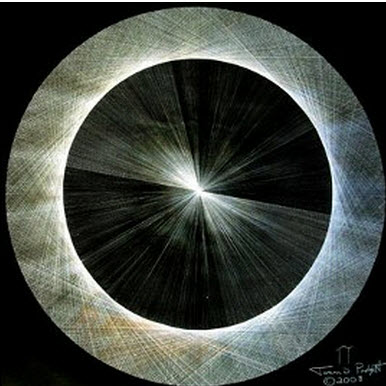
Jason Padgett's drawing of Pi (credit: Jason Padgett)
Jason Padgett, 41, sees complex mathematical formulas everywhere he looks and turns them into stunning, intricate diagrams he can draw by hand with no math training.
Following a concussion, a scan of Padgett’s brain showed damage that was forcing his brain to overcompensate in certain areas that most people don’t have access to, Berit Brogaard, a neuroscientist and philosophy professor at the Center for Neurodynamics at the University of Missouri-St. Louis explained.
The result: Padgett was now an acquired savant, meaning brilliant in a specific area.
Padgett was featured on ABC Nightline April 27, 2012.
Padgett Art (tools: pencil, ruler, compass)
Comments (18)
by J Andrews
Beautiful artwork and the fact it’s mathematically based is even more stunning! Bit like those geometric crop-circles!
by Prahab Gunjati
The dude can draw – I certainly did not see much math going on. Shapes and geometry ok… but advanced crazy math … I just don’t see it…
by Editor
Agreed.
by guy
exactly.. you just don’t see it….
by Spikosauropod
Interesting, but not apparently useful. Still, he might surprise us with an important discovery that someone with more conventional gifts would miss.
by me
i had a spirograph too when i was a kid. didn’t make me a math genius.
by WhiteRaven
Instead of going to school to tell others that math is beautiful…he needs to go to school..period. Get some real math training, then see what occurs. Im disappointed that the article did not specify which parts of his brain were overcompensating…is that some kind of secret now? My guess is that the Parietal lobes are not open in a way they were not before.
by star0
Ok, I watched the video. His gift doesn’t strike me as something that will necessarily lead to new mathematical insights; it COULD, but it will require that he develop other mathematical talents as well.
Modern mathematics is highly abstract. It requires a comfort with abstraction, and an ability to think about relationships among abstract objects, not just an ability to “see equations” and to “think in fractals”; furthermore, it has its own highly-technical language (jargon) that is used to conceptualize these objects and relationships, that sounds something like, “Let G be a connected Lie group acting by algebra automorphisms on a finite-dimensional complex central simple algebra A”.
by Scott
yes, they cant just be pretty patterns, I agree but what a nice starting point.
by Scott
I think he would do well with Chaos Theory. Insights of geometry in all systems would be great and productive.
by babo
kids of today… you’ve got to hit them upside the head to make them learn some math
by Editor
LOL, sick, but funny
by GatorALLin
…part of this genius seems to be the combination of the idea AND then the persistence to draw them out (1% inspiration, 99% perspiration)…he uses the word “obsessed” so that seems to be part of this (I wonder if he was obsessive about anything before this head trauma?). Maybe there are genius inventors who never patent their ideas for example and we don’t know much about them….. So the obvious question is can you stimulate the brain on purpose (for highly educated folks, or not) to get this genius out of them? Are the famous composers for music going back in history just brain damaged in the right spots and amount??
by Editor
“can you stimulate the brain on purpose?” Yes. See “Savant for a Day,” http://www.nytimes.com/2003/06/22/magazine/22SAVANT.html
by star0
I don’t recall reading in “A Beatufiul Mind” that Nash actually “saw formulas” like in the movie; I would have to look it up to confirm my memory. I DO recall, however, reading that his work resulted from lots of hard work, just like being an inventor (as in Thomas Edison’s 99 percent perspiration, 1 percent inspiration): his early ideas seemed “naive” and perhaps foolish to experts; and then they seemed a little less so after he refined them; and then pretty soon, they were groundbreaking.
Where his pre-schizophrenia figured in was perhaps (this is my guess) in helping him to come up with crazy and creatively brilliant ideas; but, of course, once the disease set in, he was then unable to be productive.
by Xenon
This article absolutely, definitively misrepresents John Nash in an unflattering way. John Nash was a brilliant, brilliant mathematician from a young age who worked hard (producing Nobel Prize level material) but then became sick with schizophrenia. This disease did not contribute to his ability to work, it made it harder for him to work and this is clearly depicted in the movie.
by Editor
“Misrepresents John Nash”: Agreed. I just deleted that reference. BTW, is Padgett’s art a meaningful representation of the mathematics or the science, or is it just great art?
by BGDN
This is more like the PI movie.http://www.imdb.com/title/tt0138704/