Report from the Alcor-40 conference
October 24, 2012 by Ben Goertzel
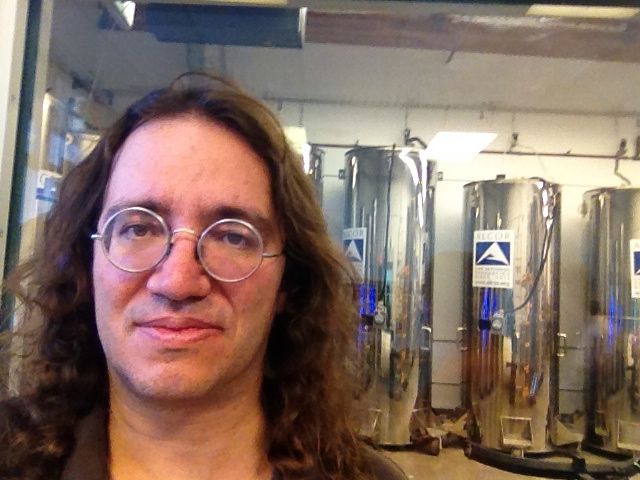
The author at Alcor (credit: Ben Goertzel)
This past weekend I attended the Alcor 40 conference, hosted by the cryonics organization Alcor to celebrate its 40th year of operation, and I was extremely impressed.
(Full disclosure: I am an Alcor member, signed up in 2005 so that in the unfortunate event my body comes to meet the criteria of legal death, they will preserve it in liquid nitrogen until the advance of technology is sufficient to allow my reanimation in one form or another.)
The crowd consisted largely but not entirely of Alcor members; there was also a fair number of non-members interested in the technology and ideas. A bunch of folks signed up as members during the conference, as well.
Cryonics meets mainstream science
I was expecting some excellent talks on the current state of cryonics technology, from the particulars of preservation via vitrification with powerful cryoprotectants, to the pragmatics of transitioning a recently deceased body from the site of death to Alcor’s facilities. And the talks on these topics were indeed worthwhile, giving me faith that, in spite of quite limited funding for research and operations, Alcor is steadily improving all dimensions of their practice. Alcor’s new CEO Max More started in the position fairly recently, and from what I can tell he’s been doing a very professional job.
What surprised me was the depth of the talks on longevity science and neuroscience. One definitely got the feeling that cryonics is not nearly as marginalized as it was a decade ago or even five years ago, and is now accepted as a reasonable pursuit by a rapidly increasing subset of the scientific community.
Of course, this is part of a larger trend of the gradual mainstreaming of transhumanist technologies. AGI and nanotechnology, for example, were laughed at by most academics in relevant fields just 10–20 years ago. Now they are much more broadly acknowledged as valid and important pursuits, though there are still differences in vision between the maverick advocates and the interested folks in the academic mainstream.
Regarding longevity, along with some other interesting talks we saw a reprise of the debate between Aubrey de Grey and Michael Rose that occurred at the Humanity+ @ Caltech conference in 2010. Aubrey reported the latest results from his SENS project, including recent tests from a therapy that resolves some but not all of the neural damage associated with Alzheimers disease. Michael Rose presented a strong evolutionary argument for following a Paleo diet, especially for folks aged 40 or over, and presented results of recent experiments with flies on different diets to indirectly support his claim.
[More full disclosure: I consult for Genescient, the firm Michael Rose co-founded to study the genomics of long-lived flies he evolved in his lab. More on that here.]
While the two advocated different approaches, both talks were in the vein of “How to avoid the need to be cryo-preserved, or at least delay it as long as possible.”
Connectomics and cryonic versus chemical brain preservation
The session on brain preservation, with MIT neuroscientist Sebastian Seung and Janelia Labs neuroscientist Ken Hayworth, was perhaps the most interesting from my personal perspective.
Seung has recently written a trade book called Connectome, focused on the hypothesis that the human mind is contained in the neural connectivity structure of the human brain. As he put it:
“Hypothesis: You are your connectome. Your connectome is unique and contains a huge amount of information. That information includes your memories, personality and other aspects of your personal identity.”
Connectome devotes a chapter to cryonics. As he pointed out in his talk, this chapter brought him protests from both the cryonics community and some of his scientific colleagues. Some of his colleagues wondered why he was speaking relatively positively of such wacky stuff. But some cryonicists, such as Ralph Merkle, took exception to the way Seung associated cryonics with religions feelings and inclinations.
Seung also touted eyewire.org … a “citizen science” website, focused on mobilizing volunteers to interact with AI to help map the retinal connectome.
Hayworth discussed the possibilities of brain preservation via chemopreservation, such as plastination, an alternative to cryopreservation such as Alcor currently practices. He also presented the Brain Preservation Prize, a prize to be offered to the first team to prove successful preservation of a human brain’s connectome according to specified criteria. The Brain Preservation Prize is agnostic regarding technique — Hayworth’s own work focuses on chemical preservation, but the prize itself may be awarded to a team doing chemical, cryonic or any other kind of preservation.
While both researchers expressed confidence that the human self and memory are most likely implicit in the brain’s connectome, neither was willing to wholly rule out that other aspects of brain structure might be important, e.g., details of the molecules in the brain beyond mere neural connectivity. As Seung noted, “It’s not enough to say that what you do is based on the best knowledge that neuroscience has to say. Neuroscientists don’t know how the brain works….” Their consensus seemed to be that, even if ultimately other aspects of the brain prove important too, the connectome — with its trillions of inter-neural connections, adding up to millions of miles in total — is definitely the place to start.
The panel discussion following their talks featured intriguing back-and-forth regarding the benefits and problems associated with both cryonic and chemical preservation of human brains.
An obvious, major difference between the two approaches to brain preservation is: If cryoporeservation is done sufficiently well, it may be plausible to re-animate the cryopreserved person simply by defrosting them in a sufficiently gentle way, and infusing them with appropriate chemicals. On the other hand, if a brain is plastinated, for example (a common method of chemical preservation), then there’s no way to revive that brain without advanced nanotechnology. Instead one has to count on reading out the preserved brain’s connectome; and then re-creating the connectome and hence, presumably, the associated mind in some other substrate.
But it’s not clear that, even given recent advances in cryopreservation technology, it can match the precision with which chemical preservation techniques preserve the connectome and other aspects of brain structure. This is a tricky but important research issue, since cryonic technology is rapidly developing, and since the technology for reading brain structure out of cryopreserved brains is not all that mature (the standard method now involves chemically preserving the cryopreserved brain and then studying it).
The Brain Preservation Prize seems like a great idea, and hopefully will be first in the line of a series of prizes aimed at pushing brain and body preservation technology forwards.
Touring Alcor’s Facilities

The conference talks spanned Saturday morning and afternoon and Sunday morning. Sunday afternoon was devoted to a barbecue and a tour of Alcor’s facilities. The barbecue was tasty but the tour was more interesting. The facilities were modern, clean and well-organized, giving the feeling of a top-notch medical establishment. A 3D printer was in evidence, being used to manufacture various doohickeys needed to maintain and enhance the lab equipment, as well as to create small plastic souvenir models of the “Dewar” chambers in which Alcor’s patients are maintained.
Seeing the equipment used to perfuse recently deceased bodies and brains with cryoprotectant chemicals was interesting. But the high point was, of course, the room full of Dewars containing cryonically preserved bodies, waiting for technology to mature sufficiently to enable their reanimation. A thick, bulletproof glass window allows visibility into the Dewar room from the main Alcor conference room — a set-up that doubtless provides Alcor staff with a vivid reminder of what their work is all about, as they carry out their meetings.
My tour through the Alcor facilities was very ably conducted by Alcor CEO Max More. Longevity guru Aubrey de Grey, also taking part in the tour, provided helpful commentary along the way, displaying his own sound knowledge of cryonics procedures and technology.
All in all, it was an interesting and educational weekend. Alcor’s professionalism gives me reasonable faith that, in the unfortunate event I need to make use of their services, my preserved body will be well taken care of.
And now I’ll get back to my usual pursuits — such as working on AGI and on the genomics of longevity — which I hope will obviate the need for me ever to take up residence in one of Alcor’s shiny silver Dewars.
As I always say when discussing cryonics, “Better frozen than rotten…. But, better living than frozen.”
Reprinted with permission from H+ Magazine

Comments (40)
by Jim
I hope that some religious group like the Mormons will come and revive people. Then I will join in and help revive anyone left.
I plan to do a poor mans preservation. Parachute into Antartica and in a few thousand years they find me and reconstruct my mind.
by Tom J
Unfortunately, we have not made any real progress in the last 20 years! Maybe this doesn’t matter because sooner or later, we still have to die in the end. After all, nothing lasts forever …
by Mr.X
@Tom: Not even the truth of your statement?
by Tom J
As usual, a lot of talk and a little workshop. I try to keep myself up to date in this area and I am so disappointed that no real progress are made in the past 20 years…
by John
I used to want to have immortality or stuff be invented before i die. Don’t care much about this stuff anymore. The ‘badness’ of death is the same construct of mind as anything else, and you can switch it as some boolean variable in computer. When it’s done, it’s very obvious, and people desperately wanting to avoid death seem awkward and childish.
by Gabriel
John…..what can I say — you have the right mentality I feel…it’s just subconsciously, what everyone wants (eternal life that is, or at least indefinite)…..nobody wants to die for death’s sake — even the religious who rationalize death as a good death, do so because they feel after you die, you will “then” acquire eternal life and so on and so forth.
Essentially, whatever lens you look through, we are all humans and all have the same wants – we just have different ideas about how to get there. That all said, I definitely agree that you shouldn’t be afraid of death…and I don’t mean that in the sense of seeing death as a good thing….just in the sense of, live life to the fullest, and if the opportunity arises in the form of some sort of augmentation to stave away death, then consider personally if this is right for you or you accept death as a good thing and choose to go for that. If such a thing never happens, it’s all moot and you should still continue to live life to the fullest anyway.
Ultimately we all have to decide what it is we want for ourselves…some may argue this agnostic impartial way of looking at things is wrong, but the thing is, it’s still up to us to individually decide what to do with ourselves, whether or not we actually have the tangible means to do something about death or not — we all have to decide if “backing up” ourselves is what we want, or to “age gracefully”…..you can make very aggressive/intelligent reasoning to go either way, but in the end, it’s up to us, and whatever the choice is, people should be respected for it and not feel mobbed by people who “want to save them” regardless of what camp they belong too.
Again, maybe this isn’t the ‘right’ way to look at things…I’m simply calling out for Respect, whatever it is you believe in — the Singularity after all, is only one of many scenarios that the future could objectively have in store for us, and whatever it is that happens, whether it was somehow “fated” or not (whether through prophecy or created in the sense that the future is something we make versus what “happens” to us…so the singularity was also fated to happen), and we all have to work with it into our plans and continue to do our best, whether we knew of it or not beforehand or whatever.
People are so anxious about the future and have all these grand endings in their heads because they want to prepare for them (for some, indoctrination)…from a practical pov, what’s arguably more important….is just living your life as best you can. Rather then living life on the edge of your seat every-day waiting for “Bridge Two” or another sign of the Rapture, or whatever you believe in….try focusing more on seeing that big movie this weekend. It’s not about being ignorant or lazy or selfish….just that, in all honesty…there are bigger things going on in your life then what/when is the inevitable fate of the world…..maybe that sounds like a oxymoron, but maybe there’s more truth to it then it appears.
by John
“it’s just subconsciously, what everyone wants (eternal life that is, or at least indefinite)…..nobody wants to die for death’s sake — even the religious who rationalize death as a good death, do so because they feel after you die, you will “then” acquire eternal life and so on and so forth.”
Gabriel, i not really agree with that. It’s when you stuck with your ‘ego’, then such thinking comes. But human mind can model the world in very different ways, also when ego is not present. Your mind can be the whole world, so when your body dies, you know that the world persists, so nothing is lost. Maybe you yourself won’t experience further advancements… but the world will.
It’s not about rationalizing death. I can see longevity coming and believe there is a good chance for myself to live as long as i want. But don’t really care, since i know, the thoughts like “oh god, i’d like to live a bit longer” – are illusions, are not true.
by Mr.X
John: You seem to be very buddhist^^
Btw: I agree with the basis of your sentiments, and I myself neither seek death nor try to hard to avoid it.Seeing conceptualizations for what they are doesn’t mean we need to despise them, or calling them unreal or unnatural.
It is the nature of our mind to create a personality, ego, to shatter and feel, a base from which we can orderly conduct our lives.
Living consciously is all about really getting to chose, having a choice, and therefore- as a means- becoming conscious aboutthe way our “ego” comes into being, and is arbitrarely to some point, all the while being malleable.
In the end, all our thoughts and ideas are real themselves and not just illusions, since our subjective world at a given time is contained in our bodies and they a an element of the whole of reality, making our subjectivity a subset of aformentioned reality.
However, in the end you can’t really banish your ego, but you can deconstruct all those cravings, values, feelings etc that you have unconsciously aquired in the course of your life, calm your mind, and then truly chose how you want to be, how your personality looks like (to some extent).
I mean, you can decide to want/like something, and then it is true that you do so, if you consciously chose that.But you shouldn’t be attached to your wants to point that causes suffering.
In the end we all should know that -as for now- we can’t really say that eventual death isn’t certain.We should take this as our working hypothesis, and live life without being all too scared, since in a sense we all are already dead.
by John
Wow man, i’m impressed. You put it all so much better than me. That’s probably right, “Seeing conceptualizations for what they are doesn’t mean we need to despise them, or calling them unreal or unnatural.” Although i don’t know yet how to value things once you know they are mere products of the mind. Don’t know what to do about ‘paradise lost’ effect, when understanding destroys magic, and you can’t bring it back, same way you can’t un-understand things. Or can ya?
by Gabriel
Both of you wrote very deep and moving posts :)
by Logic
John, not everyone wishes to avert death because of its “badness”. Many of us simply see an infinite universe with unlimited richness and adventure, and want to live infinitely in order that we may enjoy it.
When you judge people from your own frame of reference, as a consequence, it is your own perspective that seems awkward and childish, for you ignore the “goodness” of what longevity would bring.
by John
Didn’t mean to judge anyone, although indeed it sounded so and im sorry. It was to oppose the point of view presented also by Ray Kurzweil in Transcendent Man, saying “death is profoundly bad thing, and all who try thinking otherwise are simply rationalizing the inevitable”.
by Mr.X
The problem with Ray’s statement is the “all”, those absolute claims are almost (!:)) always wrong.
But I am sure that his “diagnosis” fittingly describes most of the people living in the western world, and especially all those religious types living in the USA.
by Robert
I think you are making some assumptions about motivations here John. While I can’t speak for anyone else, I know that I personally am planning on being frozen (if necessary), not out of a fear of death, but out of a love and curiosity about life.
I don’t believe in an afterlife, so I don’t fear death. How can I fear nothingness? (Which is what I expect.) At the same time, I enjoy living and I would truly love to see what happens in the coming decades, centuries and beyond.
Finally, I also think your criticism of people fearful of death is unfair. Most people are afraid of the unknown. Death being the biggest and most final unknown there is, it’s not surprising that most people would fear it.
Even I have to admit to myself, that when I actually am dying, I will likely be afraid. I’m agnostic, but it’s said no person dies an atheist…..lol. And that makes sense. Even if you have a strong intellect and pride yourself on your rationalism, the truth is, if you are dying, it’s got to be very hard not to think, “What if I’m wrong? And my disbelief means something bad will happen to me after I die?”
Lastly, I’d like to point out that there has been significant progress in the past 20 years. A very obvious example is vitrification. 20 years ago this method of preserving a brain was not available to cyonics patients.
Less directly but no less relevant to the eventual goal of bringing back suspended patients are advances in our understanding of neurology, brain chemistry, genetics, AI, nanotechnology and a host of other knowledge domains that will ultimately likely enable cryonics to bring people back.
Are there any guarantees? Nope. But between burial, cremation, and freezing, there is only 1 option that gives even the possibility of coming back as me. And the logical way to look at all this is this: We don’t know what will happen in the future. So why not choose the one method of dealing with death that at least gives us the potential of continuing our lives. At liquid nitrogen temperatures, a suspended patient is preserved so well that 10,000 years is equal to only a few seconds at room temperature. It truly “stops” time for the suspendee’s brain.
by Shannon Vyff
Thank you for the write-up Ben :)
by John Middlemas
Dead is dead I think, leave the dead to their fate. They are dead for a reason.
by Gabriel
Okay….what is that reason? I doubt it’s a very good one.
by Jon
Both reason and fate are likely constructs of the mind, which ironically seems to be a thing that stops after death.
I could be wrong, of course.
But probably not.
by Jay
So what you’re telling us is that the dead aren’t dead for a reason?
by Mr.X
By reason he meant sth like a metaphysical justification.Yes, I don’t believe in that crap.Of course they are dead for a reason, their system failed to sustain itself.
by Jerry
Actually “death” is a medical terminology meaning “In a state that current technology is unable to resuscitate/revive” and the state of death has continued to change over the course of technology advancement. A person declared dead last century could be “bought back to life” today thanks to advances.
by Mark
Sick is sick, I think, leave the sick to their fate. They are sick for a reason.
The drowning are drowning I think, leave the drowning to their fate. They are drowning for a reason.
You probably understand now why your logic is ridiculous.
by Mr.X
You meant to say reasoning, not logic:) Have a nice day.
by Gabriel
I completely agree Mark — talk about irresponsible.
by melajara
Thank you for this report. Are the presentations available online? (I’m particularly interested in Dr Fahy’s one from what I read from the approach of his research)
Besides, could the author or any knowledgeable person here enlighten us about the real PRACTICAL progress of contemporaneous cryonics?
I mean, what is the current limit in organism complexity (and/or size) to be fully frozen and then revivified?
It’s clear that the problem has been solved for (human) zygotes for quite a long time. But, then, morula? blastula? gastrula? Obviously experiments on human embryos, even at those early developmental stages will be prohibited, but has it been attempted with mice embryos?
Another building block of considerable interest for medicine (hence with potential for huge funding) is cryopreservation of body parts to alleviate the shallow buffer of recently deceased donors.
Brains cryopreservation is just one step before (more probably beyond) the holy grail of full body preservation. But in the mean time, are we already able to cryopreserve tissues? And then organs? Which ones, if any?
Those are humbler but nevertheless essential building blocks to achieve, one day, full scale cryopreservation. Unfortunately I don’t see much milestone progresses on those topics. I sincerely hope this is just because I’m underinformed, LOL
by Jon
Excerpt from the wikipedia page about cryonics:
In June 2005 scientists at the University of Pittsburgh’s Safar Center for Resuscitation Research announced they had managed to place dogs in suspended animation and bring them back to life, most of them without brain damage, by draining the blood out of the dogs’ bodies and injecting a low temperature solution into their circulatory systems, which in turn keeps the bodies alive in stasis. After three hours of being clinically dead, the dogs’ blood was returned to their circulatory systems, and the animals were revived by delivering an electric shock to their hearts. The heart started pumping the blood around the frozen body, and the dogs were brought back to life.
On 20 January 2006, doctors from the Massachusetts General Hospital in Boston announced they had placed pigs in suspended animation with a similar technique. The pigs were anaesthetised and major blood loss was induced, along with simulated – via scalpel – severe injuries (eg. a punctured aorta as might happen in a car accident or shooting). After the pigs lost about half their blood the remaining blood was replaced with a chilled saline solution. As the body temperature reached 10 °C (50 °F) the damaged blood vessel was repaired and the blood was returned. The method was tested 200 times with a 90% success rate.
http://en.wikipedia.org/wiki/Suspended_animation
by Jon
Do note: I’m aware that this isn’t true long-term cryopreservation, but I think it serves to show that progress is being made?
by melajara
You mention feats performed in 2005 and beginning 2006. This is almost 7 years from today. For (pre)Singulitarians like us, 7 years are EONS!
And note that the work you mention is only tangentially relevant to cryopreservation as it is no crypreservation at all, just slowing down living processess by cooling (but much above freezing point) to relive the stress on an injured body under severe (surgical) operation.
I would better see results around the topics I mentioned, i.e.
1, progress on full scale cryopreservation and reviving of simple organisms like e.g. protozoa, parazoa and then metazoan with a clear characteristic of the (hopefully evolving) limit in organism complexity for successfully completed cryopreservation and reviving.
2, progress on full scale cryopreservation of embryos at later developmental stages as zygotes, although successful re implantation of such embryos is a difficult independent problem preventing true measure of the innocuity of the freeze / unfreeze process.
3, progress on body parts cryopreservation, again with a clear indication of the limit of organ complexity currently addressed.
To assess true progress, we need metrics. I’m not seeing such metrics in a field, unfortunately still stuck at a stage of (black) “art” or proto science.
by Mr.X
“Better frozen than rotten…. But, better living than frozen.”
I agree.
by Gabriel
Tell me about it, it’s easily what I take from this the most from this — Cryonics is the best available method today, but that said, it still doesn’t say all that much.
We simply live in too primitive a time still when it comes to preserving life…hopefully something that will change with augmentations in the near-future which will enhance life to the point of making preservation and cryonics look like a joke.
by Snazster
I just can’t imagine the future wanting to create people wholesale any more than we would want to create enormous numbers pre-Civil War farmers, drovers, merchants, etc. Maybe a few famous ones or one or two at random for interviews.
Pity, I loved Larry Niven’s “World out of Time” and have read it many times but let’s face it, Peersa would have flown the ship.
by Vin
If you mean why revive peoples of the past, what about archaeologists, historians etc , even collectors of antiquities :D.
by Jerry
Isn’t history itself dead now? That’s what I hear most historians declaring.
But I do agree, there would be some excitement and value in bringing back people from the past. Have them tell the story of how we didn’t have mind reading AI that obeyed our every desire, how we had to walk 50 miles in the snow to sit in a room with a teacher and copy what was written in chalk on a board coloured black and green.
by Mr.X
How many historians talk to you, if I may ask you!?
by Bruce Wright
Somehow I don’t think all that many people will choose to be cryopreserved until it’s pretty clear that it’s highly likely to work – which will probably be close to the point where we’ll have advanced nanotechnology and strong AI, and will be close to having the ability to cure most diseases in those so preserved – so I don’t think there will even be the possibility of “enormous numbers” of people from much earlier times who could be revived.
It is an interesting question whether even small numbers of revived people would be able to function in the vastly changed world in which they found themselves. I tend to think that many would in fact be able to cope with this ultimate “future shock” (at least about as well as other people alive in that era), because by that time there should be numerous technologies for restoring or even enhancing youthful plasticity in brain function. However it might well be necessary to have education centers to re-integrate them into society.
Will such a future society want to take on that burden? Who knows, but I’m inclined to think probably so at some point, once the cost becomes sufficiently affordable – as a window on the past, if nothing else. Often the ordinary can give you a better idea of what the past was like than the lives of the rich and powerful.
by Giulio Prisco
@Bruce re “Will such a future society want to take on that burden?”
The chain of love: after revival A sponsors loved ones B and C – then B sponsors D and E, and C sponsors F and G…. and so forth.
by Mr.X
I’d revive anyone I could revive without too much problems (wouldn’t ruin myself for it), just because I think everyone should have a right to live, if he doesn’t or didn’t want to die.
by Mr.X
Than make way for those who have some imagination.I can easily think about scenarios in which we’d chose to do so, and having restored a substiantal amount of people would activate the “chain of love” (where restored people want to restore family, aquintances etc).
by Damon Montano
The future doesn’t have to “want” to bring you back, you paid for it before they froze you.
by Vin
“Better smeg than dead” Arnold Rimmer.