Revolutionary ‘DNA tracking chamber’ could detect dark matter
July 4, 2012
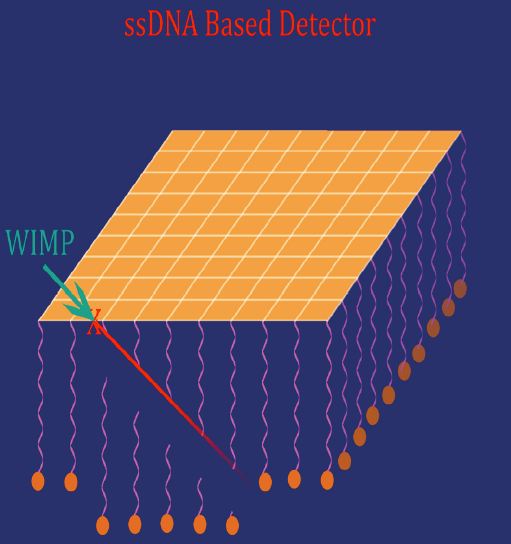
Dark matter detector: A WIMP (dark-matter particle) from the Galaxy scatters elastically with a gold nucleus situated in a thin gold foil. The recoiling gold nucleus traverses hanging strings of single stranded DNA, and severs any ssDNA it hits. The location of the breaks can be found by amplifying and sequencing the fallen ssDNA segment, thereby allowing reconstruction of the track of the recoiling gold nucleus with nanometer accuracy. (Credit: Andrzej Drukier et al.)
Physicists and biologists plan to build a dark matter detector out of DNA that will outperform anything available today, Technology Review Physics arXiv Blog reports.
Current experiments to find dark matter are looking for the unique signature that dark matter is thought to produce as a result of the Earth’s passage around the Sun.
During one half of the year, the dark matter forms headwind as the Earth ploughs into it; for the other half of the year, it forms a tailwind.
There’s a straightforward way to make better observations that should solve this conundrum. The dark matter signal should vary, not just over the course of a year, but throughout the day as the Earth rotates.
The dark matter headwind should be coming from the direction of Cygnus, so a suitable detector should see the direction change as the Earth rotates each day.
However: nobody has built a directional dark matter detector.
A collaboration of physicists and biologists brings together diverse people, such as astrophysicist Katherine Freese at the University of Michigan in Ann Arbor and George Church at Harvard University in Cambridge, a geneticist and a pioneer in the area of genome sequencing, who say they can use DNA to spot dark matter particles.
Their detector consists of a thin gold sheet with many strands of single-strand DNA hanging from it. The idea is that a dark matter particle smashes into a heavy gold nucleus in the sheet, sending it careering out of the gold foil and through the DNA forest. The gold nucleus then severs DNA strands as it travels, cutting a swathe through the forest.
These strands fall onto a collecting tray below, which is removed every hour or so. The segments can then be copied many times using a polymerase chain reaction, thereby amplifying the signal a billion times over.
Since the sequence and location of each strand is known, it is straightforward to work out where it was cut, which allows the passage of the gold particle to be reconstructed with nanometer precision. The entire detector consists of hundreds or thousands of these sheets sandwiched between mylar sheets.
The DNA sequence determines the vertical position of the cut to within the size of a nucleotide. That kind of nanometer resolution is many orders of magnitude better than is possible today. This detector also works at room temperature, unlike other designs which have to be cooled to measure the energy that dark matter collisions produce.
And finally, the mylar sheets make the detector directional. Each sheet should absorb the gold nucleus of this energy after it has passed through the DNA forest. Any higher energy nuclei, from background radiation or cosmic rays for example, should pass through several ‘pages’, which allows them to be spotted and excluded.
With the device facing in one direction, a dark matter particle strikes a gold nucleus, propelling it into the DNA forest. But in the other, the gold nucleus is propelled into mylar sheet where it is absorbed. That’s what makes it directional–the detector should only record events coming from one direction.
This should allow the device to spot the change in dark matter signal each day, which in turn should make the detection much less statistically demanding.