Rewriting DNA to understand its ‘language’ and improve gene therapy
June 1, 2012
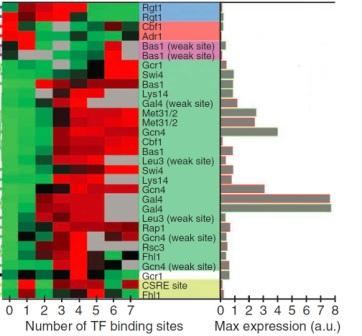
The relationship between gene activity and the number of binding sites for regulatory proteins in the gene’s control region. The red-green scale shows gene activity levels (red is high). Gray bars show the maximal level of gene activity achieved by each type of regulatory protein. (Credit: Prof. Eran Segal/Weizmann Institute)
New Weizmann Institute technology speeds up DNA “rewriting” (altering) and measures the effects of the changes in living cells.
To advance our understanding of the genetic code, a new Weizmann Institute study proposes a way of introduce DNA segments into genomes of living cells and test the effects of these changes.
Until now, changing the DNA sequence has been a slow and labor-intensive process. It took several weeks to alter just one DNA region at a time; testing the effects of each of these changes took even longer.
Understanding the hidden DNA language
Weizmann Institute scientists have developed a technology that makes it possible to simultaneously introduce tens of thousands of DNA regions into tens of thousands of living cells — each region in a separate cell — in a planned and systematic manner, and measure the results of each such change with great precision and in a single experiment.
“This fast method will significantly advance our ability to understand the ‘language’ of DNA,” says research team leader Prof. Eran Segal, of the Weizmann Institute’s Computer Science and Applied Mathematics and Molecular Cell Biology Departments. “Reading out a person’s entire genome is already a manageable task, but what exactly is written in that genome?”
Why we need to identify DNA “words” and understand their meaning
- Understand how genotypic differences among people generate observable differences among them — from the way we look to the way our cells function. For example, which genetic differences are responsible for the development of various diseases in certain individuals?
- Improve genetic therapies based on introducing new genes or improve regulatory sequences into cells to repair genetic defects.
- Understand how the control of gene expression is encoded in the DNA — that is, the instructions determining the level of activity of each gene in the genetic code — one of the central in molecular biology, because gene activity levels have crucial effects on cell function. For example, how a gene’s activity level is affected by the gene’s distance from its regulatory sequence.
The new method consists of four steps: (1) creation of 50,000 different genetic sequences on DNA chips, (2) massive insertion of these sequences into cells at the same time, (3) sorting the cells with the help of a sorting machine that senses the expression levels of a “reporter” gene, and (4) high-throughput parallel DNA sequencing.
Ref.: Eilon Sharon et al., Inferring gene regulatory logic from high-throughput measurements of thousands of systematically designed promoters, Nature Biotechnology, 2012, DOI: 10.1038/nbt.2205
Ref.: Tali Raveh-Sadka et al., Manipulating nucleosome disfavoring sequences allows fine-tune regulation of gene expression in yeast, Nature Genetics, 2012, DOI: 10.1038/ng.2305
Comments (2)
by Phil Osborn
Katherine got it right.
I recall a short story from many decades ago in which robots had long replaced humans and then decide that it’s time to ressurrect them, at least as a test. So they get some DNA, build a successful artificial womb, etc., all of which never works right the first time, and there are objections to reviviing an evolutionary dead end, etc. And then they decide that to bypass some of the obvious design problems, they will reanalyze human fetuses for a while and rewrite the DNA. Everything appears to work, until gestation, when the babies always die in great distress. So, they decide not to change anything for the next round, and raise a boy and girl pair successfully in an artificial environment so that the children have no contact with the robots to contaminate their minds, until they finally decide to face them, and the first words from the kids are commands, which the robots helplessly obey, mere slaves again, due to backdoors in their code, similar to the introns and other “garbage” that may actually be there for a reason…
I refused to accept the idea that the vast numbers of introns were just poor evolutionary housekeeping when I first heard of them. I can SEE in the mirror that most evolution is just not that sloppy. But they didn’t fit the standard model, so forget common sense. So, how will the researchers detect the problems of information that may only be called on during rarely occurring circumstances? Information that may well be preserved as seemingly random introns or may actually be structurally integral to normal functioning while having an entirely different alternate use.
I recall another much more recent fictionalized account that bears on this. Cameron’s (Avatar) one venture into TV with “Dark Angel,” which was almost pure hard science fiction. In DA, our hero Max (Jessica Alba) was a result of a secret U.S. project to breed super soldiers. At some point, the methods were explicitly described as involving removal of all the introns and reprogramming the general DNA to remove non-functioning components and, where feasible, replace with improved sequences, sometimes drawn from other animals altogether. As in the short story I mentioned, there were a LOT of failures. However, to make the story work, there had to be successes, of course, and there was certainly room for envy of the prowess of the reengineered Homo Superiors.
Perhaps Mr. Cameron might be contacted for possible funding, since it is clear from this and Avatar that he is personally very concerned with this whole area of research, and he seems to have the brains to actually understand the science.
If Bill Gates can run a charity, anything is possible.
by Katherine MacLean (old science fiction writer and research fan
This type of sudden advance should be credited to the new tech machinery redesigned to display and speed up counting minute differences and let the researcher compare them to the survival and shape of the animals who grow from eggs with insertrd, changed DNA. The great strides forward toward improved body design must l be credited to the machine designers and their fame is rewarded by the price charged for the new lab gear these machines put a staggering loads on the budget of the Universities backing their PhD to win a race for treatments for increased health and endurance and success whether for the glory of an improved human or race horse!, Improved machines can win car races or horse races or Olympic champions swimmers or sky soaring or even Nobel prize winners in thinking physics theory all by improving fleshly design. Wow,