Robots improve patient care in the ICU: physicians
July 11, 2012
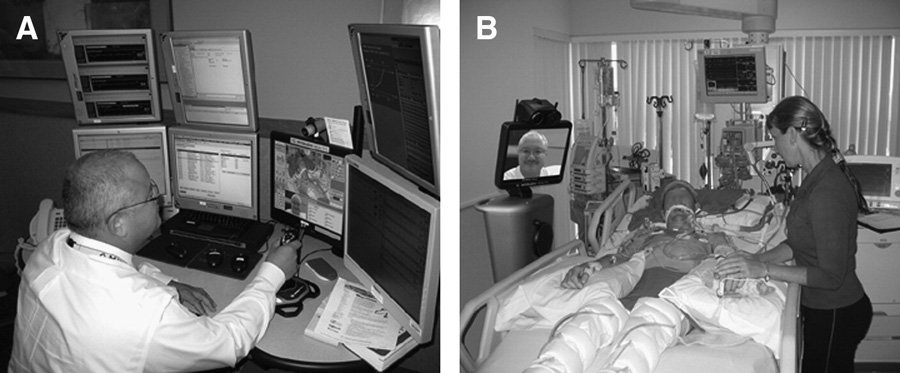
(A) The remote clinician is controlling the robot at the bedside of a critically ill patient. (B) The monitor on the robot shows the face of the remote clinician performing real-time activities. Staff at the bedside can function as the “surrogate” examiner. (Credit: Eliza M. Reynolds/Telemedicine and e-Health)
Physicians who employ remote presence “robots” (actually, teleoperated devices) to supplement day-to-day patient care strongly support the positive clinical and social impact of using robots, according to a report published in Telemedicine and e-Health, a peer-reviewed journal from Mary Ann Liebert, Inc.
The article is available free on the Telemedicine and e-Health website.
“The technology used is a semi-autonomous, Internet-enabled, real-time, two-way audiovisual telecommunications platform that moves about in a wireless environment,” says the report. The ‘robots’ are enhanced with electronic stethoscopes and may be further enhanced with lights to illuminate the retina, pharynx, ear canal, or tympanic membrane. … The robots are controlled real-time by a remote physician at a ‘control station.’’’
“The integration of robotics in healthcare adds value to patient care and management of an in dividual’s health,” says Charles R. Doarn, MBA, Editor-in-Chief of the Journal and Research Professor of Family and Community Medicine, University of Cincinnati, Ohio.
The survey article entitled “Utilization of Robotic ‘Remote Presence’ Technology within North American Intensive Care Units” was conducted by investigators at InTouch Health (Santa Barbara, CA) and the Adams Cowley Shock Trauma Center, University of Maryland School of Medicine (Baltimore), found that most of the physicians utilizing robotic remote presence in the ICU were more senior staff who specialized in critical care medicine.
The authors report that all survey respondents intend to continue using the technology and believe that it improves patient care and patient and family satisfaction.