Russia calls for united meteor defense
February 28, 2013
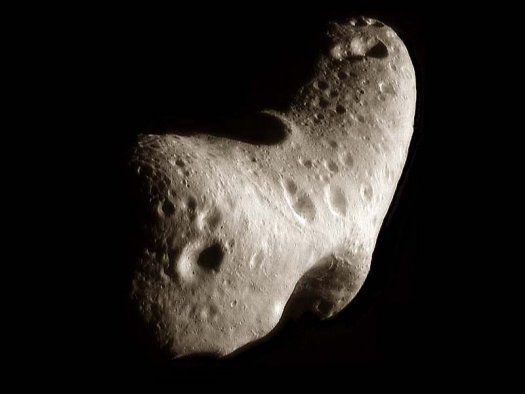
Asteroid (credit: NASA)
Russian Deputy Prime Minister Dmitry Rogozin says the world should unite to establish a defense system against space objects that threaten Earth, under the umbrella of the United Nations, Space Daily reports.
The Russian leader said the threat from asteroids, meteorites, comets and other stray space objects should serve to “unite humanity in the face of a common enemy.”
Alexander Bagrov, a senior researcher at the Institute of Astronomy of the Russian Academy of Sciences, told the Voice of Russia such a worldwide defense system against space objects can be created.
“I think that it is possible,” he said. “The system would have to solve two problems — gaining enough time to detect a dangerous space object and to clearly identify its trajectory.”
A relatively small space-based telescope would be sufficient not only to detect dangerous cosmic bodies but also to and calculate their orbits and provide an opportunity to counter them, Bagrov said.
However, Rogozin is concerned that if such a worldwide anti-asteroid system were to be established, some countries could use it as a pretext to deploy nuclear weapons in space.
Comments (11)
by Mike
An earth defense against asteroids is long overdue. But, NOT handled-by/through the United Nations. Such a space defense system should be handled by NASA in unison with other space agencies, through a system similar to the International Space Station.
by Brad
Nope. Obviously the past 100 years prove meteors are a Russian problem. Let them deal with their own problems.
by Vid Beldavs
This year Russia presides over the G20 which is an appropriate forum for a new global space initiative. G20 meetings were underway in Moscow when the Chelyabinsk event happened. Russia should raise planetary defense as an agenda item for the G20. In the process Russia shoul add asteroid mining, the Moonbase project, SPS — in effect space industrialization as a means to create jobs worldwide and deal with other major issues such as global warming through the delivery of carbon free electricity from space.
by Bri
I’m not sure a nuclear weapon would be wise or even effective against an asteroid. From what I understand they are lose conglomerates of materials. Depending on the size it may just spread the destruction over a wider area. The kinectic energy is formidable. Again depending on the size it may have little effect. The smaller ones, like the one that hit Russia aren’t that much of a threat. They usually explode or burn up in the atmosphere. The larger one can punch a whole through the atmosphere. Comets are another story. They almost always explode and can have a much larger blast than an asteroid. Some kind of a space tug will need to be developed. Al these objects are rotating. That rotation would have to be stabilized. In order to mine asteroids all these issues would have to be addressed. That makes the two endeavours be interrelated. I agree that the UN should be involved. It is a mutual threat. If these objects can be harvested then the proceeds could offset the development costs. It really is an issue that we should address. Time is not on our side no matter how rare these collision event occur. They are random. All of this is also great for space development.. Setting up new industries. The subjects of each of these space rrlated articles today can reinforce each other. Great opportunities are at hand for near space development.
by Brad
I hear this comment all the time but I don’t buy it. What you rather be hit by? One piece 100 meters wide, large enough to destroy an entire city and kill millions of people, or 1000 pieces 10 meters wide, which would each have pretty much the same effect as the one that hit Russia? The answer should be obvious.
by Bob
I suspect such a system, over the course of its life, would be more of a threat to humans than meteors. Speaking in geological terms meteors are more of a threat to life, but in the short term, say 300 years the system would be prone to abuse of governments and hackers.
by Gorden Russell
What harm could governments or hackers do if the system only involves having ion-drive spacetugs ready in orbit?
by Gorden Russell
Also, a number of space telescopes have to be put in orbit between the Earth and the Sun to spot the sun-grazing Aten asteroids that are lost in the glare. There are a lot of telescopes out there already and they aren’t being abused by hackers (they’re just not positioned to see the Aten objects).
There is a private non-profit already trying to raise money to launch telescopes like these. They named themselves after the asteroid in “The Little Prince.”
Also, the joint European/U.S. Asteroid Impact and Deflection Assessment mission, or AIDA, will work to intercept the asteroid Didymos in 2022. Here’s a quote from the article describing the mission at Space.com:
“The proposed asteroid-smashing AIDA mission will send one small probe crashing into the smaller asteroid at about 14,000 mph (22,530 kph) while another spacecraft records the dramatic encounter. Meanwhile, Earth-based instruments will record so-called “ground-truthing” observations.”
The rest of the article is here:
http://www.space.com/19933-asteroid-deflection-mission-aida-didymos.html
by Gorden Russell
Here is the article from Space.com about the B612 Foundation:
http://www.space.com/16338-sentinel-private-telescope-asteroids.html
by Gorden Russell
Well of course, Rogozin is right. If an approaching asteroid is discovered too late, a nuclear bomb might be the only chance of deflecting it.
But with a few years of warning, an asteroid could be boosted up into a higher orbit, or dropped into a lower orbit, with a small ion drive engine.
by Gorden Russell
That phishing scam is back here again to tell you that you have won a prize. Don’t fall for it.
It’s URL is:
http://www.deals13.net/index.php?source=trafficvance&keyword=Kurzweilai.net