Single-atom transistor is ‘end of Moore’s Law’ and ‘beginning of quantum computing’
February 20, 2012
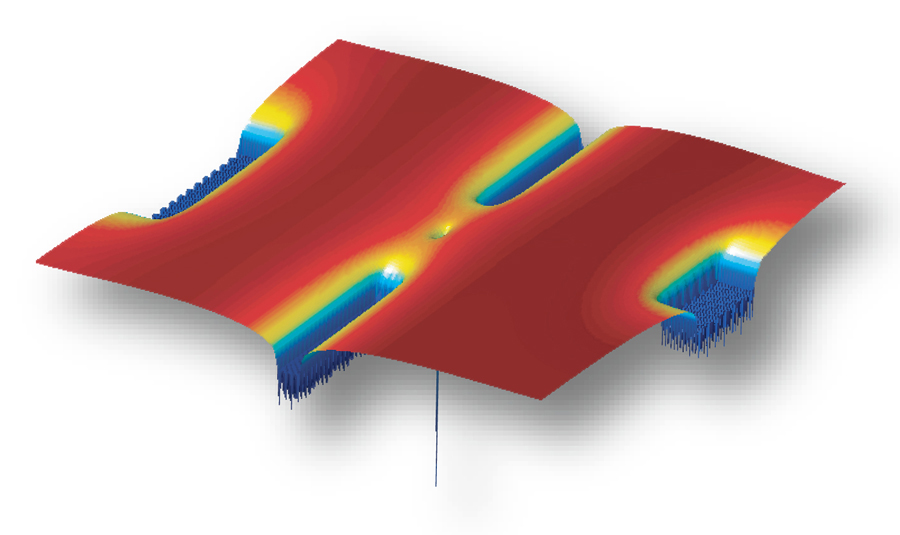
A controllable transistor engineered from a single phosphorus atom. The atom, shown here in the center of an image from a computer model, sits in a channel in a silicon crystal. The atomic-sized transistor and wires might allow researchers to control gated qubits of information in future quantum computers. (Credit: Purdue University)
The smallest transistor ever built has been created using a single phosphorous atom by an international team of researchers at the University of New South Wales, Purdue University and the University of Melbourne.
The latest Intel chip, the “Sandy Bridge,” uses a manufacturing process to place 2.3 billion transistors 32 nanometers apart.
A single phosphorus atom, by comparison, is just 0.1 nanometers across, which would significantly reduce the size of processors made using this technique, although it may be many years before single-atom processors are manufactured.
“To me, this is the physical limit of Moore’s Law,” Gerhard Klimeck, who directed the Purdue group that ran the simulations, claims. “We can’t make it smaller than this.”
According to University of New South Wales Prof. Michelle Simmons, “We made a single-atom transistor roughly 8 to 10 years ahead of where the industry’s going to be,” consistent with Moore’s law, in 2020.
Basis for a quantum computer
The researchers used use a combination of scanning tunneling microscopy and hydrogen-resist lithography. Although single atoms serving as transistors have been observed before, this is the first time a single-atom transistor has been controllably engineered with atomic precision. The structure even has markers that allow researchers to attach contacts and apply a voltage, says Martin Fuechsle, a researcher at the University of New South Wales and lead author on the journal paper.
The single-atom transistor could lead the way to building a quantum computer that works by controlling the electrons and thereby the quantum information, or qubits. Some scientists, however, have doubts that such a device can ever be built.
The single-atom transistor does have one serious current limitation: It must be kept very cold, at least as cold as liquid nitrogen, or minus 391 degrees Fahrenheit (minus 196 Celsius).
“The atom sits in a well or channel, and for it to operate as a transistor the electrons must stay in that channel,” Klimeck says. “At higher temperatures, the electrons move more and go outside of the channel. For this atom to act like a metal you have to contain the electrons to the channel.
The same research team announced in January that it had developed a wire of phosphorus and silicon just one atom tall and four atoms wide that behaved like copper wire.
Ref.: Martin Fuechsle et al., A single-atom transistor, Nature Nanotechnology, 2012 [DOI: 10.1038/nnano.2012.21] (open access)
See also: Single-atom transistor created
Comments (16)
by Anon
Not necessarily the end of Moore’s law, as Moore’s law only states that transistor count will double every 18 months, which can be achieved with other means, eg increasing transistor density or enlargeing the chip.
by Jori van Dam
Moore states that the amount of transistor per mm2 doubles every 18 months so enlarging the chip is not a argument. Increasing transistor density IS possible but it has limitations. Moore also said that there will be limitations to his own law. In his 1965 article he predicted that the trend would last for at least 10 years.
by Dirk Bruere
Not the end of Moore’s law at all, not if computing substrate increases in area and goes 3D at the same time.
by Hero
Moore’s Law is limited by the a two dimentional plane though is it not? Any three dimentional innovations in spatial assortment of components wouldn’t apply to his law necessarily, although they’d still be quite relevant.
by Editor
“Moore’s law” is a business model for the semiconductor industry (not a “law” in the science sense and it’s a self-fulfilling forecast), so the meaning of “Moore’s law” is defined by that industry, especially by Intel. Intel says their 3D tri-gate silicon transistor is an example of Moore’s law, as noted here:
http://www.intel.com/content/www/us/en/history/history-moores-law-fun-facts-factsheet.html.
by Mentalyptis
Looks like we can do no Moore.
by Dan Robinson
That’s a very funny looking “single phosphorous atom” shown in the picture. Must have a lot of peripheral stuff connected. So when will I be able to get a computer of proportionate size, perhaps that I can wear under my skin, powered with excess belly fat?
by aaallison
A characteristic of a mirage is that it remains a fixed distance from the observer. By this definition, the end of Moore’s Law, like “Peak Oil” is one that’s been around for half a century! Gordon himself predicted that the limit was a quarter-million transistors LOL
by Sean D
Just to clarify, but I believe 2020 was used in reference because according to Moore’s Law/Kurzweil/futurists 2020 is the year associated with the physical limitations of silicon transistors as they can only be manufactured so small. This article, to me, means the heir to silicon is closer than we think so we won’t be left scraping for its replacement come 2020.
Of course, there are still articles on major breakthroughs in graphene transistors, so it’s quite possible graphene is the more viable option going forward as a result of the very strict temperature limitations on this particular innovation.
by tim the realist
the size at .1nm for the phosphoous atom does not correlate to the size of the the transistor or directly to the logic gate size. You need wires to get data in and out and plenty of addditional separation to prevent crosstalk between the transistor / wires and neighbors.
by john
true.
..and that pesky temp limit will be a problem for some time to come.
still, its a “quantum leap” (sorry, i had to) forward from current tech.
by Steven Roth
Too bad these things are 8-10 years away. I wish they’d start making them ASAP!! I would love Mr. Kurzweil’s opionion of D Wave “quantum computers” and whether Lockheed Martin got their money’s worth when they purchased one of D Wave’s computers for 10 million dollars.
by Nyc Labretš
Well, at least now, (even with that whole, ‘Won’t really work unless we keep things chilled to -196° Celsius’ issue), we have a decent End Point from which to work back from.
Anybody taking bets or laying odds as to which year between now and the year 2032 that this tech becomes commercially viable?
by Editor
Nyc, apparently Prof. Michelle Simmons is saying ~2020. We’ll need more information before we can evaluate that claim.
by Atmic
Is this as big evidence of acceleration as the USB Gene Sequencer was just a little bit ago? Or is it more mundane with respects to jumping ahead of projections?
by Editor
Atmic: A good question. It’s premature to say if this technology will work in practice, but note that the ITRS roadmap puts a 7 nm gate at 2024, so a leap to .1 nm (whatever the actual gate dimension is) by 2020 (their estimate) looks impressive. Based on your question, I just added this statement from the video to the news item:
According to University of New South Wales Prof. Michelle Simmons, “We made a single-atom transistor roughly 8 to 10 years ahead of where the industry’s going to be,” consistent with Moore’s law, in 2020.