Stalking the wild microbiome
January 31, 2013 by Amara D. Angelica
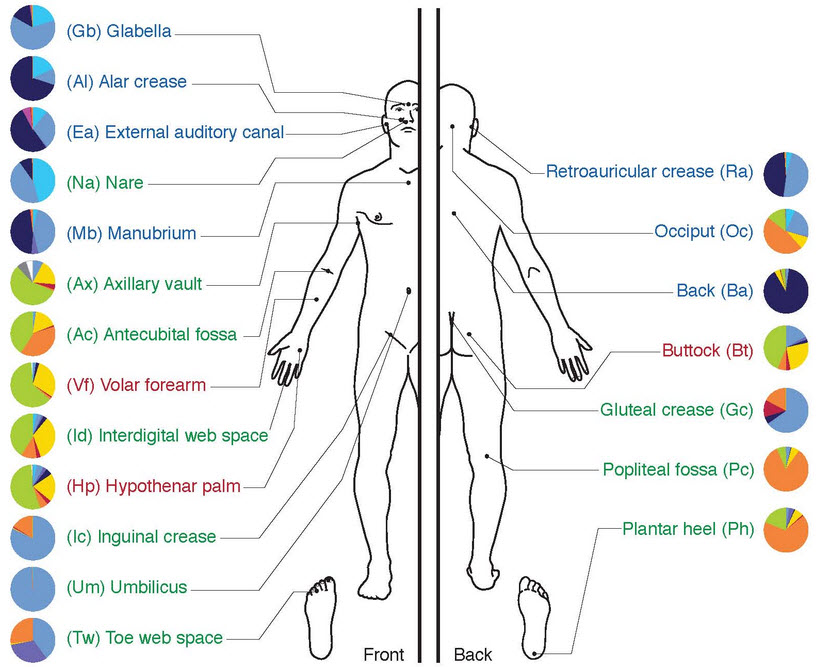
Bacteria that predominate in the human body (credit: National Human Genome Research Institute)
Did you know that foreign microoganisms outnumber our own cells by 10:1, and that we know almost nothing about how they affect our personal health?
Neither did I. But biotech startup µBiome, a UCSF Quantitative Biosciences Institute spinoff, hopes to fix all that by launching the world’s first citizen science effort to fully map the human “microbiome” (all the microbes in your body), using crowdsourced funding at indiegogo.
µBiome has raised an impressive $232,556 as of Wednesday night), but the project expires just before midnight Thursday Jan. 31.
I encourage you to check this out. (To deal with my own digestive problems, I just signed up for their $79 GI Microbiome kit — delivery: May 2013.)
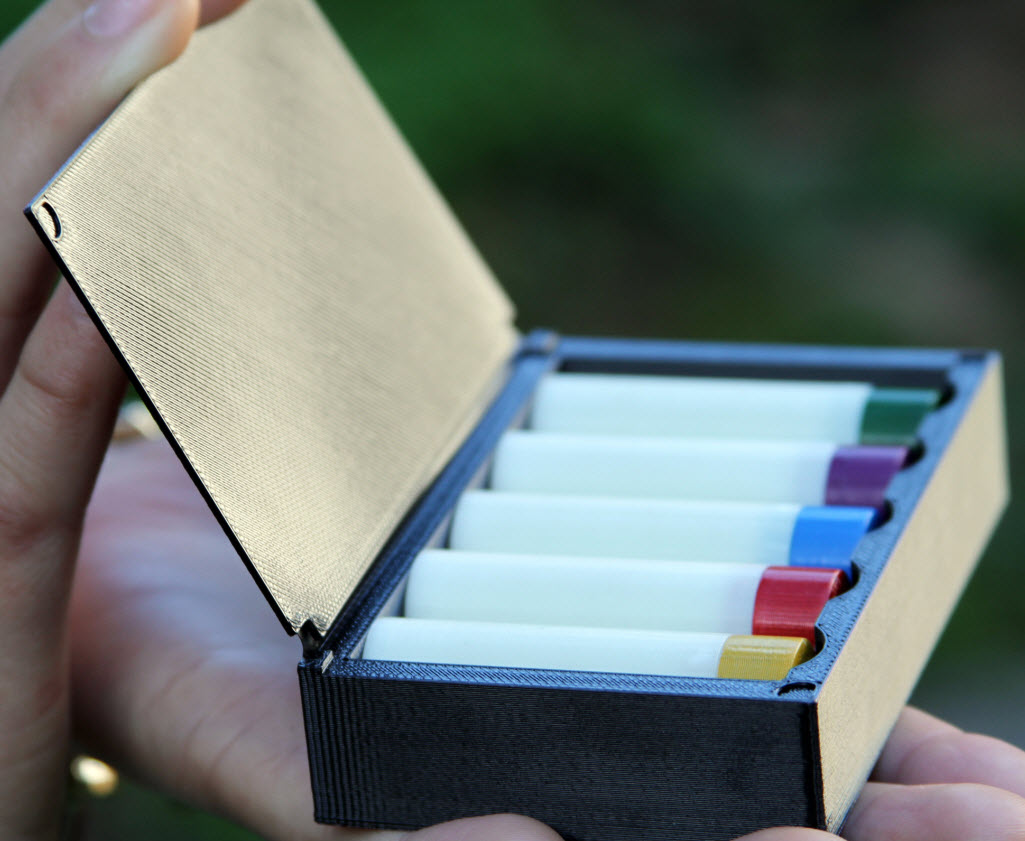
The full microbiome analysis will be available with uBiome’s $1,337 Delta Five kit (credit: µBiome)
How to discover your microbiome
This may creep you out, but these microbes are all over your body — literally every inch of your skin and inside you.
However, these microbes are mostly not harmful, but rather are co-evolved symbionts, essential collaborators in our physiology, explains uBiome co-founder Jessica Richman, a Stanford grad and now DPhil student at Oxford University’s Internet Institute (also a c0-founder of the #pdftribute movement).
“Like the rainforest, the healthy human microbiome is a balanced ecosystem. Recent research suggests that the correct balance of microbes serves to keep potential pathogens in check and regulate the immune system. Microbes also perform essential functions such as digesting food and synthesizing vitamins.”
As we’ve noted on KurzweilAI (see Related links below), studies have linked the microbiome to human mood and behavior, as well as many gut disorders, eczema, and chronic sinusitis.
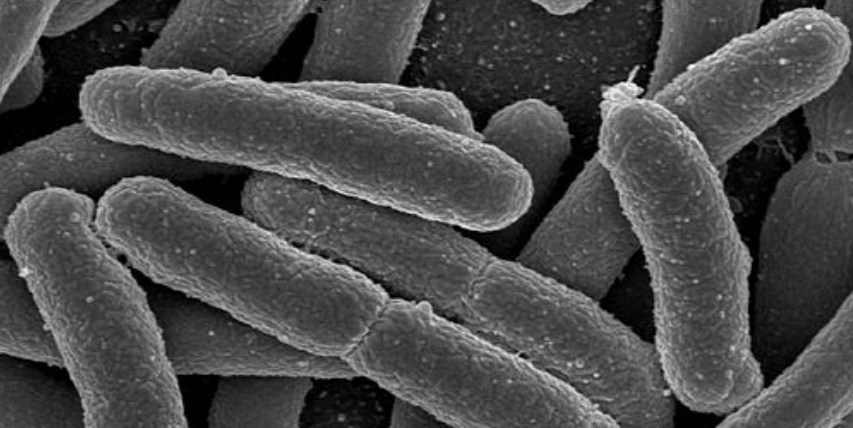
Escherichia coli, one of the many species of bacteria present in the human gut (credit: NIAID/NIH)
“We have two aims with µBiome,” said co-founder Zachary Apte, who has a PhD in biophysics from UCSF. “First, we want to make the science and the technology available to everyone. Now anyone can have their microbiome sequenced. Second, we want to curate the world’s largest microbiome dataset.
“Citizen science is the answer. If you’d told me even five years ago that high throughput sequencing technology would be in the hands of citizen scientists, I would have told you that you’d been watching way too many science fiction movies. Today, uBiome makes this dream a reality.”
µBiome will be using techniques from the NIH’s $173 million dollar Human Microbiome Project to find out what microbes are living in your body, compare you to others, and keep you up to date on research that applies to your data.
Five Things Your Microbiome Can Tell You
1. Obesity. Ley et al (2006) and others have identified gut microbes associated with obesity, such as Eubacterium rectale. In addition, Upadhyay et al (2012) did experiments with mouse models and suggested the possibility that the microbiome could be manipulated for weight control in the near future
2. Dietary composition. Wu et al (2011) found that gut enterotypes were strongly associated with long-term diets, particularly protein and animal fat (Bacteroides) versus carbohydrates (Prevotella).
3. Antibiotics. If you have recently taken antibiotics, your gut microflora may not yet have been replenished. Dethlefsen et al (2008) found that ciprofloxacin treatment influenced the abundance of about a third of the bacterial taxa in the gut. Similarly, Jernberg et al (2007) found that long after the selection pressure from a short antibiotic exposure has been removed, there are persistent long term impacts on the human intestinal microbiota that remain for up to two years post-treatment.
4. Allergies. Is your nasal microbiome associated with the profile of chronic sinusitis? Abreu et al (2012) found that multiple, phylogenetically distinct lactic acid bacteria were depleted concomitant with an increase in the relative abundance of a single species, Corynebacterium tuberculostearicum, in patients suffering from chronic sinusitis.
5. Bacterial vaginosis. If you have a penis, your microbiome may be correlated with bacterial vaginosis in women. Price et al (2010) found that two families found in certain penis microbiomes — Clostridiales Family XI and Prevotellaceae — have been previously associated with bacterial vaginosis. This may correspond to frequent infections in your partner.
Comments (20)
by Editor
Just received from Indiegogo:
Over 2,500 of you joined uBiome, contributing a total of over $350,000, making this the largest successful crowdfunding campaign for citizen science to date.
We are now moving into the research portion of the project. As planned, we will send out the kits starting in May, and will update you as they are sent out. In the meantime, we are putting your kits together, setting up our website, and other great things! Here are some updates on our progress:
We are currently designing the web interface for you to view, interact with, and download your microbiome data. Making data understandable to citizen scientists is one of the primary goals of our project, and we hope you’ll be impressed!
Many of you have asked questions around shipping charges, address changes, order changes and the like. Before we start shipping out kits, we will confirm your address, send out additional billing for shipping charges, and answer any order questions you may have. You will be able to specify your upgrade kit preferences, t-shirt size, etc. at that time.
Balancing the needs of open access while maintaining your safety and privacy is very important. To achieve this end, scientists rely on an Institutional Review Board to provide ethical oversight, and we have been working with ours to achieve these goals. We will update you when this process is complete.
We are excited to create the future of citizen science with all of you!
Thanks again for your support!
by SmartAndSober
There was MuBiome in the KAI’s video section. But it was removed.
Can you provide a link (for video on Yotube, Vimeo or other sites)?
Thank you.
by Editor
This just in from the Microbiome folks (they extended the project fundraising to Monday 18 Feb at 11:59PM PT):
“We wanted to let you know that our featured project, uBiome, has been featured on NPR Morning Edition about citizen science crowdfunding (listen here). We’re really excited to see how citizen science is growing, and just how many people have supported uBiome. They have raised over $300,000 — triple their crowdfunding goal — one of the largest citizen science projects in history.
“Their next research target is 2,500 people, let’s see if we can get them there in the last hours of their campaign!
“Please sign up to get your friends or your loved ones’ microbiomes sequenced: http://www.indiegogo.com/ubiome “
by cosmowrench
Maybe the Mayans were right after all. 2012 the year humans took controle over their own evolution. In a sense…the end of the human era and the start of post human era.
by GatorALLin
….start of the Human2.0… ahh, I get it. Very cool comment….that was deep.
But for the record, I don’t think the Mayans were trying to predict the end of time or human demise, rather the calendar could not be made up to go on forever, they had to pick an easy stopping point or it would have been too big. So I think the media made the jump from end of a calendar to end of human existence or end of the world theories. A foolish jump of logic, but a story/idea that spreads easily and sells news (I mean advertisements).
by Bri
Let’s face it, the story of the end of the world in 1212 was foisted on us because of greed. The desire to make money without any undo concern for how truthful it is, or it’s affects on people. Bad scary news sell. Who cares if it’s truthful. There’s a sucker born every moment. Your mission is to delude them and take their money. I can’t tell you how many times I run across this mentality in high paid professionals, like doctors and lawyers. Ooohhhhhh don’t get me started.
by SmartAndSober
Let’s hope the post-Singularity superintelligences will not commit such crimes.
The most guaranteeing way is to augment yourself and become superintelligent by yourself, instead of relying on beings with greater intelligence than you.
If you do not augment, the artifacts of the posthuman AIs would be incomprehensible: applying shortcuts in laws of physics that you do not know of, and even if they (the superhuman AIs) release the detailed blueprint for the artifact, it will be very difficult (or even impossible) for you to comprehend it. The doubling time of computing components will no longer be 2 years (actually the better-known figure 18 month is not true), but will shorten to months, days, hours and eventually a fraction of a second. How can we catch up?
Let us augment ourselves as early as possible.
by SmartAndSober
I wish to point out that Mayans did not know much about science.
They are a pre-scient culture.
by Health
I just joined the project and look forward to contributing to the project and get my own data. If you are interested in your own personal genetics, look up, The personal Genome Project run by George Church at Harvard. and 23andMe, which can provide you with comprehensive SNPs’ genetic data.
by Scott
I know that anywhere from 10-15lbs of body weight is due to bacteria at any given time! We are much more symbiotic than people realize.
by SmartAndSober
I wish those 10-15 lbs of excess body mass (at least on me) are, or can be converted to, computronium-based extensions of my nervous system.
Imagine the incredible gain in intelligence once you have *distributed* nano-computers insde your body: in the cardiovascular systems, in the lymphatic systems and other locations.
by Gorden Russell
I sure hope somebody tells my doctor about ” the possibility that the microbiome could be manipulated for weight control in the near future.” I need to loose 60 pounds and all the peppers, onion, garlic, tomatoes and beans I’ve been putting in my chicken-breast chili don’t seem to be working.
by WLGJR
I have an idea: Extract your excessive biological material(so you lose weight) and store them for future use.
I kow this sounds a little bit gross, but imagine the applications.
Biohacking at home, using your own tissues.
Biofuels made from your own tissues. And even more.
by Gorden Russell
Great idea WLGJR, but my refrigerator is too small. The freezer won’t hold two value packs of skinless chicken breasts. They’re a great buy. Ten pieces at $3.99 a pound.
by SmartAndSober
How much would you sell your tissue? (For research purposes).
I suggest practicing a kind of self-hypnosis that gives you the illusion of being full.
by Health
You need to add a 24 hr fast to that regimen, and you WILL lose weight.
by SmartAndSober
There is the danger of the fast person *binge back* the weight he/she had just lost. Brute force, when it comes to dieting, is not applicable (unless what Colin Powell said is true, “People (not just kids) need structure”. I recommend his TED talk.)
by WLGJR
Incredible. From a genome of a single human to 100 trillion microbes.
Kurzweil’s prediction of that this decade is the decade of “Bridge 2″ is coming true.
by Ralph Dratman
The pace of innovation has noticeably increased over the past 12 months. About halfway through last year I started thinking, “I made it to the future.”
by Alex
“From a genome of a single human to 100 trillion microbes.”
What time period do you mean when you say ‘from a genome of a single human’?