Studies of gene regulation in brain development may lead to new treatment of mental disorders
December 4, 2012
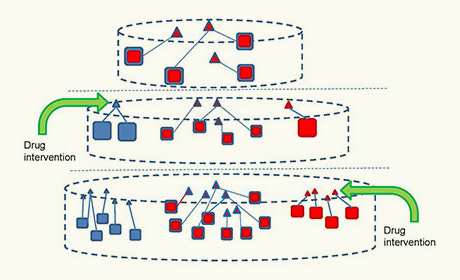
Diagram showing the hierarchy of TFs and CGGs networks and the novel strategy of drug design based on hierarchical gene–TF network analysis. The blue squares are schizophrenia-related; the red squares are autism-related CGGs and TFs. Some CGGs and TFs are common for both disorders, while some are unique for each disorder. Drugs can be administered at different levels of hierarchy and delivered either to a set of possible targets or the selected CGG. (Credit: Igor Tsigelny, SDSC/UC San Diego)
A team of researchers at the University of California, San Diego and the Institut Pasteur, Paris has come up with a novel way to describe brain development.
The findings could lead to new drug designs for mental disorders such as autism-spectrum disorders (ASD) and schizophrenia.
In the paper, the researchers identified the hierarchical tree of two types of gene networks that determine the patterns of genes expressed during brain development: coherent–gene-groups (CGGs) and transcription-factors (TFs).
The found that some “master transcription factors” at the top level of the hierarchy regulated the expression of a significant number of gene groups.
Instead of a taking the approach that a single gene creates a single response, researchers used contemporary methods of data analysis, along with the Gordon supercomputer at the university’s San Diego Supercomputer Center (SDSC), to identify CGGs responsible for brain development which can be affected for treatment of mental disorders.
The team found that these groups of genes act in concert to send signals at various levels of the hierarchy to other groups of genes, which control the general and more specific (depending of the level) events in brain structure development.
“We have proposed a novel, though still hypothetical, strategy of drug design based on this hierarchical network of TFs that could pave the way for a new category of pharmacological agents that could be used to block a pathway at a critical time during brain development as an effective way to treat and even prevent mental disorders such as ASD and schizophrenia,” said lead author Igor Tsigelny, a research scientist with SDSC, as well as UC San Diego Moores Cancer Center and Department of Neurosciences. “On a broader scale, these findings have the potential to change the paradigm of drug design.”
Using samples taken from three different regions of the brains of rats, the researchers used Gordon and SDSC’s BiologicalNetworks server to conduct numerous levels of analysis, starting with processing of microarray data and SOM (self-organizing maps) clustering, before determining which gene zones were associated with significant developmental changes and brain disorders.
Researchers then conducted analyses of stages of development and quick comparisons between rat and human brain development, in addition to pathway analyses and functional and hierarchical network analyses. The team then analyzed specific gene–TF interactions, with a focus on neurological disorders, before investigating further directions for drug design based on analysis of the hierarchical networks.
In addition to SDSC and its computational resources, support for the research paper was provided by a National Institutes of Health grant.