Study offers new clue on how brain processes visual information
July 24, 2012
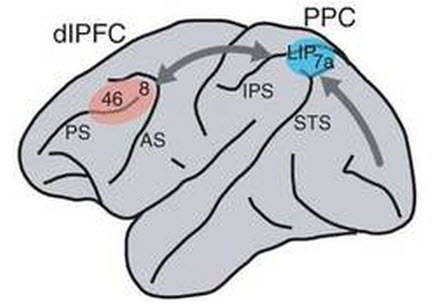
Schematic diagram of the monkey brain and areas in which recordings were performed. AS, arcuate sulcus; IPS, intraparietal sulcus; PS, principal sulcus; STS, superior temporal sulcus. (Credit: F. Katsuki et al./Nature Neuroscience)
Researchers at Wake Forest Baptist Medical Center have discovered an important clue to how the human brain — which is constantly bombarded with millions of pieces of visual information, can filter out what’s unimportant and focus on what’s most useful.
Evidence from an animal study shows that the prefrontal cortex is involved in a previously unknown way.
“Our findings suggest that both the ability to focus attention intentionally and shifting attention to eye-catching but sometimes unimportant stimuli depend on the prefrontal cortex,” said Christos Constantinidis, Ph.D., associate professor of neurobiology and anatomy at Wake Forest Baptist and senior author of the study.
“Our findings provide insights on the neural mechanisms behind the guidance of attention.”
Two types of attention are utilized in the selective attention process:
- Bottom-up attention is automatically guided to images that stand out from a background by virtue of color, shape or motion, such as a billboard on a highway.
- Top-down attention occurs when one’s focus is consciously shifted to look for a known target in a visual scene, as when searching for a relative in a crowd.
Traditionally, scientists have believed that separate areas of the brain controlled these two processes, with bottom-up attention occurring in the posterior parietal cortex and top-down attention occurring in the prefrontal cortex.
“This has implications for conditions such as attention deficit hyperactivity disorder (ADHD), which affects millions of people worldwide. People with ADHD have difficulty filtering information and focusing attention.”
In the Wake Forest Baptist study, two monkeys were trained to detect images on a computer screen while activity in both areas of the brain was recorded. The visual display was designed to let one image “pop out” due to its color difference from the background, such as a red circle surrounded by green. To trigger bottom-up attention, neither the identity nor the location of the pop-out image could be predicted before it appeared. The monkeys indicated that they detected the pop-out image by pushing a lever.
The neural activity associated with identifying the pop-out images occurred in the prefrontal cortex at the same time as in the posterior parietal cortex. This unexpected finding indicates early involvement of the prefrontal cortex in bottom-up attention, in addition to its known role in top-down attention, and provides new insights into the neural mechanisms of attention.
“We hope that our findings will guide future work targeting attention deficits,” Constantinidis said.
The research was supported by the National Eye Institute contract ROI EY016773 and the Tab Williams Family Endowment.