Synaptic electronic circuits that learn and forget like neural processes
December 27, 2012
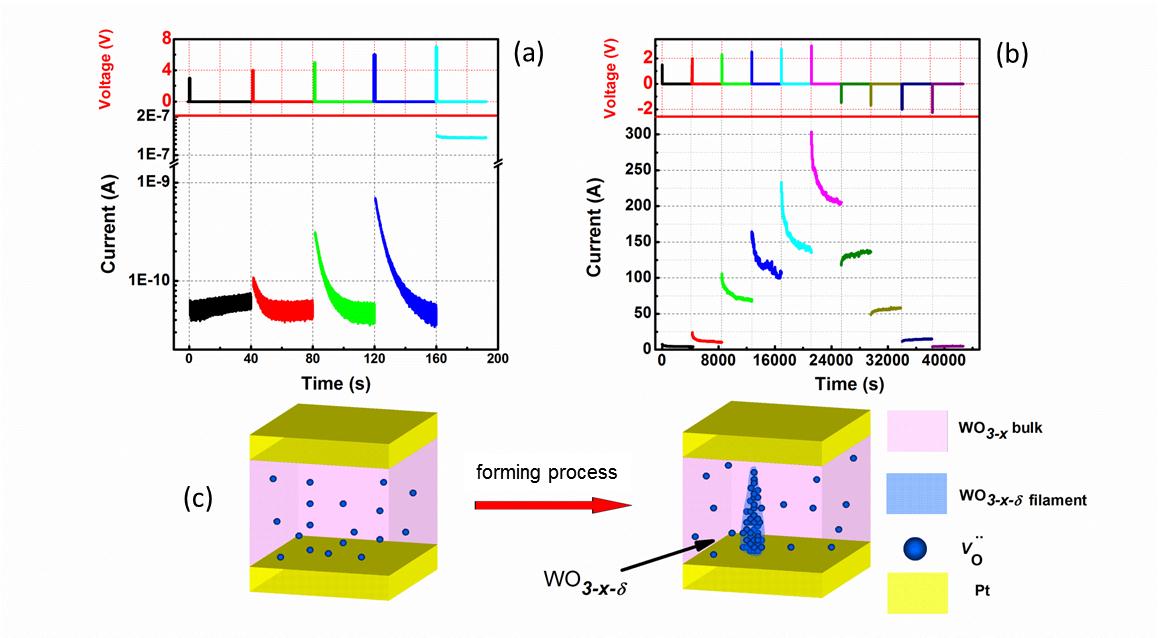
(a): Volatile (short-term) memory property of two terminal device before the forming process. Current change observed by applying sequence of positive voltage pulses at intervals of 40 s and widths of 0.5 s. (b): Nonvolatile (long-term) memory property in the device after the forming process following application of a sequence of positive and negative pulses with widths of 0.1 ms. (c): Schematic illustration of the device structures before and after forming process. (Credit: MANA, NIMS)
Rui Yang, Kazuya Terabe and colleagues at the National Institute for Materials Science (NIMS), and the International Center for Materials Nanoarchitectonics (MANA) in Japan and at the California NanoSystems Institute/UCLA have developed “nanoionic” (processes connected with fast ion transport in all-solid-state nanoscale systems) devices capable of a broad range of neuromorphic and electrical functions.
Background
Such a device would allow for fabrication of on-demand configurable circuits, analog memories, and digital-neural fused networks in a single device architecture.
Synaptic devices that mimic the learning and memory processes in living organisms are attracting interest as an alternative to standard computing elements to help extend performance beyond current physical limits. However, artificial synaptic systems have been hampered by complex fabrication requirements and limitations in the learning and memory functions they mimic.
How it works
The device is based on a platinum-tungsten trioxide (WO3–x) device using oxygen ions migrating in response to voltage sweeps. Accumulation of the oxygen ions at the electrode leads to Schottky diode-like potential barriers and resulting changes in resistance and rectifying characteristics. The stable bipolar switching behavior at the platinum-tungsten trioxide-based device is attributed to the formation of a conductive filament and oxygen absorbability of the platinum electrode.
The researchers noted that the device properties* — volatile and non-volatile states and current fading following positive voltage pulses — are similar to neural behavior — that is, short- and long-term memory and forgetting processes.
The device was found to possess a wide range of time scales of memorization, resistance switching, and rectification varying from volatile to permanent in a single device.
“These capabilities open a new avenue for circuits, analog memories, and artificially fused digital neural networks using on-demand programming by input pulse polarity, magnitude, and repetition history,” the researchers conclude.
* In its initial pristine condition the system has very high resistance values. Sweeping both negative and positive voltages across the system decreases this resistance nonlinearly, but it soon returns to its original state, indicating a volatile state. Applying either positive or negative pulses at the top electrode introduces a soft breakdown, after which sweeping both negative and positive voltages leads to non-volatile states that exhibit bipolar resistance and rectification for longer periods of time.