Ten extraordinary Pentagon mind experiments
March 15, 2013
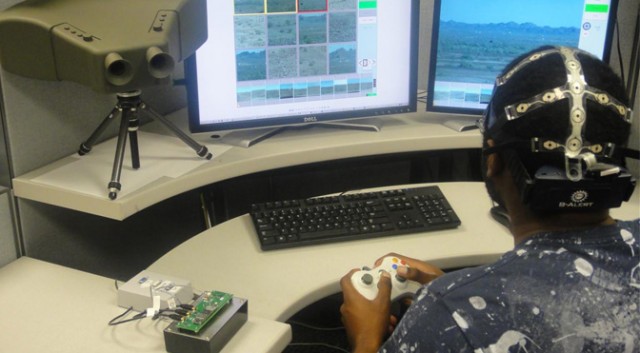
Cognitive Technology Threat Warning System (credit: DARPA)
Duke University experiments in connecting the brains of two rats through implanted electrodes and the planned Brain Activity Map project reflect a growing Pentagon interest in neuroscience for applications that range from such far-off ideas as teleoperation of military devices (think mind-controlled drones), to more near-term and less controversial technology, like prosthetics controlled by the human brain, BBC Future reports.
The Pentagon’s expanding work in neuroscience in recent years has focused on medical applications, like research to understand traumatic brain injury and on concepts intended to help the military fight wars more effectively, such as studying ways to keep soldiers’ brains alert even after days without sleep.
But under the rubric of “Augmented Cognition,” DARPA has also pursued a number of military technologies, like goggles that would monitor a soldier’s brain signals to pick up potential threats before the conscious mind is aware of them.
While some of the applications might be a generation away, or may never arrive, like mind-controlled drones, others, like the brain-monitoring goggles, are already in testing (though probably not ready for use in the field). That’s raising questions from ethicists, who are pushing for the government to begin now to think about “neuro ethics.”
In a 2012 article published last year in the journal Plos Biology, Jonathan Moreno, a professor of medical ethics, and Michael Tennison, a professor of neurology, argued that many neuroscientists don’t think about the contribution of their work to warfare, or consider the ethical implication of such work.
The question they raise is what choice future soldiers might have in such cognitively enhanced warfare. “If a warfighter is allowed no autonomous freedom to accept or decline an enhancement intervention, and the intervention in question is as invasive as remote brain control,” they write, “then the ethical implications are immense.”
Sharon Weinberger spoke in more detail about the Pentagon’s growing interest in neuroscience in her talk A Manhattan Project of the Mind at SXSW.
Comments (6)
by augmented
i need help getting home
by Sea bass
The Manchurian Candidate of the future!! Proceed with caution. After M.K. Ultra and Ted Kacsynzki, there is no doubt the government has been working on this technology for quite some time. Ever wonder why “sensitive information” is released years after?
Conspiracies aside, at least ethics professors are speaking up. Until they get silenced, mwahahaaha.
by MatthewQ
From the article: “or may never arrive, like mind-controlled drones, ”
I don’t know why they say this. They can do this right now. I mean, today. No need to wait for the future. Obviously if a monkey can control a mechanical arm with its brain, you can wire a human to do the same thing. And the monkey did that about a decade ago.
An XBox controller has about 20 basic functions (more once you add in the joystick directions). Ok. So you need to wire up 20 neurons in the brain to correspond to each of these functions. You interface it with a HUD or contact lens projection screen or full face visor. You develop software that translates the basic commands from the controller into more complex effects (like how the controller does different things in different games) and then you can use the wired in the brain controller to interface with a vast array of devices- flying drones, remote combat vehicles, sentry robots, sniper/stalker robots- a whole army of Robo-Joes. Maybe wire up 3 dozen more neurons for a basic qwerty keyboard. You’d train it the same way you trained yourself to type. Now, you don’t think about where the letters are on the keyboard, you just think the word and your fingers do it for you. The same with gamers- they don’t think ‘Need to hit the X button’.
They could do it now. Today. They could so do this. It just requires invasive surgery. I guarantee there is someone out there who would do this if asked nicely ;-)
by Ralph Dratman
My DARPA brain implant has alerted (before my conscious mind was aware of anything) that this may be a dangerous research program.
CURRENT STATUS: Waiting for the implant to tell me what to do next.
by JC
Soldiers have been sent on missions of certain death without knowing that was the intended outcome since war began. I do not see how an improved compliance system will change that . In fact this may spread the penalties for war crimes further up the chain of command. Where it belongs.
by tflahive
Look at history. The Russian government worked very hard at mental telepathy for a reason. We should assume that our “new enemies” are working hard at neuroscience, or, perhaps obtaining hacked information to make their work easier.