The avatar economy
July 19, 2012
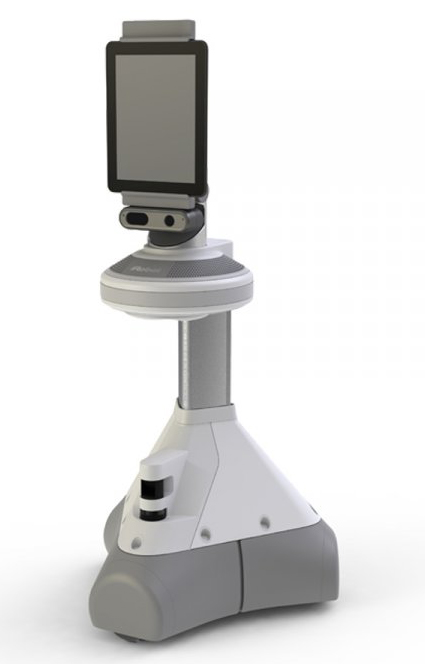
iRobot’s mobile robotics platform Ava (credit: iRobot)
A robot remotely controlled by a low-wage foreign worker could soon compete with some U.S. workers, suggests MIT doctoral student in information technology Matt Beane in Technology Review.
Companies now produce and sell robots that allow users to navigate through a remote working environment, interacting by means of a computer screen.
The next wave promises much more capability per dollar. DARPA recently issued a robotic challenge involving a complex set of tasks to be performed by a semiautonomous, remote-controlled humanoid robot — driving, walking through rubble, replacing a valve.
Progress toward the “avatarization” of the economy has been limited by the speed of Internet connections and the latency involved in long-distance communication.
How much bandwidth is enough? A “perfect” (just like being there) connection to a robotic telepresence system must accommodate a signal of 160 megabits per second. Theoretically, too, the distance between robot and worker shouldn’t exceed 1,800 miles: any farther and the operator could get confused by the time lag as signals travel round-trip.
Realistically, however, avatar workers can probably be effective janitors or doctors even if they are farther away and sensory fidelity is weaker. The VGo runs on Verizon’s 4G network, for instance, and the U.S. military’s drone-control facility in Italy is 2,700 miles from Afghanistan.
Mexico, China, Poland, and Thailand have added 26.4 million high-bandwidth Internet users in the last 12 months. These countries have relatively low labor costs and are close to more developed countries. More than half of U.S. states are within 1,800 miles of the Mexican border.
Telepresence means that in theory, ten, a hundred, or a thousand times as many workers could compete (virtually) for the same work. The same outsourcing logic applies to many high-wage jobs that rely on physical presence and motor skills, including the work done by cardiologists and machinists.
Beane believes outsourcing of nonroutine labor via robotic telepresence could begin to occur on a mass scale within a decade.
Comments (9)
by AvatarToBe
Ideal job for me.
by Neil Craig
If this makes economic sense for a job as a janitor in New York thnik how much sense it makes for a platinum miner on the Moon!
Somewhat more difficult to handle because the time lag is 3 seconds there and back but with feedback systems that need not be a problem for almost everything but huggling. Come to think of it juggling is easier there.
Also automata don’t need to breathe, or use up other transported resources, dont need much radiation shielding and can be made much lighter than humans.
by tedhowardnz
I started programming computers in 1974. Have seen a lot of changes in that time. Earlier this year I did Sebastian Thrun’s programming course on how they did the Google Self Driving Car.
It is now very clear to me that our current societal control systems (money and markets) have passed their useful period for humanity.
We can now create abundance of all the necessities of life, but there is no money in doing so, as there is no monetary value in abundance.
Oxygen is very important for humans, and it is abundant, and free.
We could create systems to produce all the necessities of life (food, shelter, water, transport, education and communication) in abundance similar to oxygen, yet there is no money in doing so, as monetary value has a scarcity function.
Thus, it seems to me, humanity stands at a cross roads.
We can choose to create systems that empower all individuals, to follow their own path to self actualisation, or we can continue with the known systems of domination and conflict.
It seems the choice really does come down to each and every one of us.
One thing seems clear, the dominant paradigm of money will not incentivise universal abundance, freedom and security.
The development of telepresence has profound implications for “middle classes” the world over.
Interesting times indeed!
by jiyengar
Very well said.
by Bennie Beaver
Just what we need, more outsourcing to dictatorial nations further empowering them over our constitutional republic. There’s still hope that it will lead to world wide rules….That’s world order!
When you play ball with another team with unfair advantaged rules, you lose! What do we want America, a further weakened homeland, or rules that say, “if you sell in a country, you need to produce in that county.” Otherwise, create the same rules. Yes, world trade will likely continue to develop, and produces trade among nations, but somewhere along the line we need fair trade.
by GatorALLin
…love the idea, but hope I don’t have to speak with them (if American Express puts me over to another person in India who can not speak English, I think I have to take business elsewhere!). Maybe a text to speech tool built in, or some help on the communication side with the foreign person on the other end please.
by Bri
Within a decade the robot itself won’t need a slow paced human!
by melajara
Exactly. In a decade or more, the telepresence economy IMHO will not boom with low-wage jobs (performed by neuromorphic robots) but with highly skilled ones, i.e. on the contrary for high-wage jobs wit top responsabilities (e.g. politicians, judges, top executives) or in need of high visibility (reporters in the field, teleperforming artists, politicians again, etc).
by Starheart
Considering the military has done an admirable job of beta-testing the concept through various UAVs and unmanned ground-based security vehicles, I am quite sure that we will have useful telepresence technologies in the civilian sector, with robots working 24/7 while their operators rotate in shifts.
The question whether outsourcing their operators will be practical is another matter, as it involves something not neccessary for things like outsourcing phone tech support to India: telecommunication upgrades in various third world countries, which kind of negates the benefit of paying a minimum wage, thus ensuring the technology is unlikely to spread beyond relatively-poor-but-still-developed countries as mentioned in the article.
Finally, analysis of telepresence input and output over remote channels is likely to be far easier than analysis of native human I/O, therefore enabling rapid development of task-oriented AI to the point where the drone performs most of the tasks it is capable of autonomously (note the gradual shifts towards this with military drones: we have robotic aircraft capable of performing such complicated tasks as landing on aircraft carriers). Operators shall oversee entire fleets of these and mainly intervene in emergencies. Therefore, I do not foresee the technology being a massive job spot creator.