The computing trend that will change everything
April 10, 2012 | Source: Technology Review
The electrical efficiency of computing (the number of computations that can be completed per kilowatt-hour of electricity used) has doubled every year and a half since the dawn of the computer age.
The power needed to perform a task requiring a fixed number of computations will continue to fall by half every 1.5 years (or a factor of 100 every decade). As a result, even smaller and less power-intensive computing devices will proliferate, paving the way for new mobile computing and communications applications that vastly increase our ability to collect and use data in real time.
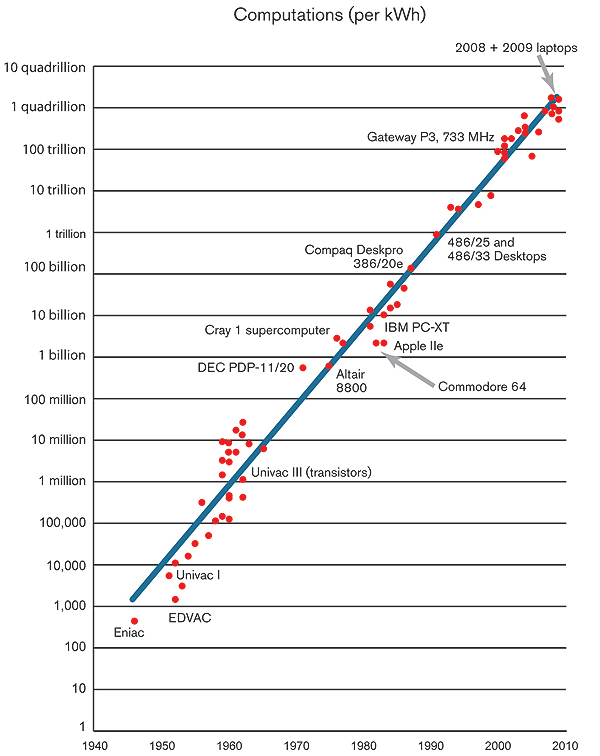
The number of computations computers can carry out using the same amount of energy has been increasing by a factor of two every 1.5 years (credit: Jonathan Koomey)
Also see: How to cool electronic devices more efficiently
Comments (13)
by AlexG
@john lux. We’re all just waiting for you to give us a solution. Maybe something with some kind of camps and trains running on time?
by Th3k1
What may be increasing in at least a rough parallel to computing power is our networking abilities. Globally collaborative projects…both under and over ground…
Not many of us may be able to beat machines at chess… but it will be a very long time before you can have a machine exposed to the general public that wont get owned by the mischevious monkey tribe that we are.
We may have to have to surrender the concept of the individual as a competitve unit when we take on AI’s, however.
by Kelsey473
Computing power is increasing in throughput but human brain power is not. What is the solution?
That statement does not give a `problem` as such – therefore it needs no `solution`. Its like saying steam engines and trains are getting better and better what is the solution, when the meme of the time was horse transportantion. Define the `problem`.
by poo888xx
Problems can be almost anything, and in this case the given problem is “Computing power is increasing in throughput but human brain power is not”, even if it’s vague. I would not dismiss this as a problem just on intuition.
by dpmartin
Nobody wants to state the truth because it is politically incorrect.
by eldras
>>>>Computing power is increasing in throughput but human brain power is not. What is the solution?
We merge. Brain chips, false hips, pacemakers, artificial limbs able to run in the olympic games. All here already in use and more. In a billion years we will be something astounding with sublime interactions…and the billion years will be here in the next couple of decades at a hard take off.
by Gorden Russell
Your solution, John Lux, is coming. In ten or twenty years you will be able to swallow a computer in a capsule. Then you will be able to stick your pinky finger in the new style USP and enmesh in the web.
by gaoptimize
But will it be enough savings to balance against higher utilization rates, both computational and network? Trends so far suggest not.
by Robin Mackey
I believe there is a typo ” factor of 100 every decade” should be ” factor of 1,000 every decade”.
by Editor
Robin: 100 looks correct to me. E.g., 1980: 10^10; 1990: 10^12.
by Bruce Wright
Robin: If the efficiency is doubling exactly every 18 months, then there will be about 6.67 doublings every 10 years, which works out to a factor of about 101.2 every decade. For such purposes, the accuracy beyond a couple of decimal places is probably spurious. So I’d have to agree with the editor, whether you use the graph or the text of the article you get around a factor of 100 per decade.
by Bruce Wright
Oops, copied that down wrong for the posting – it’s about a factor of 101.6 per decade. Doesn’t change anything else about what I said though.
by john lux
Computing power is increasing in throughput but human brain power is not. What is the solution?